
Chapter-by-Chapter Outline
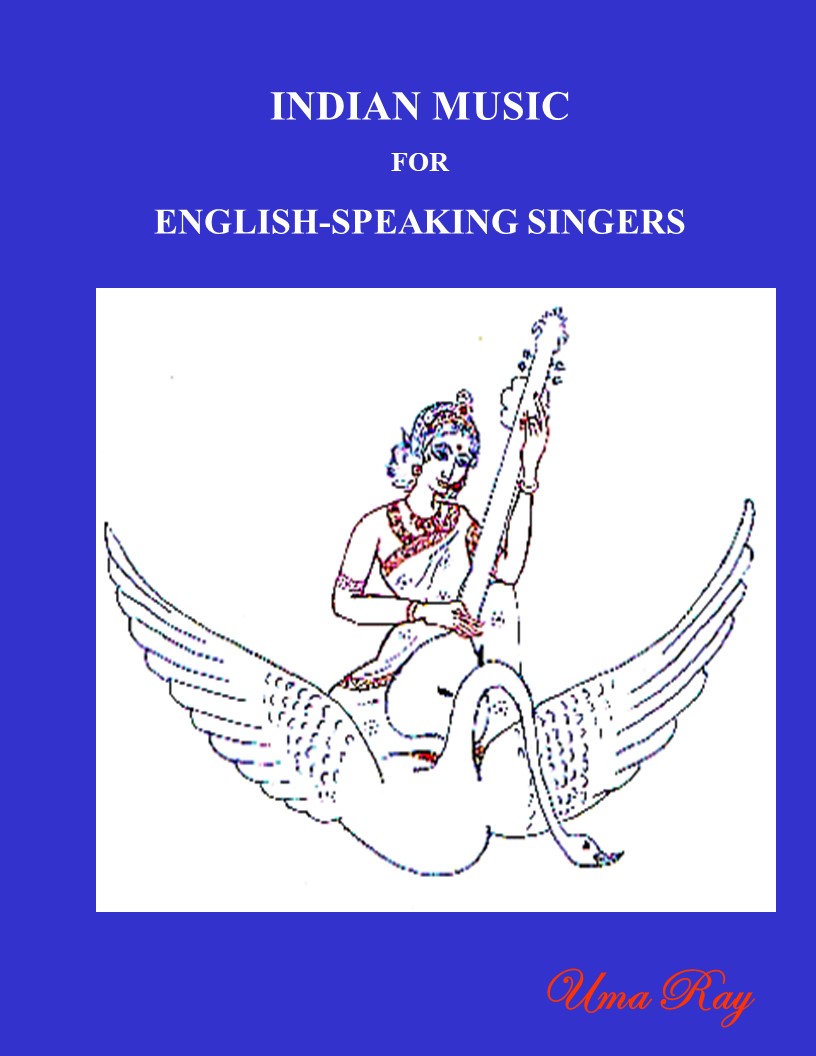
The cover is designed and drawn by the present author. The image of the Goddess Saraswati, riding a white swan, is believed to be the goddess of all sorts of learnings and wisdom and all kinds of fine arts.
Front Matters [9 pages]
This section consists of the title page, the dedication page, the foreword, the preface and ackowledgements and the contents of the book
PART ONE: Elementary level
Chapter I
(6 pages)
The goal of this chapter is to introduce the basic structure of Indian music. This chapter is divided into three sections.
Section 1: This section introduces the basic concepts of seven Suddha Swars (regular scale) along with one Theebra [sharp]and four Komal [flat] Swars in each of three Saptaks (octaves), which have been discussed with the help of three tables. The concept of timing as beat is defined.
Section 2: This section contains exercises on very simple voice training with Suddha Swars in Madhya Sapthak (middle octave)only.
Section 3: Familiarity with two very simple Thaals (rhythm pattern), Daadra and Kaahaarwa.
Chapter II
(2 pages)
The aim of this chapter is to make learners familiar with some more difficult exercises. This chapter has two sections.
Section 1: This section has some more exercises on voice training with Suddha Swars (regular scale)in three Saptaks (octaves).
Section 2: This section makes the learners familiar with three more frequently used Thaals (rhythm patterns)- Theora, Ekthaal and Threethaal.
Chappter III
(7 pages)
The objective of this chapter is gradual introduction of two very simple Raags. This chapter is divided into four sections.
Sections 1 & 3: The Raags Bilawal and Kaaphee are introduced by verbal descriptions as well as practical demonstration of Sargam (notations). Both the Raags have illustrative songs for practice and exercises.
| Section 1 | Bilawal | Section 3 | Kaphee |
Section 2: Exercises on voice-training with mixed notes, Shuddha (regular) and Bikrita (flat) Swars. This section is placed before section 3 which introduces Raag Kaaphee, as this set of exercises prepares the learners for Kaaphee Raag with flat notes.
Section 4: In this section the learners become familiar with another Thaal (rhythm pattern) Jhampak.
Chapter IV
(5 pages)
This chapter introduces two more simple Raags and a simple Thaal (rhythm pattern). This chapter is divided into three sections.
Sections 1 & 2: In each of these two sections, the following two simple Raags, are described in verbal and musical manners. Both the Raags have their song illustrations for exercise and practice.
| Section 1 | Eeman | Section 2 | Khaambaaj |
Section 3: In this section the learners may choose to be familiar with a new optional Thaal (rhythm pattern).
PART TWO: Intermediate level
Chapter V
(6 pages)
This chapter aims at introducing two more Raags and conception of Laya (speed) of a piece of music. This chapter has three sections.
Sections 1 & 3: In these sections, the Raags, Bhairavee and Bhoopaalee have been described theoretically as well as practically and each of them has appropriate song illustration as exercises.
| Section 1 | Bhairavee | Section 3 | Bhoopaalee |
Section 2: In this section, an exercise on Laya [speed] practice based on Raag Bhairavee has been added. For this reason this section is placed after the section in which Bhairavee Raag has been introduced and discussed.
Chapter VI
(24 pages)
Aim of this chapter is to introduce eight more new Raags and a new Thaal (rhythm pattern). This chapter has nine sections.
Sections 1 through 8: In each of the eight sections, one of the following eight Raags, is described verbally and musically and each has suitable illustrative song sample for practice and exercise.
| Section 1 | Bhairav | Section 2 | Haambeer | ||||
| Section 3 | Behaag | Section 4 | Kedaar | ||||
| Section 5 | Desh | Section 6 | Tilak-Kaamod | ||||
| Section 7 | Vrindabonee-Sarang | Srction 8 | Bhimpalashree |
Section 9: In this section, learners may get familiar with a new optional Thaal (rhythm pattern).
PART THREE: Advanced level
Chapter VII
(48 pages)
Objective of this chapter is to introduce nine more new Raags of increased difficulty and six more difficult Thaals. In addition to those, some important terminologies and concepts have been defined and explained. This chapter has fourteen sections.
Sections 1 through 9: In these sections one of the following nine Raags has been introduced and described theoretically as well as practically, and is illustrated by more difficult types of song for practice and exercise.
| Section 01 | Pooravee | Section 02 | Aashaawary | Section 03 | Baageshree | ||||||
| Section 04 | Piloo | Section 05 | Jounpooree | Section 06 | Maalkosh | ||||||
| Section 07 | Chhayanat | Section 08 | Joy-jayanthee | Section 09 | Ramkelee |
Section 10: In this section, learners get acquainted with six more Thaals (rhythm patterns) of greater difficulty, Chouthaal, Soor-fankthaal, Dhaamaar, Roopakrha, Nava-thaal and Ekaadashee.
Section 11: In this section, Raags and other important related terminologies are defined and explained.
Section 12: In this section, Maatra (beat), Chhanda (meter) and Thaal [rhythm] have been defined and the notations of thirty-six Thaals (rhythm patterns)including fourteen already introduced in previous chapters are illustrated. These Thaals are organized systematically according to the number of their Matras (beats).
Section 13: In this section, the physical structures of songs of different types of classical music are defined.
Section 14: In this section, the use and interpretation of the alphanumeric notations have been discussed.
Chapter VIII
(45 pages)
The objective of this chapter is to introduce twelve more complicated Raags and the technique of preparing the notation of a given song. The salient features of most widely popular variety of songs of Indian classical music have been discussed here. The book ends with a short note on style of a particular singer and tradition and heritage of a school of singers. This chapter has fifteen sections.
Sections 1 through 12: In each of these twelve sections, one ofthe following twelve Raags has been introduced and described theoretically as well as practically and is supplemented by illustrative song for practice and as exercise.
| Section 01 | Jogiya | Section 02 | Lalith | Section 03 | Torhee | ||||||
| Section 04 | Moolthaan | Section 05 | Shree | Section 06 | Sohinee | ||||||
| Section 07 | Mallaar | Section 08 | Baahaar | Section 09 | Darbaaree Kanarha | ||||||
| Section 10 | Aarhaana | Section 11 | Paraj | Section 12 | Vasanth |
Section 13: In this section, different types of songs of classical music and their mode of presentation have been discussed.
Section 14: In this section, the technique of preparation of musical notations of a given song has been discussed in detail and with illustrations.
Section 15: In this section, the Gayki [special styles] of singers as well as the Gharana [special tradition/heritages] of particular schools of musicians have been discussed.
BACK MATTERS [5 pages]
| This section consists of | the references | and an index |
The back cover contains some information about this book as well as author's other works.
Back to Book Description | Back to Homepage