Background
Tensions in Poland, Czechoslovakia and Hungary, due to
uprisings which were dispersed by Warsaw Pact troops, have
exploded into a series of limited clashes on a number of east-west
hot spots. North Korean incursions across the demarcation
line, a number of shootings on the border to the GDR near
Berlin as well as Soviet troop movements in the Baltic, especially
in Lithuania and on the Finnish border, have both Nato and the
Warsaw Pact at their highest alert status since the Cuban missile
crisis. Economic conditions and political tensions in
Cuba have convinced the Government of that nation that a U.S.
attack seems again imminent. Rather than fighting American or
surrogate troops on their own soil, Cuban military high command
has developed a bold plan to counter the American presence in
Central America by committing Cuban troops in support both of the
Sandinista Revolutionary Army and the communist guerilla elements
in the west of Colombia. This support which initially consisted of
"observers" and the supply of arms and intelligence, has
slowly grown into a commitment of more than 2.000 elite Cuban
troops fighting alongside the rebel forces. The Republic of
Panama now seems the focal point of an east-west proxy war, with
40.000 U.S. troops stationed in Panama and supported by the
Panamanian National guard units pitted against guerilla and
paramilitary forces as well as possibly a large Cuban
Expeditionary Force. |
Scenario Description
| Game start |
15.01.2004 |
| Alliances: |
2 |
| Combatants: |
4 |
| Map size: |
250 x 250 |
| Moves: |
25 |
|
|
Victory Conditions
Each combatant will have his/her own victory conditions and a
win will be credited to the alliance whose combatants have
achieved all their goals. Each combatant will receive his/her
victory conditions confidentially. These can but do not need to be
shared with other alliance members. After 25 turns, the
administrator will decide which conditions have been met and to
what extent. Partial wins are possible and even probable.
Homeland Restrictions
For this scenario, all military activity is limited to the
Panamanian mainland and on the Pacific Ocean and Caribbean Sea. To
the far northeast and northwest (Florida and Cuba), an area of 50
x 50 squares is considered homeland where no enemy units will be
able to operate or fire into.
Scenario Notes Since this will be
the first major test of the PBeM-Engine, it is possible that
errors and omissions will be discovered and might need to be
handled manually. The administrators ruling are final.
|
|
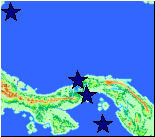
 United States Southern Command United States Southern Command
American force concentrations can be found at or near a number
of U.S. bases distributed throughout the Panama Canal Zone, an
area bordering the canal on the east and west. In addition, a
naval task force is present on the pacific side (south) including
a carrier and a number of support ships giving the U.S. side air
strike and recon capabilities. Also, a number of reinforcements
are located in the south of Florida (top left of map) which can be
sea lifted to Panama but which might have to contend with Soviet
submarines in the Caribbean Sea.
|
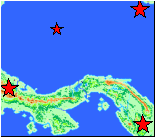
 Cuban
Expeditionary Forces Cuban
Expeditionary Forces
A small number of Cuban forces are dispersed in the far east and
west on Panama's borders to Colombia and Costa Rica in support of
the Sandinista Revolutionary Army. A large expeditionary force has
been assembled on the Cuban mainland (far top right of map) and can
be sea and air lifted to the battle field. Cuban forces are no match
for American air power and heavy armor but their mobility promises
to be a perhaps decisive advantage on terrain consisting to a large
extent of mountains and jungles.
|
|
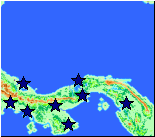
 Panamanian National Guard Panamanian National Guard
Panamanian units consist largely of light armor and infantry with
no meaningful air forces but some naval units for coastal and river
movement. Panamanian forces are distributed more or less evenly
across the map with most units in defensive positions near
provincial capitals.
|
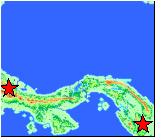
 Sandinista Revolutionary Army Sandinista Revolutionary Army
Although consisting almost exclusively of lightly armed
irregulars, they have meaningful popular support among the
inhabitants of the border areas to east and west and their low
profile and good camouflage values allow them more or less free
movement even in enemy controlled areas.
|