Power Projection
Note: To understand this concept you will need to be
familiar with "Ownership".
Most terrain types have an owner property showing which
combatant is in possession of the square. Exceptions could be,
dependent on the scenario, deep sea squares or similar terrain
types. In order to determine the ownership of a square, most
units have a power projection value assigned which defines how
strongly and how far they are able to project their power/influence.
Example:
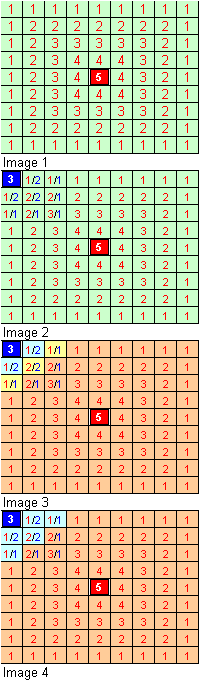
Image 1 shows a unit with a power projection value of 5 and a
power projection distance of 5. Therefore the square where the
unit is located has a value of 5, other squares lesser values
depending on the distance to the unit (which always decreases
linearly).
If we assume an enemy unit in the vicinity (image 2), this
unit will also have power projection values assigned. Assuming
no other units are in the area, the values for both sides are
compared in every square which will determine the owner of the
square (image 3).
Most terrain squares also have a base value associated with a
combatant. For example, if a terrain square has a value of .2
assigned to the combatant "Cuba", this terrain will be
Cuban-held until an enemy unit can project enough power in the
area to top this value. If we assume that the yellow squares in
image 3 (right) where both units project the same amount of
power, are originally owned by blue with a value of 0.1, that
would then be enough to tilt ownership towards blue (image
4).
Comment 1: Base values assigning squares to a
combatant are usually low, somewhere between 0.1 and 0.5 so that
this territory will only remain in the possession of the
original owner as long as no enemy units are near by. Some
scenarios though might use very different base values: A
"Nicaragua" scenario (not yet available) will have
base values of 2 or even 4 or 5 for a specific region where the
Sandinista fighters are home-based, thus showing great popular
support in this area and forcing any invader to assign large and
powerful troops to this area in order to "conquer" it.
Comment 2: Although low base values are easily topped
by any unit moving into the area, it also means that this
territory will revert back to the original owner as soon as the
unit exits the region. This could force an attacker to leave
behind occupying forces in order to hold on to conquered
territory.
Comment 3:
You will see units popping up in individual scenarios with
very different power projection values. In the
"Panama" scenario for example, an early version of an
AWACS is available on the U.S. side which has a low power value
of 2 but a projection distance of 25, thus possibly establishing
control over a very large but unoccupied area. Even propaganda
units could be defined which have no fire power and little sight
range and movement, but very high power projection values.
|