PBeM
Home Page
Discussion Group
Membership
Scenarios
The Panama Gambit
The Finland Excursion
The Mexican Adventure
Battle of the Bulge
Stalingrad
Antietam
The Alaskan Retribution
The Battle of Crete
The Banana Republics
The 30 Year War
Academy Training Grounds
How to Play
Introduction
  Signing In
Alliances and Combatants
Reading the Map
Terrain and Infrastructure
  Roads and Railroads
  Moving Units
  The Fog of War
  Terrain Ownership
  Economy
  Command and Supply
  Victory Conditions
  Doing Battle
  Air- and Sea-Lifts
  Long-Range Weapons
  Creating Orders
  Submitting Orders
  Updating Intelligence
  Trouble-Shooting
  Beta-Test Results
Learning by Example
Introduction
  Fire and Shell
Attack
Move
  Airlift
  Sealift


Armor

Each unit has an "Armor" value which expresses, in %, the casualties it will incur when fired upon or attacked. To be exact, units posses four armor values named front, side,  rear and top armor so casualties will be higher where the armor is weaker. In the "Panama" scenario for example, a Russian T-55 tank has a front armor of 70%, side armor of 50%, rear and top armor of 30%. If fired upon from the side with a strength of 250, the armor will deflect half of that fire power leaving 125 casualties to be dealt with.


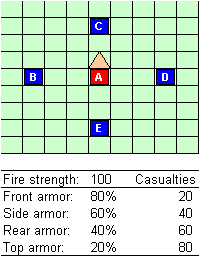
Example (see right): Unit A is facing north and is being fired upon by four enemy units. The table lists the casualties which will be incurred by the unit depending on the position of the enemy in relation to the orientation of the unit.


Border Line Shots

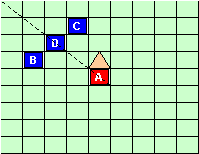
Extending a diagonal from the unit under fire shows where the armor sides end. Unit C is still engaging from the front while unit B is clearly hitting the opponent form the flank. For units directly on the armor border line, the armor value most advantageous to the defender will be chosen (in this example that would be the front armor).


Hosted by www.Geocities.ws

1