PBeM
Home Page
Discussion Group
Membership
Scenarios
The Panama Gambit
The Finland Excursion
The Mexican Adventure
Battle of the Bulge
Stalingrad
Antietam
The Alaskan Retribution
The Battle of Crete
The Banana Republics
The 30 Year War
Academy Training Grounds
How to Play
Introduction
  Signing In
Alliances and Combatants
Reading the Map
Terrain and Infrastructure
  Roads and Railroads
  Moving Units
  The Fog of War
  Terrain Ownership
  Economy
  Command and Supply
  Victory Conditions
  Doing Battle
  Air- and Sea-Lifts
  Long-Range Weapons
  Creating Orders
  Submitting Orders
  Updating Intelligence
  Trouble-Shooting
  Beta-Test Results
Learning by Example
Introduction
  Fire and Shell
Attack
Move
  Airlift
  Sealift


Firing on Enemy Units (Basics)

To decide which damage a fire command will cause in an enemy unit, it is important to understand a number of concepts, including formation, orientation, terrain types and armor. All these are discussed separately. This page is only concerned with the basic concept of the fire command.


Damage 

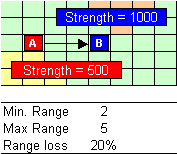
All units are equipped with weapons and these weapons have a "Damage" value assigned to them which describe the amount of damage the unit can inflict on an enemy. This is a percentage value of the unit strength meaning the number of men (strength) that will fall due to fire. If this was the only value of interest, the example (see right) with unit A having a damage value of 50% would inflict a loss of 250 men on unit B. (50% x 500 = 250). 


Min and Max Range

Units are limited by their weapons range. These values define how near or far the target unit must be in order to take it under fire. Typical values for infantry troops would be 1 to 3 allowing the unit to fire on an enemy 1 to 3 squares removed. Other weapon types, especially artillery, will have values of 2 or 3 (min) to 5 or more (max).


Range Loss

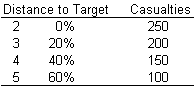
The "Range Loss" concept attempts to simulate the loss of accuracy when firing on units at a greater distance. Range Loss is a percentage value defining the amount of fire power lost per square. In the example on the right, Unit A, with a strength of 500 and a damage value of 50%, fires on unit B which is 3 squares removed. Due to the longer distance, the casualties for unit B will not be 250 but only 200.


Comment: Remember that formation, orientation, terrain types and armor also impact the casualty count but these are discussed separately.


Hosted by www.Geocities.ws

1