|
A PROPER JOB Profile of the working Environment of Falmouth Docks.
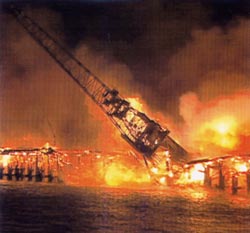
03.43 hrs 8th Jan 2003, I received a telephone call telling me that the Docks were on fire. After a brief conversation my wife and I got dressed and made our way to Woodhouse Terrace where we were confronted with the Queen's Wharf completely alight. Flames were billowing from all corners of the Wharf and were being fanned by an Easterly wind somewhere in the region of 25/30 m.p.h. There was no way that the fire would burn itself out. Fire tenders were in attendance but were unable to get near the fire. Firemen were on the two Harbour tugs, the Percuil and Ankorva, directed fire operations whilst the tug crews did a magnificent job in sailing their vessels as close as possible to the fire. A survey vessel, the "Tornado" had been tied up alongside before the fire had started, and the crew- all Russians- managed to untie their craft whilst the Harbour Pilot vessel came alongside and towed them to safety. The Lifeboat, "Richard Cox Scott" stood by the vessel whist the crew members were taken off suffering with smoke inhalation and also to keep an eye on the "Tornado" itself.
This is now a really tricky situation for the Docks as they are in the process of trying to obtain funding for the future of the yard and also this is another area of the yard that cannot be used for ship repair. * * * * * "A Proper Job" is an expression that has been passed down over the years. Whether we hear it now or whether it was spoken 150 years ago, it makes no difference. The end result is a reflection of how the job in hand has been finished. This is something like a mirror that reflects our journey through Falmouth Docks. Whatever era we look at the answer is the same - give the customer what they want and if possible, a little more. It is sometimes said that the “Impossible” takes slightly longer to complete. Where do we start a story of this magnitude? 150 years ago there was no sign whatsoever of a dockyard in Falmouth. Yes, there were small and very efficient boat builders but not to the extent that was required if the town was to remain a true Maritime port. For many years, Falmouth had been a very successful “Packet Station” (Sailing ships that were employed to deliver mail and goods to various parts of the world). However, with the development of the steam ship, Falmouth no longer held that licence. The geographic position of the town in relationship to other ports on the South Coast made no difference. Now that steam had taken over the new ships were not dependent on the correct prevailing winds and they could therefore leave from other ports further up the channel. Rumours of Falmouth becoming a redundant town soon spread and so a group of people decided to do something about it and the seeds of a dockyard were born. History alone, will in time decide whether these people were correct in their foresight. Much water has passed under the bridge since the laying of the Foundation Stone in 1860, but most people will agree that it was one of the most important changes ever in the town's history.
|
Time | Energy | Workforce | Movement | Further Work | Industrial Relations | Dry-docks | Alterations | Aerial Photos | Buildings and Workshops | Personalities | Flow of the Job | Engine Room | War Work | Re-cycling | Sports | Docks Tours | Thoughts on the Docks | The Future | Credits and Bibliography | Links | Sign Guestbook | View Guestbook | |