|
THE ENGINE ROOM
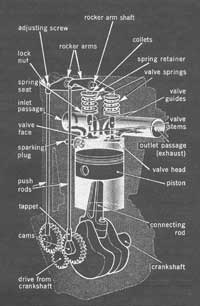
The first illustration helps anyone who is not conversant with the general layout of the Internal Combustion Engine. Words like piston, crankshaft, valves and push rods may seem quite alien to people but may be of assistance if someone has need of major repairs to their car engine. Engines have changed dramatically over the years. In many cases the engines have become much smaller but give a higher output of power. Although this may sound to be more simple it still necessitates hard work to overhaul them.
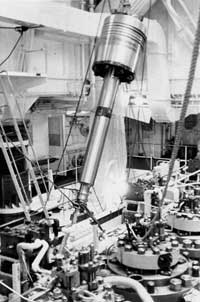
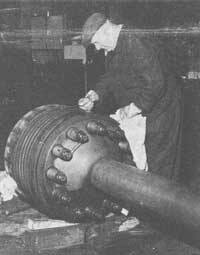
The photo below left shows a piston in mid-air ready to be installed in the engine. In effect, this was a spare piston and was fitted to enable the worn one to be overhauled. This means an excessive cleaning and the fitting of a new set of piston rings. This exercise was carried out to allow time for the other repair. See below right.
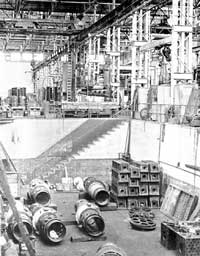
The piston fits neatly into the liner or cylinder which also has to be removed occasionally. These would be sent to the fitting shop for overhaul. The photo (below left ) shows the fitting shop Pit which was synonymous with the docks during many years but has now been filled in. It shows engine liners lying on the floor.
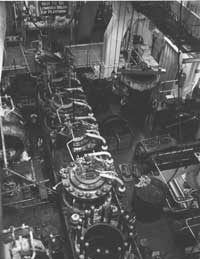
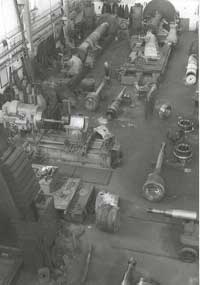
The photo (above right) was taken from one of the overhead cranes. It shows a piston on the floor and some of the shop’s machines. Pistons that were exceptionally dirty would be sent to a cleaning shed, necessary for quickness of repair. (If the machinery is cleaned it means that the workforce are able to repair and overhaul the items much more quicker than if they were working on dirty equipment). The pistons would then be scraped and polished, new rings fitted and sent back to the ship. A major job, which was not always done at all dry-docking, would be the removal of the main engine Crankshaft, which would entail the dismantling of the engine.
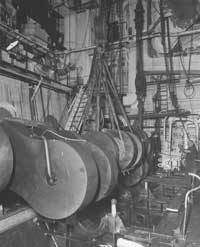
The first photo (all circa 1960) shows the lifting of the Crankshaft. Chain blocks, wire ropes or strops and crane hooks are in view. This was a delicate operation but always carried out with extreme professionalism. The person that can be seen in the background is the very famous Cornishman "Dick Williams" (deceased). He was the Cornish Samson. A strongman given to appearing at various exhibitions around the country. On one occasion, when the Docks staff held their annual dinner, the highlight of the evening was a display of strength featuring himself and the British Strongest woman, "Joan Rhodes".
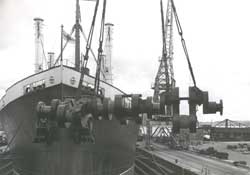
The second photo shows. the crankshaft being removed from the engine room. The bow of the “Cambridge”, owned by the Federal Line, is in view. The crankshaft is waiting to be loaded on transport for the long journey to the engine builders - William Doxford of Sunderland.
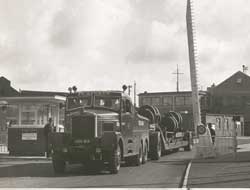
Photo no three shows a low loader starting on it’s long journey with the crankshaft. A “Pickfords” lorry was used. You see, they don’t only shift furniture. When it returned with the repaired crankshaft, the engine would be completely rebuilt - just everything done in reverse.
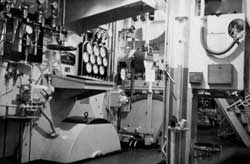
After everything has been replaced and the ship is made ready for sea, rigorous trials are performed. The engine room is thoroughly cleaned by a squad of men, removing all unnecessary materials not used - rubber joints, nuts and bolts, welding rods, temporary lighting equipment etc. Finally the floor plates are cleaned until it looks something like the photo (above). Another success for Falmouth Docks.
|
| Home | Time | Energy | Workforce | Movement | Further Work | Industrial Relations | Dry-docks | Alterations | Aerial Photos | Buildings and Workshops | Personalities | Flow of the Job | War Work | Re-cycling | Sports | Docks Tours | Thoughts on the Docks | The Future | Credits and Bibliography | Links | |