|
ALTERATIONS Whenever something new encroaches upon an area then it's a good bet that other things have to be altered to accommodate it. Take, for instance, the enlarging of No 2 dry-dock. As was discussed on the dry-dock page, it was necessary to widen and lengthen the then existing dock. To do this extensive job many feet of existing buildings had to be removed. In fact, someone who was directly involved with the operation said that a total of 60ft had to be lost on two of the major workshops, namely the Platers and Boilermakers (in today's jargon they would be referred to as the Fabricators). Therefore, to accommodate this venture it was decided to build another workshop.
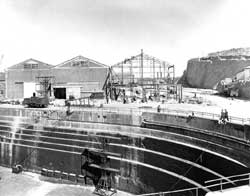
The photograph above gives the observer some idea of the shape of the new building being erected. In the background, work is still proceeding with the Cliff. Another thing of importance can be seen in the foreground namely a painter's trestle, used when painting the hull of a ship. These were used extensively and were able to be manoeuvred to various parts of the dock. This photo was taken in 1957.
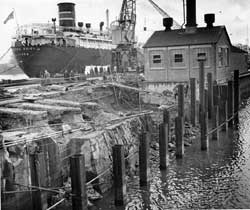
Two further photographs taken in 1957 are to do with the building of a new air compressor house. Prior to this being built, all compressed air was supplied from a diesel compressor house situated by the side of no.2 dock. These were to be left as stand by sets after the new building and machinery were available. A new supply of steam was already there supplied by three new boilers. The first photo is an excellent shot of the foundations. A great amount of effort went into developing the site. Extra piles and reinforcing to give a perfect bed to the new style of electrical driven compressors. A greater delivery load of air would be available around the yard. The new compressors were made and designed by Holman Bros of Camborne, one of the leading engineering firms in developments of this type of equipment. A really dependable company and well known throughout the world.
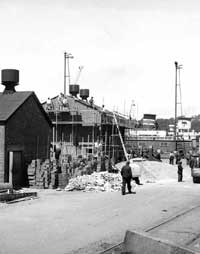
The second photo is of the compressor house nearing completion. There are two interesting vessels in the background. Both are the American designed T2 type Tankers (Turbo- Electric Propulsion) that were built during the 2nd World War and then sold off to various commercial companies after the conflict. BP owned 9 of them and they were frequent visitors to Falmouth Docks. In 1960, two of the BP vessels were sold on to a Norwegian company, taken to the Fjords and used as temporary power stations. The other tanker in the photo belonged to the Eagle Oil Company. These were also regular visitors to the port. One of their predecessors was called the San Demetrio and a successful film was made of it's exploits in WWII.(San Demetrio, London 1943) It was damaged and caught on fire. The crew abandoned her but returned a few days later, put out the fire and eventually continued her voyage back to Britain. A momentous achievement in maritime history.
|
| Home | Time | Energy | Workforce | Movement | Further Work | Industrial Relations | Dry-docks | Aerial Photos | Buildings and Workshops | Personalities | Flow of the Job | Engine Room | War Work | Re-cycling | Sports | Docks Tours | Thoughts on the Docks | The Future | Credits and Bibliography | Links | |