|
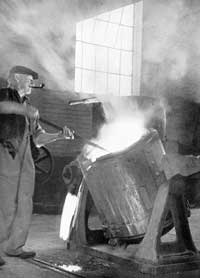
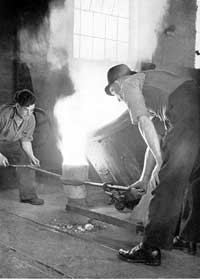
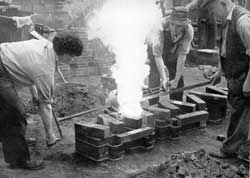
THE FLOW OF A JOB It has not always been possible to get a spare part off the "Shelf". If this occurs it may have to be fabricated. In past years most of the “Fabrication” was done in the Iron and Brass Foundry. This was one of the oldest departments in the yard. An outline map of the yard dated 1897 can be found here and on it you can see the area devoted to the foundry on the left hand side of the Western Breakwater. All major industries had their own Foundry, Holman Bros of Camborne being a prime example. They became experts in the development and manufacture of Air Compressors and would in time supply these type of machines to the Docks. In the manufacture of a piece of equipment e.g. A Gear Wheel, calculations would be made on the correct size and number of teeth. All this would be done at the Drawing Office. Here, a drawing was made, checked and passed. The drawing would then be sent to the Pattern Makers to make a full size replica in wood. These people were the Wood Engineers, and experts at their trade. In the meantime, information would be sent to the Moulding Shop to get them ready to make up a mould for the pattern when it arrived. Furnaces heated the metal to a molten state. Ready to receive the molten metal a mould or framework would have been made ready. In this framework would have been a mixture of substances ( clay and sand ) sometimes referred to as loam. The pre-prepared wooden pattern was then pressed into the loam mixture and if there were any holes required in the finished job, the moulder would create them with wooden plugs. The photos below show various phases in the preparation of the metals:
Once the mould had been prepared and the metal heated up to the correct temperature, one of the personnel removed the slag which accumulated on the surface of the metal
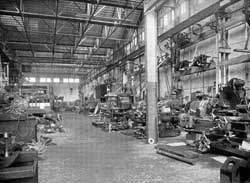
The pouring of the metal into the pre-prepared mould is shown below. When all the metal has been poured and excess metal is blown out, the mould is allowed to cool. Eventually, after cooling, the mould and loam are broken away to reveal a rough form of the product. After removing the jagged edges, the unit would be taken to the Fitting Shop for “Finishing Off”. This could mean some form of machining and hand fitting. The last photo shows part of the Fitting shop in the 1940’s. Take note of the Belt Driven machinery. These would be replaced in the late 1950’s with new lathes with self-contained motors. Belts were always a source of trouble and not many days would pass before the maintenance fitter would be called for a repair to a broken belt. Lighting also was not of the highest standard but eventually replaced with more up to date equipment.
|
| Home | Time | Energy | Workforce | Movement | Further Work | Industrial Relations | Dry-docks | Alterations | Aerial Photos | Buildings and Workshops | Personalities | Engine Room | War Work | Re-cycling | Sports | Docks Tours | Thoughts on the Docks | The Future | Credits and Bibliography | Links |
|