|
MOVEMENT IN THE DOCKS How do we describe "Movement" ? A dictionary may say it is an "Act of Moving". It can be anything from stillness to excessive speed. It can even be human based or mechanical. Movement is so very important as that is how the final job is finished - efficiently. Let us commence with stillness in the dockyard.
Steam cranes, diggers and locos were so important to everyday working life. These have gone now, but never let us underestimate the importance of the equipment and the personnel who worked them. All these were the main movers in the case of construction, mostly associated with the building of the dry-docks themselves.
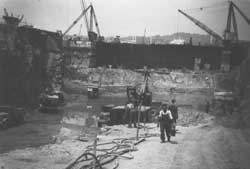
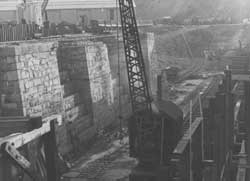
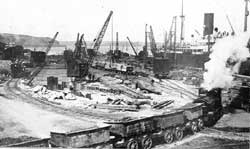
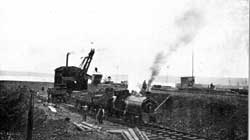
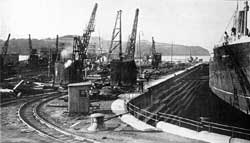
It wasn't until 1928 and the finishing of No 4 dry-dock that the first electric crane was installed. Until then, each day was a proper "Steam Up". The workforce involved, whether drivers or their assisting firemen would "Flash Up" their respective machines for the day as soon as the arrived for work. This would entail the igniting of boilers to produce steam. In some cases they would arrive before the official starting period to allow themselves time to start their fires. It would be the fireman's job to search for wood to start things rolling and then it would be a consistent shovelling of coal. In time the fireman, hopefully, would attain driver status, whether it was on a crane or loco. In the following years as cranes with electric drives started to take over a lot of the duties, the driver would still come in early as in previous years but this time his job would be to grease various points on the crane. The following 3 photos are of the construction of No 4 dock circa 1926/28
Just notice the amount of steam equipment that is associated with the task in hand. Extra tracks had to be laid to accommodate all these "Beasts of Labour". Thousands of cubic feet of rock had to be blasted and removed. The "Removal Van" was of course the steam loco. As the dock grew deeper, with the help of a predetermined incline, so the rock would come to the surface in relays.
This shows the steam digger or navvy emptying rock into the wagons below surface level.
A general picture of the steam cranes. There is Federal Company steamship in the adjacent dry-dock and Trefusis headland is in the background.
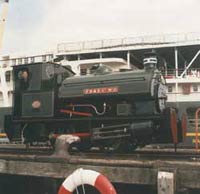
Behind the loco that Cyril is driving is a ship called the "Rangiterra". Originally she was a ferry which ran between the North Island and South Island of New Zealand. She led a chequered life that culminated in arriving at Falmouth for lay-up, going up to Scotland as accommodation for Offshore oil workers and eventually getting the "call-up" for the Falklands conflict in 1982. Some of her conversions were made at the Docks.
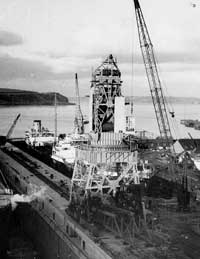
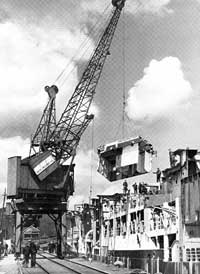
The photo on the right is of No. 21 crane in the process of being installed in1958/59. A mobile crane is shown in attendance helping with the construction. It is situated on the East side of No 2 dry-dock. In 2001/ 2002, the crane went through extensive repairs which included the removal of it's jib. It is back in working order now. It was a very costly job but necessary if it is to maintain it's ability to lift 50 tons. Click here for a more up to date photo- 2002, of the crane after a major refurbishment.
The cranes themselves, apart from having a driver also had a helper known as a "Ropy". He was responsible for looking after the trailing electric cable which supplied the crane especially if the crane came to it's full length of travel either on the wharf or dockside. Then the cable plug would have to be removed and plugged into another socket. Yes, it was just like plugging in an electric kettle- except the plug was heavier and much bigger! This could cause some concern as far as safety. In later years, after the County and Duchy wharves were constructed, it was not unusual for some of the plug fittings to be damaged. Although the sockets were below the surface of the wharf, the plugs would be visible. However, they were not seen by many Taxi drivers bringing ship's personnel back late at night, and many times in reversing their taxis, the plug would be hit. Sometimes a massive amount of sparks would be seen.. This caused a lot of excitement, especially the effort carried out to find out who caused the damage
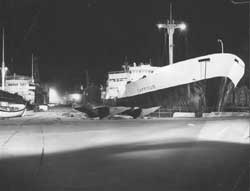
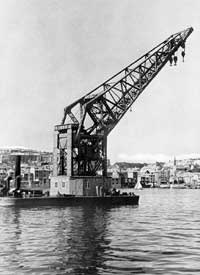
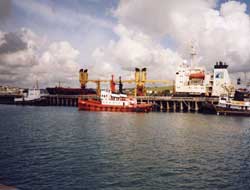
Falmouth Docks became a very important Oil Tanker repair port especially after the 2nd World War and it was not unusual to find the yard overloaded with shipping. This "Double Berthing" was not unusual and so to do some jobs, it was a call-out for the floating crane. It could get to areas where the Wharf Cranes could not reach. A very important acquisition to the Docks it was eventually sold. The practice of "double berthing" does not happen now and the requirement of this type of lifting device is no longer needed. However, older people in Falmouth still remember this "Goliath" with affection and the hole it left in the harbour skyline when it was towed away was noticeable for many years.
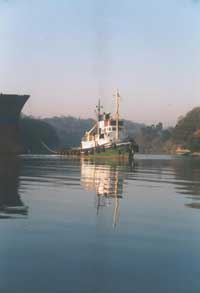
Below is a fine photograph of the St Mawes, up the River Fal after taking a vessel for lay-up. This sort of operation was seen on a number of occasions in the past and is still taking place. In many cases, as in the Banana trade, some ships are laid up due to the season, or perhaps the different types of charters that ships are involved in. In past years there have been as many as 40 ships laid up at one time This tug is no longer with the Falmouth Towage Company and was sold in 2001.
|
| Home | Time | Energy | Workforce | Movement | Further Work | Industrial Relations | Dry-docks | Alterations | Aerial Photos | Buildings and Workshops | Personalities | Flow of the Job | Engine Room | War Work | Re-cycling | Sports | Docks Tours | Thoughts on the Docks | The Future | Credits and Bibliography | Links | |