|
FURTHER WORK This page deals with some of the tasks that have been carried out in the docks over the years.
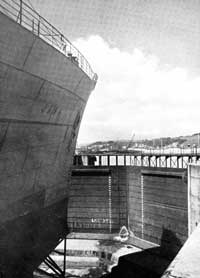
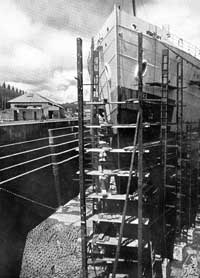
Photo on the left shows a ship in No 1 dock. This was taken in the 1940's. Today, this dock is used by Pendennis Shipbuilders as a fitting out basin as there are no longer any dock gates. These were removed quite a few years ago with the gates unable to keep the dock watertight. On the right, the photo shows work being carried out on the ship's bow and hull. The "Mecanno" units around the bow acts as staging for the workforce. The ship's anchor chains are shown in the bottom of the dock. For a close up of anchor chains, click here.
Photo (circa 1946) on the left shows holes being burned out in the main deck of a ship. The right hand photo (circa 1946) shows the fitting of a new section of plate which would be riveted in place. To get the new plate in the correct position, a set of service bolts would be inserted at various points, as can be seen in the picture.
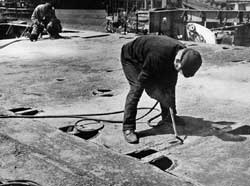
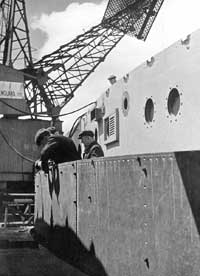
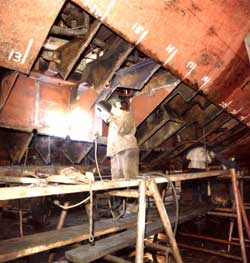
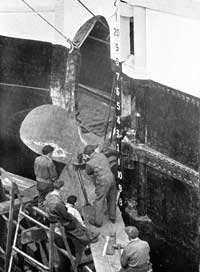
The left hand photo (circa 1980's) shows a welder working on the lower plates of a ship. The photo (circa 1946) on the right shows a group of men (the Tail End Gang). They are extremely qualified and talented in this type of work. The picture shows them performing their skills on yet another propeller.
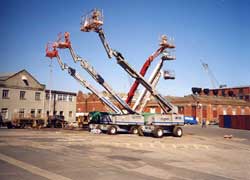
A photo of a Man Lift, Cherry Picker, whatever they are called, used extensively today to carry out various tasks around the yard and in the dry-docks. Falmouth has always prided itself in the quality of paintwork given to a vessel before it leaves the port, carried out extensively by the "Paint Gang". The "Lifts" are one of the advances that the workers have found helpful in carrying out their tasks. The workforce is trained in the operation of these units. An operator can stand on the platform with a safety harness, switch on the engine and drive it to a position of work, and then alter the angle of the extending arm to suit the required job. These are extremely helpful in the majority of awkward tasks including the cleaning of the hull before paint spraying. In the past, the "Paint Gang" would follow a ship in the dry-dock as it was pumping down, working on rafts, scraping the barnacles etc from the hull until the ship was resting on the Keel Blocks. Sometimes, the work would be finished off with pneumatic chipping hammers or, in later years, "Grit Blasting". Now it is done with "High Pressure Water Blasting". But whatever the year, the same amount of care is taken as the various coats of paint are applied And it's not only ships that have to be painted, as even the jibs on the large cranes have to be chipped and given a coat of paint.What a job!. Some minor items that may be of interest.
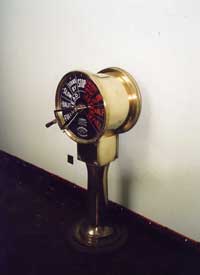
A photo of a ships Telegraph and a very important unit. It is used to convey orders for manoeuvring speeds by transmitting to the Engine Room from the bridge of the ship. The engine room staff will respond by answering the signal with the same type of unit. Times of each signal are recorded in case of an accident. The telegraph unit shown can be seen in the vestibule of the Falmouth Docks Main Office. We do hope that the previous owners never left it behind before sailing!
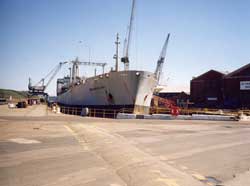
Falmouth Docks have always had strong links with the Admiralty. This photo taken in 2002 shows one of a long line of Admiralty vessels that have had their annual refits done here. Most of the time it will mean a multimillion pound contract and the vessels will be in the docks for up to 90 days. This is one of the latest to have a successful refit- the R.F.A. Brambleleaf.
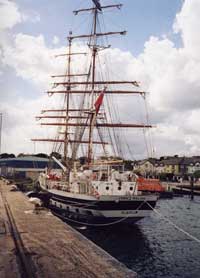
Lastly, here is one of our newer visitors, the Sail Training Association ship "Prince William" alongside the County Wharf. People were able to try out a day's sailing on her. She was built in North Devon alongside her sister ship, the "Stavros Niarchos ".
|
| Home | Time | Energy | Workforce | Movement | Industrial Relations | Dry-docks | Alterations | Aerial Photos | Buildings and Workshops | Personalities | Flow of the Job | Engine Room | War Work | Re-cycling | Sports | Docks Tours | Thoughts on the Docks | The Future | Credits and Bibliography | Links | |