|
THE 2nd WORLD WAR
Falmouth is a strategic port. A port which became so very important
to the war effort for the Western Approaches. The Admiralty took
command as it did in the 1st World War. It was assumed, and quite
rightly, that it would be a prime target for the Germans. Most
of the workforce became “Reserved Occupation” (ie they would not be
called up for active service) but these men did become fire watchers and members of the “Home Guard”. This
meant working a full day then going out on patrol or exercise and back
for another day’s work. Obviously this meant a severe lack of
sleep. First of all here are two very important extracts from a ledger kept by Falmouth Dock Co.
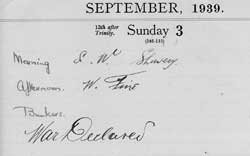
There's not a lot written on the first page, but note the date.
This page simply states the weather
conditions and below in beautiful writing a small phrase - WAR
DECLARED in red ink.
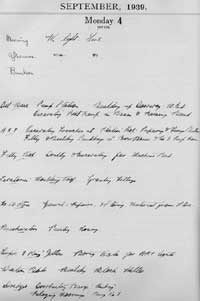
The next day seemed to be treated like any other day. The weather and
the jobs done were logged, but one interesting feature was the
installation of sand bags around the Power House and Pump Rooms. The
work also included the building of a block house, trenches and ARP
lights.
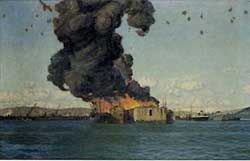 Something
which really brought home to the general public what war was all about
happened in June 1940. On this day three ships were hit by bombs on the Northern Breakwater.
A British Tanker called the “British Chancellor” was badly damaged.
It was repaired and went on trading until it was scrapped in 1960. The other
two casualties were cargo ships - the “Tuscaloosa”, which
carried general cargo and the “Marie
Chandris”, a cotton carrier. Both the cargo ships, still on fire, were towed away to
other parts of the harbour and eventually broken up. The wharf caught
alight and men had to be rescued by launch and tugs. There were
casualties both amongst ship’s crews and civilian workers. A black day for the town. Something
which really brought home to the general public what war was all about
happened in June 1940. On this day three ships were hit by bombs on the Northern Breakwater.
A British Tanker called the “British Chancellor” was badly damaged.
It was repaired and went on trading until it was scrapped in 1960. The other
two casualties were cargo ships - the “Tuscaloosa”, which
carried general cargo and the “Marie
Chandris”, a cotton carrier. Both the cargo ships, still on fire, were towed away to
other parts of the harbour and eventually broken up. The wharf caught
alight and men had to be rescued by launch and tugs. There were
casualties both amongst ship’s crews and civilian workers. A black day for the town.
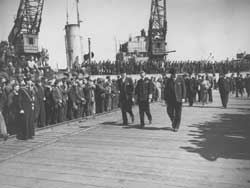 Our
scene now changes to 1942 and a visit to the town and dockyard by His
Majesty King George VI. This photo shows him in company with the managing director Mr
H.A.J.
Silley and the General Manager of the Docks - Mr Smeaton. Behind is
Her Majesty Queen Elizabeth with Captain Bartlett, the
General Manager of Falmouth Dock Company. They are
walking along the “King’s Wharf”, which is very appropriate as it was named in honour of King George
V in 1933. Work did stop for
a time so the workforce could show their respect and appreciation to the
King. My
father was working on the ship in the background. His
nickname was "Yorkie" and he was a member of the Home Guard. One favourite story that I heard
concerning him was the day that he was asked to bring in some sweets for
the rest of his mates. This was after sweet rationing had ceased. His mates were all very big men and he brought
in what
was referred to as "Lucky Bags". These were sweet bags
that contained Dolly Mixtures and very small toys. Luckily, they
all saw the joke! Our
scene now changes to 1942 and a visit to the town and dockyard by His
Majesty King George VI. This photo shows him in company with the managing director Mr
H.A.J.
Silley and the General Manager of the Docks - Mr Smeaton. Behind is
Her Majesty Queen Elizabeth with Captain Bartlett, the
General Manager of Falmouth Dock Company. They are
walking along the “King’s Wharf”, which is very appropriate as it was named in honour of King George
V in 1933. Work did stop for
a time so the workforce could show their respect and appreciation to the
King. My
father was working on the ship in the background. His
nickname was "Yorkie" and he was a member of the Home Guard. One favourite story that I heard
concerning him was the day that he was asked to bring in some sweets for
the rest of his mates. This was after sweet rationing had ceased. His mates were all very big men and he brought
in what
was referred to as "Lucky Bags". These were sweet bags
that contained Dolly Mixtures and very small toys. Luckily, they
all saw the joke!
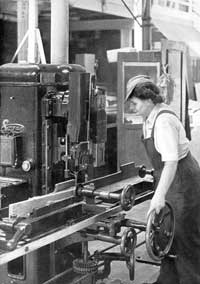 Women
played a very active part during the war and they were employed at
Falmouth Docks in
various departments. Some were trained as welders and in this photo we
see a lady performing a task on one of the machines in the Joiners Shop.
Some acted as helpers in other departments including the electricians.
Also, of course, there were the ladies who were employed in the main
office as typists, clerks
and checkers on special machines tabulating costs of materials and
labour. After the bombing in 1940, the Main Office transferred all its
staff to premises in Penryn to a site known as "Shepherd's
Meadow". This area is opposite the park in the town. They
stayed there until 1945. Women
played a very active part during the war and they were employed at
Falmouth Docks in
various departments. Some were trained as welders and in this photo we
see a lady performing a task on one of the machines in the Joiners Shop.
Some acted as helpers in other departments including the electricians.
Also, of course, there were the ladies who were employed in the main
office as typists, clerks
and checkers on special machines tabulating costs of materials and
labour. After the bombing in 1940, the Main Office transferred all its
staff to premises in Penryn to a site known as "Shepherd's
Meadow". This area is opposite the park in the town. They
stayed there until 1945.
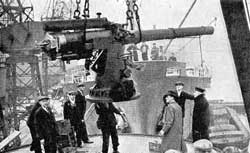 Guns were
an important part in defending ships against
surface raiders. Ships had to have special platforms built and
reinforced to take the shock and recoil of these guns as they were
fired. This was one of the more important tasks carried out at this time
at Falmouth Docks. The guns would be assembled in
the fitting shop “Pit”. On one occasion, whilst disassembling
a captured German Gun, some men were badly injured and at least one
person was killed. The photo (although not of Falmouth Docks) shows a
typical type of gun that was installed - possibly a 7.5 lb. Guns were
an important part in defending ships against
surface raiders. Ships had to have special platforms built and
reinforced to take the shock and recoil of these guns as they were
fired. This was one of the more important tasks carried out at this time
at Falmouth Docks. The guns would be assembled in
the fitting shop “Pit”. On one occasion, whilst disassembling
a captured German Gun, some men were badly injured and at least one
person was killed. The photo (although not of Falmouth Docks) shows a
typical type of gun that was installed - possibly a 7.5 lb.
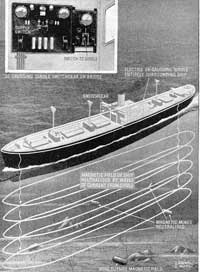 A major success was the defeat of the German manufactured Magnetic
Mine. Some sources say that this weapon was originally a British idea.
However, a device to repel the setting off of the mine was developed, and Falmouth
Docks played an important roll in fitting out various types of vessels
with this type of protection. The process was called Degaussing and it
was made up of a magnetic coil wrapped around the ship which acted
as an anti-magnetic device by altering the magnetic effect of the ship's
metal structure. It has been reported that the first magnetic mine of
WWII was dropped in Falmouth Bay by a German aircraft and detonated by a
ship that had just left the docks following repair. The ship was an oil
tanker called the CORONI RIVER, owned by a British company called Houlder Brothers Ltd. A major success was the defeat of the German manufactured Magnetic
Mine. Some sources say that this weapon was originally a British idea.
However, a device to repel the setting off of the mine was developed, and Falmouth
Docks played an important roll in fitting out various types of vessels
with this type of protection. The process was called Degaussing and it
was made up of a magnetic coil wrapped around the ship which acted
as an anti-magnetic device by altering the magnetic effect of the ship's
metal structure. It has been reported that the first magnetic mine of
WWII was dropped in Falmouth Bay by a German aircraft and detonated by a
ship that had just left the docks following repair. The ship was an oil
tanker called the CORONI RIVER, owned by a British company called Houlder Brothers Ltd.
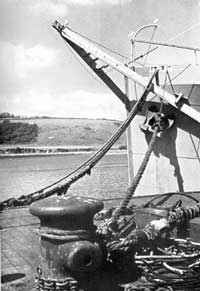 Many vessels visited the port
for dispersal or repair. This photo shows a bow of a ship on
the Northern Arm. A small thing to notice are the hemp ropes attached to the
ship and wire
ropes attached to the bollard. The anchor has been raised so the ship is
ready for sea at a moments notice. This is probably a Minesweeper. In the
background is Trefusis, part of an estate that is a prominent
landmark in Falmouth. During WWII, a barrage balloon was
situated on this piece of land. Bombs also fell in the same area. Many vessels visited the port
for dispersal or repair. This photo shows a bow of a ship on
the Northern Arm. A small thing to notice are the hemp ropes attached to the
ship and wire
ropes attached to the bollard. The anchor has been raised so the ship is
ready for sea at a moments notice. This is probably a Minesweeper. In the
background is Trefusis, part of an estate that is a prominent
landmark in Falmouth. During WWII, a barrage balloon was
situated on this piece of land. Bombs also fell in the same area.
Another fact that Falmouth is famous for is the departure of the Destroyer
H.M.S.
Campbletown accompanied by a flotilla of motor
torpedo and gun boats to attack the "Normandie"
dry-dock in St Nazaire. Over 600 commandoes and personnel took part in
the operation and amongst the number of medals awarded, were 5 Victoria
crosses. One of the recipients was a Seaman, William Savage, who was
killed in battle and is buried in the war cemetery in Falmouth
Photos of Landing craft that were in Falmouth Docks prior to the
D-Day invasion Today, the area below is composed of houses
and apartments and is known as Port
Pendennis.
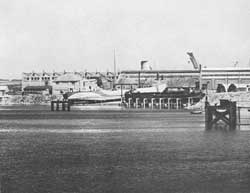
1 A landing Craft being checked over and minimal damage repairs
carried out on a slipway. The slipway was situated in an area that has
since been taken over by the County Wharf.
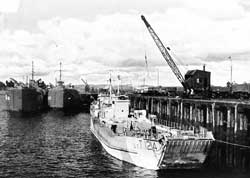
2 LCT's (Landing Craft Tank) and landing craft alongside the Eastern Breakwater. This
breakwater was also used for refuelling destroyers and submarines. Also
accepting fuel for their storage tanks.
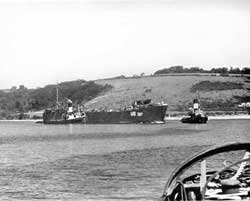
3 An LCT being towed by two local tugs with Trefusis in the
background. There is no sign of a barrage balloon that was in that area.
This photograph was probably taken just after hostilities had ceased
|