|
Credits and Bibliography My thanks will have to go to a tremendous amount of people who have helped me in this rather new venture that I have entered into. A&P Falmouth. (Head Draughtsman Richard Lawrence) My thanks to Falmouth Art gallery for the use of one of their paintings. " The Bombing of the British Chancellor 10th July 1940". Two books that have been used for reference are as follows- Hurd, Sir Archibald(Ed) (45/46) "Britains Merchant Navy" Odhams Press London. About the Author
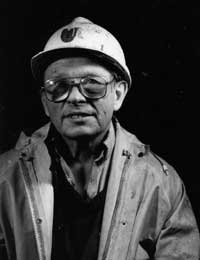
Cedric Paterson was born in Falmouth in 1935. He attended Falmouth Grammar School, served his apprenticeship as an Electrician at Silley Cox and Co. Ltd. Spent over 7 years in the Merchant Navy, returned to the Docks and stayed there until he was made redundant with over 900 others in 1979. In 1982, he went to work at South Crofty Tin Mine and was there until the closure in 1998. Returned to the Docks as a casual worker until his retirement in 2000. Spends a small part of his retirement showing tourists around the Docks. Happily married with two grown up sons and a daughter-in-law
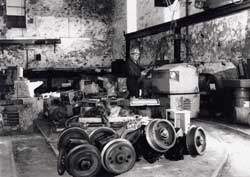
The first photograph was taken at South Crofty Tin Mine before it's closure in 1998. The author was employed as an Electrician and one of his duties was the repair and overhaul of the electrical driven locomotives. The locos were driven by an electric motor which derived it's power from heavy duty batteries. Their were two types of locos: 1.75ton and 5.0ton units. The areas they were able to work in was determined by the tracks, headroom and also the amount of material they were able to pull. The photo shows some of the axles ready to be installed in the loco chassis.
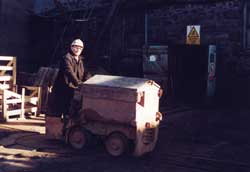
The Author driving a 1.75ton "Clayton" loco. He worked in the Locomotive shed. One of his duties was to charge ,and change the heavy duty batteries, then drive the locos to the Loading Station - Robinson's Shaft. One very important safety rule was for the driver to, at all times, be stood in the loco Pan. One particular day, the author was faced with extreme high winds which forced the doors to close on the loco as it was being driven from the loco shop. Unfortunately, the driver had to manoeuvre the loco through the doors whilst standing outside of the pan. The loco inadvertently went over his foot and after reporting the accident to the First Aid, who in turn informed his foreman, was given a Written Warning as he was told he had contravened the Management Rules. I do believe it was the first time this rule had been enacted. Some people wondered if the warning had been given un-necessarily. About the driver's foot- all he sustained was slight bruising on his small toe.
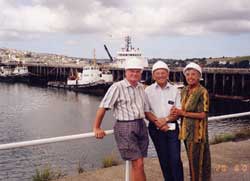
These happy looking people are two tourists being shown around the dockyard by the author! The driver of the bus, which helped to show tourists around, took this photo. The couple came from Wigan and were very kind in forwarding this picture to the docks. This is one of the nice things that happens on our tours. Many interesting pieces of information come to light with these visits and it is surprising to meet people who visited the dockyard during and just after the 2nd World War. Contact: [email protected]
|
| Home | Time | Energy | Workforce | Movement | Further Work | Industrial Relations | Dry-docks | Alterations | Aerial Photos | Buildings and Workshops | Personalities | Flow of the Job | Engine Room | War Work | Re-cycling | Sports | Docks Tours | Thoughts on the Docks | The Future | Links | |