|
THE DRY-DOCKS An integral part of any ship repair dockyard are the dry-docks. There are not many times that a ship will come in for repair without using these facilities. Whether it is for the hull to be painted or repairs to various parts of the ship below the waterline, the dock is a necessity. The largest of this type of dock in Falmouth is No.2 and hopefully the following photos and text will describe some of it's features over the years.
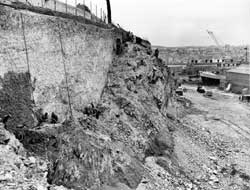
This Company were known throughout the shipping world as a very efficient ship repair yard. Many companies, no longer with us, were customers year after year. Tanker fleets were getting larger in numbers and in physical size also. Because of this it was deemed necessary to enlarge one of the docks and no. 2 became the object of this exercise. Much planning and work had to be done to accomplish this task, which included the severe cutting of the cliff-face and the diversion and construction of part of a new road behind it. 150 ft was the distance to move the cliff-face back into Castle Drive. The height of the cliff eventually became 110ft and the total amount of rock removed was 250,000 cubic yards. The spoil of which became added reclaimed land to the seaward side of the Eastern Breakwater. With the alterations of the road leading around Castle Drive a wonderful viewing area of the docks became available. Many tourists and locals use this facility.
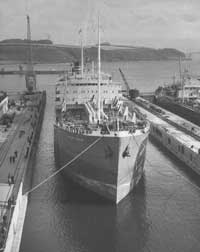
We'll jump a few years to show the first ship to enter the dock after the completion of all alterations. The dry-dock was officially opened in May 1958 by HRH The Duke of Edinburgh and named it the "Queen Elizabeth 2nd" dry-dock. In the following pages we shall see some of the things that went towards the reshaping of this new facility. Before any work could commence on the dock, alterations to the cliff had to be done. The photos will give the reader a chance to observe various parts of this task.
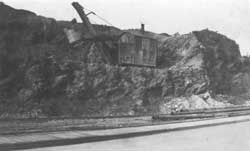
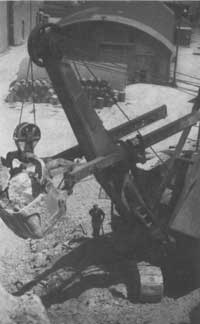
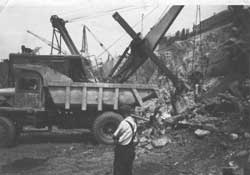
The first photo shows the steam navvy working to remove the lower levels of rock. There would be 2 navvies working on this operation. The other one was a diesel operated navvy.
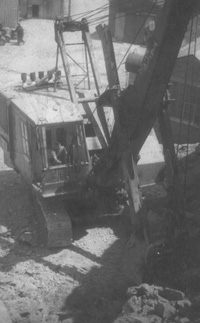
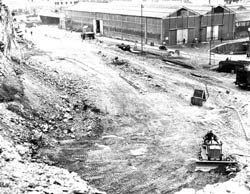
These next two photos show the size relative to the men working with them. Also, you can see the size of the rocks that had been removed in the bucket. A little story about the diesel digger (navvy). It was a 5 cylinder Ruston and weighed in the region of 74 tons. It was only 5 years old when the Falmouth Dock Company bought it. The Dock Co. were responsible for the Civil Engineering side of the works. One particular day, whilst working on the lower slopes of the cliff, this machine decided to run away backwards, out of control. The driver was not able to stop the machine but luckily it came to a halt. Sighs of relief all round. The manager (Mr Underwood) was quite concerned that no one was hurt. He was informed that although the digger was only 5 years old, it had done the equivalent of 10 years work. Mechanics from the manufacturers were summoned from Lincoln and the defective parts (the clutch) were replaced and various other parts overhauled. Soon it was back to work again.. This unit became the driving force behind the developing of the incline (slope) to the bottom of the dock
The photos above are of the rock being removed and also the men working on the face. Much blasting had to be done before the rock was taken away.
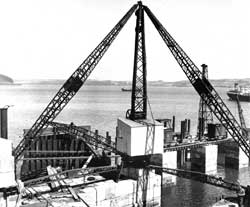
As mentioned above, work continued in other parts of the dockyard. If blasting was to take place, for example at lunch break, an audible alarm would sound giving people a chance to shelter from flying rocks. The following photos show various stages of the refurbishment of the dock. As a new dock gate had to be installed, a dam had to be constructed to allow the fitting of this 500 ton piece of equipment.
The photo above shows the three legged crane assembly used in building the dam with the pile driving equipment in the background. This was a long drawn out exercise but done very efficiently. All the time that this work was in progress, the yard still had to maintain a good working relationship with the various shipping companies and of course the Falmouth and County councils. Divers employed by the Dock Company played a very important roll as can be imagined with the initial laying of blocks for the dam well below the waterline.
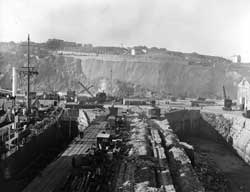
A view in the bottom of the dock as work was progressing. It look's a bit of a mess but one has to remember that " Rome wasn't built in a day". That remark was used on many occasions but as always the wise-cracker would come out with, "But I wasn't the Foreman!".
As the width of the land between the docks was diminishing it was necessary to move the crane from the Eastern side of no.2 dock. This photo is of the crane at the head of the dock as it was being moved. Special tracks and rollers were installed to help in this operation. Great skill and patience was shown in order to carry out this exercise.
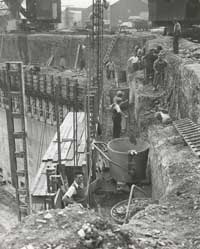
Photo of men working on the head of the dock with staging, buckets of concrete, reinforcing etc. All these things were to be seen, day in and day out, whatever the weather, work still carried on.
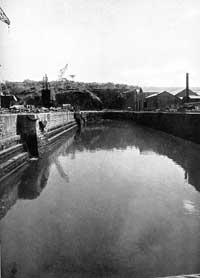
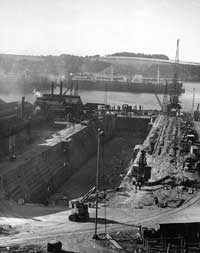
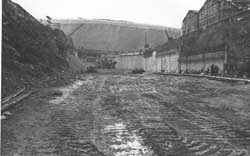
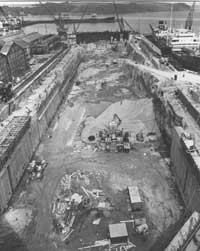
The photo shows a view of the dock. Note the incline- all the way to the bottom. There's also a large pile of shingle ready to be mixed for concrete. The shingle was brought in from a local quarry by coaster (a small vessel) and unloaded into lorries on the Eastern Breakwater. It was then transported to the dockside and emptied into the bottom of the dock. A concrete plant was eventually installed in the very bottom of the dock itself and so concrete could be made available to all parts by being pumped around via a pipeline.
1928. This was the year that No 4 dry-dock was opened. Many dignitaries were invited to a dinner to commemorate the event. The dinner was held on a passenger ship in the docks called the "Domala" and hosted by Viscount Inchcape (the shipping company's chairman). A presentation booklet was given to all the guests comprising the dinner menu and photos of the construction of the dry-dock at different stages. The Chairman of the Docks presented the Mayoress of Falmouth with a Jewel box and the wife of the ship's Captain with a diamond brooch. Three photos in this section show various stages in the construction
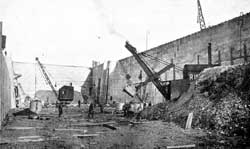
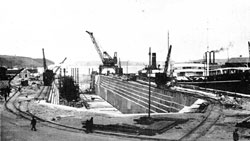
Photo shows excavation work being carried out and an amount of rock still to be removed. The dammed entrance can be seen in the background with steam crane and navvy shown working.
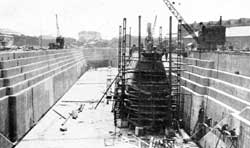
A general view of the dock nearing completion. In the background of the photo can be seen the newly erected electric crane capable of lifts of 30 tons. It is still working today, 2002, despite being the first electric crane in the yard.
This photo shows the construction of the caisson. They are ugly things. Today they would use dock gates. A caisson is a large hollow steel gate which fits against the dock entrance. When water is pumped out the pressure of the sea holds the caisson against the dock. When flooding the dock, the caisson can be towed away.
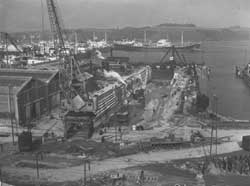
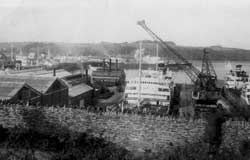
The photo shows a view of No. 2 dry-dock being occupied by the BP tanker, British Duke taken in 1952. This was before any alterations to the cliff or dock. One interesting feature is the crane, which in a previous photo was shown being moved.
|
| Home | Time | Energy | Workforce | Movement | Further Work | Industrial Relations | Alterations | Aerial Photos | Buildings and Workshops | Personalities | Flow of the Job | Engine Room | War Work | Re-cycling | Sports | Docks Tours | Thoughts on the Docks | The Future | Credits and Bibliography | Links |
|