|
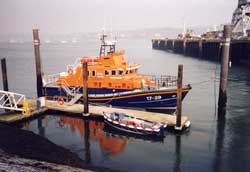
FALMOUTH AND THE DOCKS There is always a lot to associate with the docks, going back many years. For instance, the Lifeboat. The first one to come to Falmouth was in 1867. That was called the " City of Gloucester ", followed by the " Jane Whittington" and the " Bob Newbon ". These were rowing vessels and up until 1918, were housed in a shed in the Docks. Because of the alterations to be carried out in the dockyard at this time it was deemed necessary to move the lifeboat to a part of Falmouth Inner Harbour. All this was carried out quite amicably and the space given up by the vessels was eventually taken over by two new dry-docks and both finished by 1928. The latest of the lifeboats, Richard Cox Scott, "lives" quite near to the docks as the photograph shows.
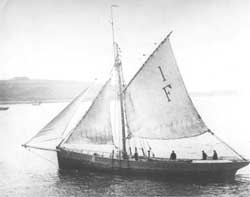
No ships can enter Falmouth without the help of a "Pilot". Vastly experienced people with a wealth of knowledge about the channels that must be manoeuvred in. The Falmouth Pilot's Association started life in the 1870's. A family concern, really. The first pilot was a gentleman called "Mr Vincent" from St. Mawes. The pilots awarded the title of pilot were local boat owners who knew the tides and various obstacles that were hazards to shipping coming into the Falmouth Area. The first photo is an old shot of the "Vincent" named after the original pilot and was typical of the type of craft that would be used.
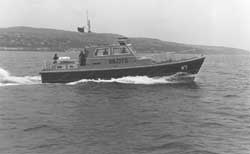
However, over the years the titles of the "Pilot" were handed over to more qualified men, notably those who attained their Masters Ticket in the Merchant Navy. Also this association became part of Trinity House. It was and is a job with many hazards to overcome and one unfortunate and tragic example of this was the ultimate death of a Falmouth Pilot trying to board a ship in difficulty in 1975. He was called Mr Mitchell and the vessel he was boarding was the P&O ferry "Eagle" which ran from Southampton to Spain, Portugal and Tangier. Storms had caused the ship to call into Falmouth for repairs. Above is a photo of the L K Mitchell, a new Pilot boat that was ordered and given his name in his honour. It was built in Scotland and has a Nelson 56 ft Hull (photo circa 1976). The photo shows the proto-type on trials. The head pilot of that time, Capt. Frank Sowden went to oversee some of the work carried out. Although officially retired, he is still actively involved with the Pilots namely with the Harbour commissioners. One very unusual aspect of Captain Sowden's life is that he is a decedent of the Vincent's, so the clock has done a full circle.
Many years ago, whist in the Merchant Navy, it wasn't unusual to be in a port and be asked where I was from. Naturally I was proud to say I was from Falmouth, wondering if the person knew where it was. The reply in many cases would be, " Oh! They've got a good repair yard there, haven't they?". At another time,our ship was visited by a Lloyds Surveyor down in the River Plate. It turned out that he had served his apprenticeship in the Docks as a marine fitter, went to sea, attained his Chief Engineers tickets in both Steam and Diesel and eventually became a surveyor. Strange! These small instances gives one the idea of what the docks is all about.
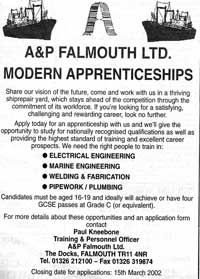
An advert placed in a local paper 2002 asking for applicants for apprenticeships. A very good sign for the industry In 1860, the foundation stone was laid to commemorate the opening of the Docks. All this was recorded in the "Falmouth Packet". One hundred years later, a supplement in the same paper recognized the Docks and what it meant to the town. But, will there be a feature in the "Falmouth Packet" in 2010 to celebrate 150 years? Who Knows? And when the next ship sails, the exhausts are coming from the funnel, and men look at her with pride, will someone say- "That was a Proper Job". |
| Home | Time | Energy | Workforce | Movement | Further Work | Industrial Relations | Dry-docks | Alterations | Aerial Photos | Buildings and Workshops | Personalities | Flow of the Job | Engine Room | War Work | Re-cycling | Sports | Docks Tours | Thoughts on the Docks | Credits and Bibliography | Links | |