|
THE AFTERMATH OF THE QUEEN'S WHARF FIRE The scene of the crane tumbling into the harbour will stick in the memory of many people associated with the fire. After all the trauma of that night and the following weeks it was quite apparent that the Insurance Company were happy to accept it as an unfortunate accident. The probable cause of the fire was discovered after many hours of enquiries, and that was the breakagee of some temporary Halogen lighting fittings that toppled over in the fierce wind that was blowing that may have caused the fire to commence.
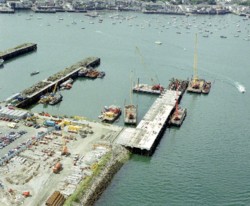
With the insurance side sorted out, the Docks Management were then able to put out for tendering the future rebuilding. Both the Insurance Company and Ship Repair Company looked carefully at the estimates and the eventual 'winner' was a Plymouth based firm called SEASTRUCTURES. To the ordinary man in the street, that name meant nothing but they were a firm which had started in the early 1980's. They already had experience in Civil Engineering work both in the UK and abroad.
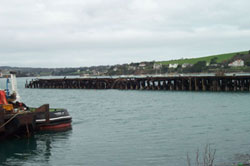
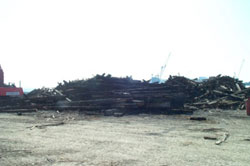
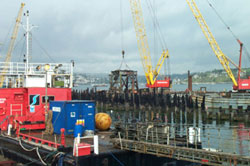
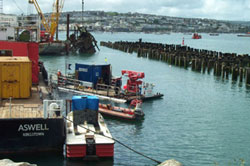
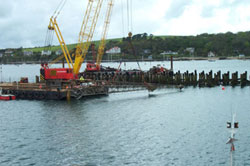
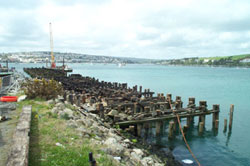
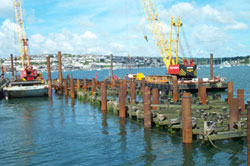
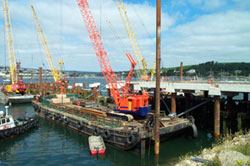
During the middle of March 03, Seastructures moved equipment into the Docks. This included surface cranes, floating cranes, air compressors etc. A small workforce was overseen by a General Manager, Mr Bob Shanks and ably assisted by his Chief Engineer, Mr Duncan James. Mr Shanks, a Scotsman, had that ability to 'get the job done'. One of the first jobs to be done was to remove the old wharf's burnt top timbers and to cut the old existing piles down to at least fifteen feet or roughly five metres. Cross members and ruined timbers were removed completely. This work took somewhere in the region of 5-6 weeks with the help of the workfoce using underwater chain saws.
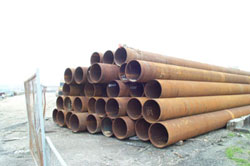
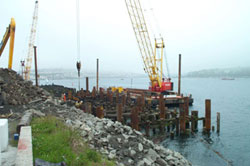
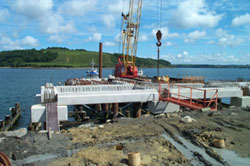
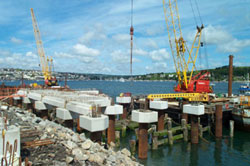
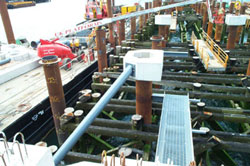
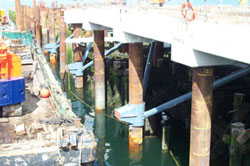
The new main piles of the new structure were of tubular section amd thirty metres in length. They were ordered and delivered by ship from Belgium. These were driven into the sea-bed to a depth of fourteen metres which allows future dredging in the area to allow access for larger draught ships, especially Cruise Liners. The piles were fitted in rows of three interspaced between the remains of the existing piles. Forty two rows of piles were used. Stability brackets were fitted to half of the rows.
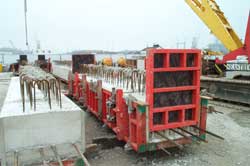
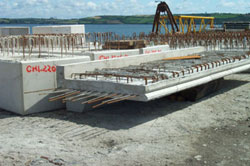
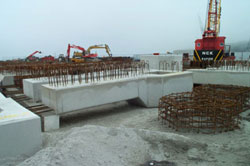
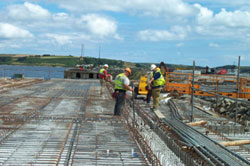
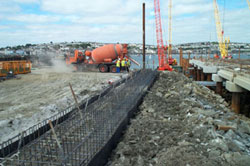
Once the piles were started to be fitted, special formed concrete caps and beams were fitted over the tops of the piles. Another job that had to be accomplished before the piles could be completed was the removal of the remains of the crane from the harbour. Concrete planks were made and fitted to the tops and finally concrete slabs were fitted on top of these. The Contractors produced many of the concrete formed materials in situ in the Docks. Before the final surface was applied to the wharf, provision was made for a set of crane tracks to be installed. The Docks are in the process of looking for a crane.
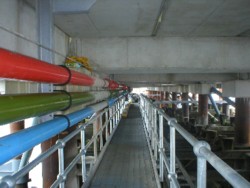
Various other items were installed-Electrical Feeder Pillars (3), new Pipework supplying Fresh Water, Sea Water and Compressed air. Also a supply of Oxygen and Acetylene.
Fitting out of the wharf was completed by a new Floodlight at the end of the wharf,and a complete walkway beneath the wharf and access ladders. All metalwork was carried out and manufactured by their subsidery firm SEAFORGE.Large rubber fenders were fitted-11 on the inboard side of the wharf and 15 on the seaside. New bollards were also installed- 12 inboard and 14 outboard.
The new wharf is now 194 metres in length and 18 metres in width. What you are able to see was accomplished by a workforce, (including sub-contractors) of roughly sixty people.
That the work was accomplished on time is a credit to SEASTRUCTURES. They have created something which some people had doubts about and done it in the time they said it would be done. Thankfully, no-one in the Docks lost their jobs because of the fire. This was a major concern at that time-perhaps paper talk. Indeed the docks have performed all their tasks with a missing wharf majestically. In time, hopefully SEASTRUCTURES will be able to continue their work across to the remains of the Northern Arm. This is, I believe, what A&P have in mind for the future of the Docks. At the end of the day, we've not lost a wharf - just gained a better one.
|
|
| Home | Time | Energy | Movement | Further Work | Industrial Relations | Dry-docks | Alterations | Aerial Photos | Buildings and Workshops | Personalities | Flow of the Job | Engine Room | War Work | Re-cycling | Sports | Docks Tours | Thoughts on the Docks | The Future | Credits and Bibliography | Links | |