X-6
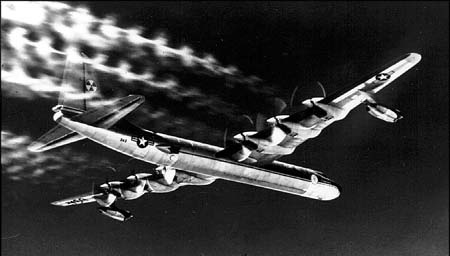
Specifications Company-
Convair Division, General Dynamics
Type-
Modified NB-36H.
Goals- Test Feasibility
of nuclear propulsion.
Primary Testing Facility
Research- Convair Testing Facility
Dimensions-
Span- 230 ft, 0 in; Length- 162 ft, 1 in; Height- 46' 8''
Max Speed-
390 MPH
Range- N/A
Max Altitude-
40,000 ft
Power Plant- Six Pratt &
Whitney R-4360-53 radials of 3,800 lbs of horsepower and four General
Electric J47-GE-19 turbojets of 5,200 lbs of horsepower
Thrust- N/A
Weights-
Fully Loaded: 360,000 pounds
Payload- N/A
Flights-
47
Number of Prototypes Built- 1
Project Tenure- 1955-1957
Project Status- Cancelled Information
The Convair X-6 was a proposed experimental
aircraft which never left the drawing board. In May, 1946, the Nuclear
Energy for the Propulsion of Aircraft (NEPA) project was started by the
Air Force. Studies under this program were done until May, 1951 when
NEPA was replaced by the Aircraft Nuclear Propulsion (ANP) program. The
ANP program contained plans for two B-36s to be modified by Convair
under the MX-1589 project. One of the B-36s was to be used to study
shielding requirements for an airborne reactor while the other was to be
the X-6.
The first modified B-36 was called the Nuclear Test
Aircraft (NTA), a B-36H-20-CF (Serial Number 51-5712) that had been
damaged in a tornado at Carswell AFB on September 1, 1952. This plane
was redesignated the XB-36H, then the NB-36H and was modified to carry a
1,000 kilowatt, air-cooled nuclear reactor. The reactor was operational
but did not power the plane. Its sole purpose was to investigate the
effect of radiation on aircraft systems. The NB-36H completed 47 test
flights between 1955 and 1957. Based on the results of the NB-36H, the
X-6 and the entire nuclear aircraft program was abandoned in 1957.
In the Sixties, the Soviet Union's Tupolev design
bureau, conducted a similar experiment using a Tupolev Tu-119, which was
a Tu-95 bomber modified to carry an operational reactor.
** Information provided by Wikipedia ** |