X-22A
 Specifications Company- Bell
Aerospace
Type- Test viability of ducted lift propellers for VTOL aircraft.
Goals- Research
dual-tandem-ducted propeller.
Primary Testing Facility
Research- Bell, Calspan Test Facilities
Dimensions- Span- 39 ft, 3 in; Length- 39 ft,
7 in; Height: 20 ft, 8 in
Max Speed- 255 MPH
Range-
455 miles
Max Altitude- 27,800 ft
Power Plant- Four General Electric YT58-GE-8D
turboshaft engines with 1,267 hp each
Thrust- N/A
Weights-
Empty: 10,478 lbs; Maximum: 17,644 lbs
Payload- N/A
Flights- 501
Number of Prototypes Built- 2
Project Tenure- 1966-1984
Project Status- Cancelled Information
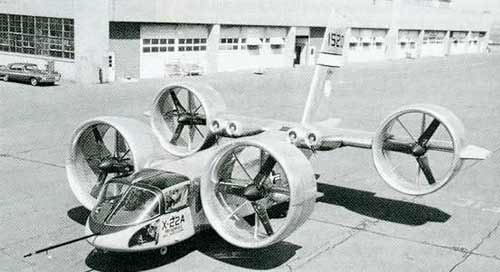
The Bell X-22 was a V/STOL X-plane with four
tilting ducted fans. Take-off was to selectively occur either with the
propellers tilted vertically upwards, or on a short runway with the
nacelles tilted forward at approximately 45�. Additionally, the X-22 was
to provide more insight into the tactical application of vertical
take-off troop transporters, such as the preceding Hiller X-18 as well
as the X-22 successor, the Bell XV-15. Another demand was that, while
flying horizontally, a minimum speed of 525 km/h (283 knots; 326 mph)
was to be attained.
Triple blade propellers were mounted on four wings
and, synchronized through a wave-interconnection system, were connected
to four gas turbines which themselves were mounted in pairs to the rear
wings. Maneuvering was achieved by tilting the propeller blades in
combination with control surfaces (elevators & ailerons), which were
located in the thrust stream of the propellers.
In 1962, the US Navy announced their request for
two prototype aircraft with V/STOL capability, powered by four ducted
fan nacelles. Bell Helicopter already had intensive experience with VTOL
aircraft and was able to utilize an already developed test mockup. In
1964, the prototype, internally referred to by Bell as Model D2127, was
ordered by the Navy and received the X-22 designation.
Maiden flight of the prototype occurred on March
17th, 1966. In contrast to other tilt-rotor craft (such as the Bell
XV-3), transitions between hovering and horizontal flight succeeded
nearly immediately. However, interest increased more towards VTOL and V/STOL
properties, not the specific design of the prototype.
Due to diminished maintenance, the prototype
crashed on August 8th, 1966 and technicians stripped it for components
in order to make the second prototype flight capable. The fuselage was
still used as a simulator for some time afterwards.
The second X-22 first flew on August 26th 1967.
Early that year, it was equipped with a variable flight control and
stabilizer system from Cornell Aeronautical Laboratory, which improved
flight performance. Although the X-22 was considered to be the best
aircraft of its type at the time, the program was cancelled. The
required minimum speed of 525 km/h was never reached. The second
prototype was moved to Cornell Aeronautical Laboratory for further
testing; the last flight occurred in 1988. The craft is currently on
display in the Niagara Aerospace Museum, New York.
Although the ducted fan propellers were considered
usable, they were never utilized again on a US military aircraft.
** Information provided by Wikipedia ** |