X-21A
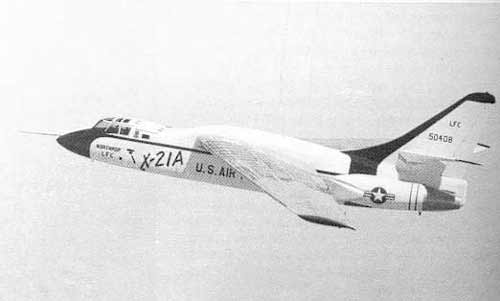 Specifications Company- Northrop
Type- Flight demonstrator for laminar flow control testing.
Goals- Test full-scale
boundary control on large aircraft.
Primary Testing Facility
Research- Edwards AFB
Dimensions- Span- 93 ft, 6 in; Length- 75 ft, 3 in;
Height: 25 ft, 7 in
Max Speed- 560 MPH
Range-
4,780 miles
Max Altitude- 42,500 ft
Power Plant- One General Electric J79-GE-13
Thrust-
18,800 lbf
Weights- Empty: 45,828 lbs;
Fully Loaded- 83,000 lbs
Payload- N/A
Flights- Unknown
Number of Prototypes Built- 2
Project Tenure- 1963-1964
Project Status- Cancelled Information
The Northrop X-21A was an experimental aircraft
designed to test wings with laminar flow control. It was based on the
Douglas WB-66D airframe, with the wing-mounted engines moved to the rear
fuselage and making space for air compressors. The aircraft first flew
on 18 April 1963 with NASA test pilot Jack Wells at the controls.
Although useful testing was
accomplished, the extensive maintenance of the intricate laminar-flow
system caused the end of the program.
Laminar-flow control is a technology that offers
the potential for significant improvement in drag coefficient which
would provide improvements in aircraft fuel usage, range or endurance
that far exceed any known single aeronautical technology. In principle,
if 80% of wing is laminar, then overall drag could be reduced by 25%.
The frictional force between the air and the aircraft surface, known as
viscous drag, is much larger in a turbulent boundary layer than in a
laminar one. The principal type of active laminar-flow control is
removal of a small amount of the boundary-layer air by suction through
porous materials, multiple narrow surface slots, or small perforations.
Two major modifications were required, the first
involving the standard underwing podded J71 engines being removed and
replaced by a pair of 9490 lb.s.t General Electric XJ79-GE-13
non-afterburning turbojets mounted in pods attached to the rear of the
fuselage sides. Bleed air from the J79 engines was fed into a pair of
underwing fairings, each of which housed a "bleed-burn" turbine which
sucked the boundary layer air out through the wing slots.
The X-21A test vehicles (55-0408 and
55-0410) also incorporated sophisticated laminar flow control
systems built into a completely new wing of increased span and area,
with a sweep reduced from 35 � to 30 �. The wing had a multiple series
of span-wise slots (800,000 in total) through which turbulent
boundary-layer was "sucked in," resulting in a smoother laminar flow.
Theoretically, reduced drag, better fuel economy and longer range could
be achieved.
The forward cockpit carried a pilot and two flight
engineers while two additional flight test engineers were housed in a
central fuselage bay underneath the wing.
In initial testing there were significant problems
with the porous materials and surface slots getting plugged with debris,
bugs, even rain. In certain conditions, ice crystals would form due to
the rapid cooling of air over those laminar surfaces abruptly disrupting
laminar flow, causing rapid melting and rapid transition back to laminar
flow. Maximum achievement was 95% laminar flow over those areas desired.
However, the design effort was cancelled due to the plugging problems.
Nevertheless, pioneering data were obtained in the
X-21 flight program, including the effects of surface irregularities,
boundary-layer turbulence induced by three-dimensional spanwise flow
effects in the boundary layer (referred to as spanwise contamination)
and degrading environmental effects such as ice crystals in the
atmosphere.
** Information provided by Wikipedia ** |