X-13
Vertijet
 Specifications Company- Ryan
Aeronautical Company
Type- Testbed for Vertical Take Off and Landing (VTOL) aircraft.
Goals- Test pure-jet
vertical takeoff and landing.
Primary Testing Facility
Research- Edwards AFB
Dimensions- Span- 21 ft,
0 in; Length- 23 ft, 5 in; Height: 15 ft, 2 in
Max Speed- 350 MPH
Range-
192 miles
Max Altitude- 20,000 ft
Power Plant-
One Rolls-Royce "Avon" turbojet
Thrust-
10,000 lbf
Weights- Empty: 5,334 lbs;
Fully Loaded: 6,730 lbs; Maximum: 7,200 lbs
Payload- N/A
Flights- Unknown
Number of Prototypes Built- 2
Project Tenure- 1955-1957
Project Status- Cancelled Information
The Ryan X-13A-RY Vertijet, Ryan Model 69, was an
experimental Vertical Take-Off and Landing aircraft flown in the United
States in the 1950s. The main objective of the project was to
demonstrate the ability of a pure jet to vertically takeoff, hover,
transition to horizontal forward flight, and vertically land.
Just after World War II, Ryan engineers wondered
whether the Ryan/U.S. Navy FR-1 Fireball, which had a thrust-to-weight
ratio of 1 at low fuel quantities, would take off vertically. The Navy's
Bureau of Aeronautics in 1947 awarded Ryan a contract to investigate the
development of a vertically launched jet fighter. This was part of a
program to evaluate the feasibility of submarine-based aircraft. Ryan
conducted remote controlled VTOL tethered rig tests from 1947 to 1950
and a flying rig in 1951. Ryan was awarded an Air Force contract in 1953
to develop an actual flying jet-powered VTOL aircraft, which was given
the designation X-13. Two prototypes were built.
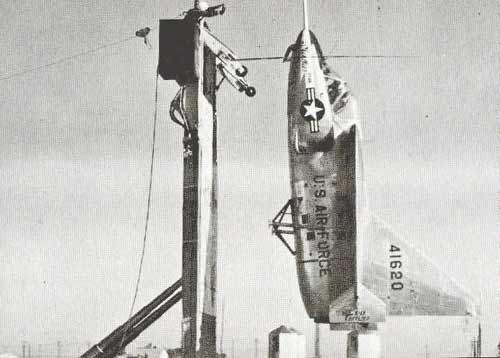
The Ryan X-13 Vertijet was 23 ft 5 in (7.14 m)
long. It was just large enough to accommodate the single place cockpit
(with a tilted seat) and the 10,000 lbf (45 kN) thrust Rolls-Royce Avon
turbojet. The high mounted delta wing of the aircraft had a wingspan of
only 21 ft (6.4 m) and was capped with flat endplates. The nose of the
aircraft had a hook on the underside and a short pole for gauging
distance from the trailer. The hook was used to hang the Vertijet from
the vertical trailer bed landing platform. After the aircraft was
secured vertically, the trailer was lowered to horizontal and then used
to transport the aircraft on the ground. Pitch and yaw control in hover
were provided by vectored engine thrust. Roll control was provided by
"puffer" jets mounted outboard of the wingtip endplates. The first
prototype (#54-1619) was fitted with temporary landing gear and made its
first horizontal flight on December 10, 1955. Later, it made full
horizontal to vertical attitude conversions and back again at altitude.
The first prototype then had the landing gear replaced with a tail
mounted framework that held it in a vertical attitude on the ground.
Using this rig, hooking practice was conducted. The second prototype
(#54-1620), on April 11, 1957, made a vertical take-off from the
vertically raised trailer, transitioned to horizontal flight and back
again. It then returned to the vertical trailer and landed by hooking
the landing wire.
On July 28-July 29, 1957, the X-13 was demonstrated
in Washington, D.C. It crossed the Potomac River and landed at the
Pentagon.
The Air Force chose not to continue development of
the Ryan X-13 Vertijet because of the lack of an operational
requirement.
The X-13 was designed to investigate vertical
takeoff, horizontal flight transition, and return to vertical flight for
landing. The first prototype of the X-13 was equipped with temporary
tricycle landing gear. The X-13 was flown conventionally on December 10,
1955 to test its aerodynamic characteristics. The Vertijet was then
fitted with a temporary "tail sitting" rig. On May 28, 1956, it was
flown from the ground in a vertical position to test its hovering
qualities. The X-13 VertiJet completed its first full-cycle flight at
Edwards AFB, California on April 11, 1957, when it took off vertically
from its mobile trailer, angled over into a horizontal attitude, and
flew for several minutes. The X-13 then transitioned to vertical flight
and slowly descended back onto its trailer and landed.
The two X-13 aircraft are now on display at
aviation museums. The Vertijet which made the full-cycle flight on April
11, 1957 (#54-1620), was transferred to the National Museum of the
United States Air Force, Dayton, Ohio in 1959. Prototype #54-1619 is on
display at the San Diego Air and Space Museum.
** Information provided by Wikipedia ** |