X-19
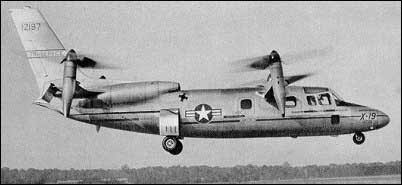 Specifications Company- Curtiss-Wright
Type- Testbed for tilt-rotor VTOL aircraft designs using radial lift propellers.
Goals- Test VTOL
technology using radial lift.
Primary Testing Facility
Research- Caldwell; NAFEC, NJ
Dimensions- Span- 21 ft, 6 in; Length- 42 ft, 1 in;
Height: 17 ft, 2 in
Max Speed- 454 MPH
Range-
325 miles
Max Altitude- N/A
Power Plant- Two
Avco Lycoming T55-L-5 turboshaft engines with 2,200 shp each
Thrust- N/A
Weights-
Maximum: 13,660 lbs
Payload- 1,200 lbs
Flights- 50
Number of Prototypes Built- 2
Project Tenure- 1964-1965
Project Status- Cancelled Information
The Curtiss-Wright X-19 was an American
experimental VTOL Tiltrotor aeroplane of the early 1960s.
In March 1960 the Curtiss-Wright corporation
developed the X-100 - a prototype for a new, vertical take-off transport
aircraft. The X-100 had a single engine, which propelled two
tilting-rotors, while at the tail swivelling nozzles used the engines
exhaust gases to give additional control in hovering or slow flight.
From the X-100 Curtiss-Wright developed the larger
X-200, of which the US Air Force ordered two prototypes designated the
X-19A.
The X-19 was a high-wing monoplane with two sets of
wings. Each wing mounted a 13 ft (4 m) propeller that could be rotated
through 90 degrees allowing the aircraft to take off and land like a
helicopter. The propellers were driven by twin Avco Lycoming T55-L-5
engines mounted in the fuselage.
The first flight of the X-19 took place in November
1963 (other sources give 26 June 1964). It was intended that the X-19
would be developed into a VTOL transport aircraft. However the first
X-19 was destroyed in a crash on 25 August 1965, and the program was
subsequently cancelled. The second prototype is currently being stored
in the restoration facilities at the National Museum of the United
States Air Force in Dayton, Ohio.
** Information provided by Wikipedia ** |