X-50A
Dragonfly
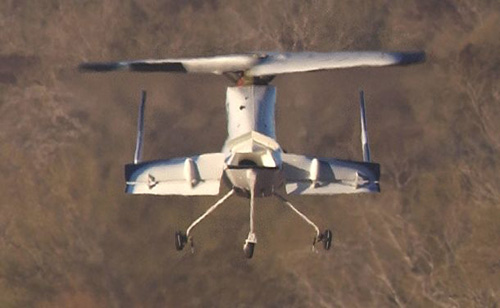 Specifications Company-
The Boeing Company
Type- Canard
Rotor/Wing (CRW).
Goals- Demonstrate the
principle that a helicopter's rotor can be stopped din flight and act as
a fixed wing.
Primary Testing Facility
Research- US Army Proving Ground; Yuma, AZ
Dimensions-
Span- 12 ft, 0 in; Length- 17 ft, 8 in; Height- 6 ft, 6 in
Max Speed-
435 MPH
Range- N/A
Service Ceiling- N/A
Power Plant-
One Williams Research F-112
Thrust- N/A
Weights-
Empty: 1,265 lbs; Maximum: 1,422 lbs
Payload-
200 lbs
Flights- 9
Number of Prototypes Built-
2
Project Tenure- 2003-2006
Project Status-
Cancelled Information
The Army, Navy and Marine Corps have a need for
affordable, survivable, vertical take-off and landing (VTOL) air
vehicles to support dispersed units in littoral and urban areas. The
Canard Rotor/Wing (CRW) program explores innovative VTOL technologies
and concepts with the potential for significant performance improvements
that would satisfy stressing mission needs. One such concept is the
advanced Canard Rotor/Wing (CRW) aircraft, that offers the potential for
a high speed rapid response capability from a VTOL unmanned air vehicle
with significant range and stealth improvements as compared to other
VTOL concepts. Design and fabrication of this scaled vehicle concept
will validate the command and control, stability and control system and
aerodynamic performance required for vertical take-off, landing and
hover via a rotating center wing that stops and locks in place for
efficient high speed cruise.
An operational CRW UAV would be able to take off
and land in confined areas without a launch or recovery system, rapidly
transition to and from a fixed wing mode and fly at speeds in access of
375 knots. The flexibility achieved through these various flight modes,
combined with the high-speed performance and survivability of this
revolutionary new concept makes the CRW an exciting option for manned
and unmanned applications.
Boeing has leveraged specific expertise that was
developed during the company's previous work on reaction drive rotor
systems, including both the XH-17 in the early 1950s and the XV-9A in
the mid-1960s. The Boeing patented CRW concept is an outgrowth from
these previous activities.
In response to a Navy requirement for an unmanned,
high-speed, ship-based vertical take off and landing (VTOL), McDonnell
Douglas Helicopter developed a concept called Canard-Rotor-Wing (CRW).
The CRW is a stoppable-rotor design which can hover and fly at
low-speeds like a conventional helicopter, whereas in its stopped-rotor
mode it can fly at high speeds comparable to those of fixed-wing
aircraft. Initial concepts include a land- or ship-based medium-range
vertical takeoff and landing, remotely piloted vehicle. An operational
CRW UAV would be able to take off and land in confined areas without a
launch or recovery system, rapidly transition to and from a fixed wing
mode and fly at speeds in access of 375 knots.
The CRW is propelled in both rotary-wing and
fixed-wing modes using a conventional turbofan engine. A diverter valve
directs the exhaust gas produced by the engine either to the rotor or
aft to the jet thrust nozzle, or to both during transition. A two-bladed
teetering rotor is used to generate the required lift for hover and
low-speed forward flight. The CRW would spin a center wing to take off
like a helicopter.The vehicle would then accelerate to about 120 knots
when flaps would deploy from the front and rear wings. Once the
rotorcraft is at a sufficient forward velocity, the required lift
generation is transferred from the rotor to a canard and horizontal
tail. Flap deployment would off load the spinning center wing, which
could then stop rotation and be locked into a position across the
fuselage to perform as a third wing. The flaps on the other two wings
would then be retraced and all three wings would share the lift loads in
a fixed wing flight mode. A reverse of these events would transition the
CRW back to its rotary wing--VTOL mode for landing on small landing
areas.
By using a reaction-drive rotor system, the CRW
concept eliminates the need for a mechanical drive train and
transmission, as well as the need for an anti-torque system. Eliminating
these typically heavy, maintenance-intensive systems will greatly reduce
vehicle weight, maintenance, complexity, and cost. Because the CRW's
rotor is stopped to allow high-speed forward flight, the rotor's airfoil
cross section must be elliptical. This is a compromise between the
optimum airfoil shape for conventional rotor flight and that for
high-speed stopped-rotor flight.
Possible manned and unmanned missions for such a
vehicle include reconnaissance, communications and data relay, logistics
re-supply, urban operations and delivery of both lethal and non-lethal
munitions. The Navy and Marine Corps have expressed a strong interest in
the CRW concept for both tactical UAV applications requiring VTOL
operations from small-deck ships and manned applications such as a V-22
Osprey escort. They have funded a portion of the research activities to
date and are considering transitioning this technology into a UAV
engineering, manufacturing, and development phase following its
successful flight demonstration.
In June 1998 a $24 million agreement between the
Defense Advanced Research Projects Agency (DARPA) and The Boeing Company
funded a 37 month effort by the Boeing Phantom Works to design, build
and fly two technology demonstrators to assess and validate this
advanced rotorcraft. DARPA and Boeing agreed to a 50/50 cost share
agreement to validate this revolutionary concept in a joint advanced
technology demonstration program known as "Dragonfly". Each contributed
$12 million toward the program, initially planned to lead to flight
demonstration in early 2001.
Development of the technology demonstrators is
being conducted by Phantom Works personnel in Mesa, Ariz., St. Louis,
Mo., as well as several other Boeing facilities. Final assembly is now
under way at the Mesa facility, with a first flight expected in 2002.
On 04 December 2003 the Boeing Company's Canard
Rotor/Wing (CRW) concept demonstrator completed its first hover flight
at the U.S. Army Proving Ground in Yuma, Ariz. During the flight test,
the CRW advanced technology demonstrator � known as the X-50A Dragonfly
� flew for about 80 seconds at 8:10 a.m. MST. It lifted off vertically
from the launch site to an altitude of 12 feet above the ground, hovered
and then vertically landed, commencing the flight test program.
The unmanned X-50A CRW has a length of 17.7 feet
and is 6.5 feet high. The rotor blades have a diameter of 12 feet.
Powered by a conventional turbofan engine, the X- 50A will utilize
diverter valves to direct thrust to the rotor blade tips (for helicopter
mode), or aft to the jet nozzle (for fixed wing mode). Dual bleed thrust
will be used during transition. By directing thrust through the rotor
tips, the CRW concept eliminates the need for a heavy and complex
mechanical drive train, transmission and anti-torque system. The CRW
will be much lighter and simpler than traditional rotorcraft and will
therefore be much cheaper to operate and support.
Follow-on CRW versions could evolve into larger,
piloted vehicles capable of conducting specialized missions, including
reconnaissance, armed escort, urban operations, tactical air support,
communications/data relay and resupply. With such flexibility,
operations could originate from small-deck ships or forward bases.
Aviation enthusiasts may have noticed that the X-50
designation was not the next in line. But Boeing's X-50 program manager
Steve Bass said that Boeing got the number out of sequence by special
request because the X-50 designation is so fitting for the CRW concept -
50 percent helicopter and 50 percent airplane.
** Information provided by GlobalSecurity.org ** |