X-53 Active Aeroelastic Wing
 Specifications Company-
The Boeing Company
Type- Active
Aeroelastic Wing (AAW) demostrator.
Goals-
Active Aeroelastic Wing demonstrator combines
aerodynamics, active controls and advanced structures to make more
efficient use of the wing planform during high-speed maneuvers.
Primary Testing Facility
Research- NASA Dryden Flight Research Center
Dimensions-
N/A
Max Speed- N/A
Range-
N/A
Service Ceiling- N/A
Power Plant- N/A
Thrust- N/A
Weights-
N/A
Payload- N/A
Flights- N/A
Number of Prototypes Built-
1
Project Tenure- 2002-????
Project Status-
Ongoing Information
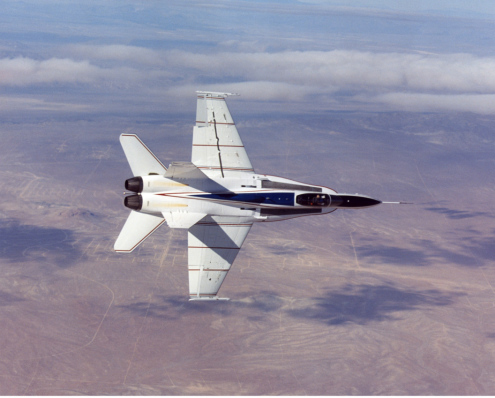
The Active Aeroelastic Wing (AAW)
development program is a current research project being undertaken
jointly by the Air Force Research Laboratory (AFRL), Boeing Phantom
Works and NASA Dryden Flight Research Center, where the technology is
being flight tested on a modified F/A-18 Hornet, designated the X-53.
AAW combines aerodynamics, active controls and
advanced structures to make more efficient use of the wing planform
during high-speed maneuvers. This is achieved through the use of
multiple leading and trailing edge control surfaces, which are
controlled by a digital flight control system to take advantage of the
wings' natural tendency to twist under air load. At high speeds, these
control surfaces are able to achieve high levels of control power while
minimizing structural loads. When applied correctly, the wing will twist
less and in an opposite direction to a conventional wing during
maneuvering.
The modified F/A-18 first flew in November, 2002.
It was redesignated X-53 on August 16, 2006, per memo by USAF Deputy
Chief of Staff, Strategic Plans and Programs.
** Information provided by Wikipedia ** |