X-46A
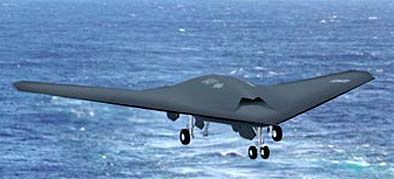 Specifications Company-
The Boeing Company
Type- Carrier-based unmanned combat air vehicle (UCAV).
Goals- F/A-18 "manned
surrogate" to test a low-cost approach to the US Navy's naval unmanned
combat air vehicle (UCAV-N) demonstrator.
Primary Testing Facility
Research- Unknown
Dimensions-
Span- 44 ft, 0 in; Length- 34 ft, 0 in; Height- 7 ft, 0 in
Max Speed- N/A
Range-
650 nautical miles
Service Ceiling- N/A
Power Plant- N/A
Thrust- N/A
Weights-
N/A
Payload-
4,000 lbs
Flights- N/A
Number of Prototypes Built-
N/A
Project Tenure- 2001-2003
Project Status-
Unknown Information
The UCAV-Navy X-46/X-47 is a program for the Navy
version of a UCAV that can be carrier-based. Apart from SEAD missions,
RECCE and strike will be among the platform�s capabilities.
The X-46 designation was assigned to Boeing in 2001
to encompass a "low-cost approach" to the US Navy's planned naval
unmanned combat air vehicle (UCAV-N) technology demonstration. An F/A-18
was to be used as a "manned surrogate" in this effort, which includes
surveillance and operations from aircraft carriers.
Boeing had kept its X-46 UCAV-N activities under
wraps, while Northrop Grumman had showcased its work on the X-47 UCAV-N,
which the company calls Pegasus. According to one report, the X-46 UCAV-N
was to be approximately 34 feet long, with a 44 foot wingspan, and a
height of 7 feet. Two large internal bays would allow the stealthy
aircraft to carry up to 4000 pounds of munitions up to 650 nautical
miles for SEAD or strike missions. Or, equipped with advanced sensors
only, the vehicle could perform surveillance missions for up to 12
hours.
As the small UCAV aircraft were being demonstrated
for the first time, the tactical environment was changing. In Operation
Enduring Freedom, both the Air Force and the Navy experienced very long
transit times associated with air combat in a remote region. Crews found
themselves flying thousands of miles just to get to the combat zone. In
addition, the Defense Department was becoming ever more aware of the
hazards of anti-access threats � those enemy capabilities which might
prevent the establishment of either land- or sea-based tactical units in
a threatened region. One result was evolution of the Air Force UCAV
design to provide more range and persistence in the battle space. To
answer the Air Force need, the Boeing team created the X-45C, based
partly on its X-46 design that had been developed for the UCAV-N.
** Information provided by GlobalSecurity.org ** |