X-34
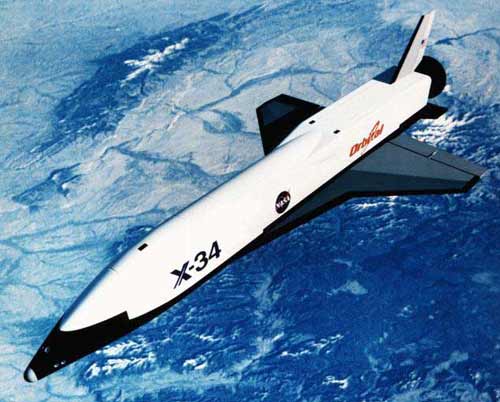 Specifications Company- Orbital Sciences Corporation
Type- Aircraft launched space transport vehicle.
Goals- Reusable
technology testbed vehicle to demonstrate technologies for lowering the
cost of access to space. Goals included speeds up to Mach 8 and
altitudes of 250,000 feet, with $500,000 per a flight recurring cost at
a rate of 24 flights in 12 months while maintaining a small work force.
Primary Testing Facility
Research- Edwards AFB
Dimensions-
Span- 28 ft; Length- 58 ft; Height: 12 ft
Max Speed- Mach 8
Range- N/A
Max Altitude- 90,000 ft
Service Ceiling- 250,000 ft
Power Plant- One Fastrac LOX/kerosene engine
Thrust- 60,000 pounds
Weights-
Empty: 18,000 lbs; Fully Loaded: 48,000 lbs
Payload- N/A
Flights- N/A
Number of Prototypes Built- 3
Project Tenure- 1996-2001
Project Status- Cancelled Information On August 28, 1996, NASA awarded to Orbital Sciences Corporation (OSC) a contract for the design, development, and testing of the X-34 technology testbed demonstrator vehicle. First flight was scheduled before the end of 1998. The intent of the X-34 program is to demonstrate "key technologies" integratable to the Reusable Launch Vehicle program. This vehicle was conceived as a bridge between the Clipper Graham (DC-XA) and the X-33. The contract is managed by the Marshall Space Flight Center. (MSFC) The objective of the X-34 program is flight demonstration of key reusable launch vehicle operations and technologies directed at the reusable launch vehicle goals of low-cost space access and commercial space launch competitiveness. The vehicle is being designed and developed by Orbital Sciences Corporation. It will be powered by a government-furnished engine. The main engine is a 60,000 pound thrust version of the Fastrac LOX/kerosene engine being developed by the Marshall Space Flight Center. This is a simple engine which uses a gas generator cycle, and a single turbopump based on the previously developed Marshall Simplex LOX pump. The X-34 is considerably smaller and lighter than the X-33. It is capable of hypersonic flight to Mach 8, compared with the X-33's Mach 15. Consequently, it is considerably less expensive and simpler to develop, to operate, and to modify for flight experiments. It has different embedded technologies and a different operational concept. The flight testing will focus on RLV-type operations, the embedded technologies, and technology test articles to be carried as experiments. Test-bed instrumentation will satisfy the needs for the embedded technologies demonstration, and for some additional experiments to be carried. Additional instrumentation requirements will be dictated by the demands of the experiments to be conducted. This test-bed vehicle is designed to be air-launched from Orbital Science's L-1011 aircraft, then accelerated to speeds up to Mach 8, reaching altitudes up to 250,000 feet. It will land horizontally on a conventional runway. The X-34 will have a wing span of 27.7 feet and is 58.3 feet long. The modular X-34 design permits easy engine removal and replacement. It may be adaptable for subsequent testing of more advanced propulsion technologies such as rocket based combined cycle, plug nozzle, pulse detonation wave rocket, and dual expansion engines. The X-34 program is divided into two phases: In Phase I, the vehicle will be designed and built, and two envelope expansion flights limited to Mach 3.8 will be made. In Phase II, 25 flight throughout the range of achievable speeds will be undertaken during a 12-month period, from locations selected to assure operational experience over a variety of weather and environmental conditions. ** Information provided by Federation of American Scientists ** |