X-20 Dyna-Soar
 Specifications Company- Boeing
Type- Proposed delta-wing space glider.
Goals- Piloted orbital
flight; provide heat materials testing.
Primary Testing Facility
Research- None
Dimensions- Span- 20 ft,
10 in; Length- 35 ft, 4 in; Height: 8 ft, 6 in
Max Speed-
17,500 MPH
Range- 22,000 nautical miles
Max Altitude-
530,000 ft
Power Plant- One Matrin
Trans-stagerocket
Thrust- 72,000 lbf
Weights-
Empty: 10,395 lbs; Maximum: 11,387 lbs
Payload- N/A
Flights- 0
Number of Prototypes Built- 0
Project Tenure-
1957-1963
Project Status- Cancelled Information
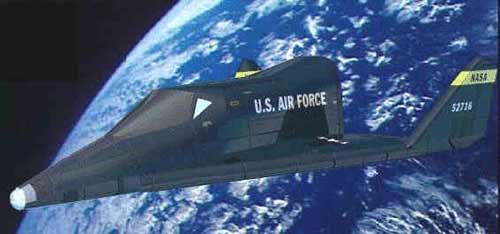
The X-20 Dyna-Soar ('Dynamic Soarer') was a United
States Air Force (USAF) program to develop a spaceplane that could be
used for a variety of military missions, including reconnaissance,
bombing, space rescue, satellite maintenance, and sabotage of enemy
satellites. The program ran from 24 October 1957�10 December 1963, cost
US$660 million, and was canceled just after spacecraft construction had
begun.
Other spacecraft under development at the time,
such as Mercury or Vostok, were based on space capsules which returned
on ballistic re-entry profiles. Dyna-Soar was much more like the much
later Space Shuttle: it could not only be boosted and travel to distant
targets at the speed of an Intercontinental ballistic missile, but it
was designed to glide to earth like an airplane under the control of the
pilot. He could land at an airfield, rather than simply falling to earth
and landing with a parachute. Dyna-Soar could also reach earth orbit,
like the Mercury or Gemini.
This made Dyna-Soar far more advanced in concept
than the other human spaceflight missions of the period. It had military
missions other than simply placing one or two men into space. It is one
of the great "what if" projects of early spaceflight. Data collected
during the X-20 program would prove useful in designing the Space
Shuttle. The much larger Shuttle would also be boosted into orbit by
large rockets for launch, and the final design would also pick delta
wings for controlled landings, but it (and a similar Soviet design,
Buran) would not fly until decades after the X-20 cancellation.
The development of Dyna Soar can be traced back to
Eugen S�nger's Silbervogel: a German bomber project of World War
II. The concept was to create a rocket-powered bomber that could travel
vast distances by gliding to its target after being boosted to high
speed (>5.5km/s) and high altitude (50-150km) by A-4 or A-9 rocket
engines.
An acknowledged inspiration of the Dyna-Soar was
Tsien Spaceplane 1949. Army Airforce Colonel Dr. Tsien Hsue-shen
developed the idea after spending time in Germany examining the V2 and
other rockets.
Essentially, these rocket engines would place the
vehicle onto an exoatmospheric ICBM-like trajectory and then fall away.
However, when the vehicle reentered the atmosphere instead of fully
reentering, bleeding off its speed and landing, the vehicle would use
its wings and some of its speed to generate lift and bounce the vehicle
back into space again. This would repeat until the speed was low enough
that the pilot of the vehicle would need to pick a landing spot and
glide the vehicle to a landing. This use of hypersonic atmospheric lift
meant that the vehicle could greatly extend its range over a ballistic
trajectory using the same engines.
Such boost-glide systems could potentially strike
at targets anywhere in the world (so called 'antipodal bombers') at
hypersonic speeds, be very difficult to intercept, and the aircraft
itself could be small and poorly armed, compared to a typical heavy
bomber. In addition, a boost-glide aircraft may be recoverable, acting
as a manned bomber, or as an unmanned non-recoverable missile.
Following the war, many German scientists were
taken to the United States by the CIA's "Operation Paperclip". Among
them was Dr Walter Dornberger, the former head of Germany's wartime
rocket program, who had detailed knowledge of the Silbervogel project.
Working for Bell, he attempted to create interest in a boost-glide
system in the USAF, and elsewhere. This resulted in the USAF requesting
a number of feasibility and design studies � carried out by Bell,
Boeing, Convair, Douglas, Martin, North American, Republic and Lockheed
� for boost-glide vehicles during the early 1950s:
- Bomi (bomber missile),
- Hywards (hypersonic weapons research and
development supporting system),
- The Brass Bell reconnaissance vehicle and
- Rocket Bomber "Robo".
In 24 October 1957, the USAF Air Research and
Development Command issued a proposal for a "Hypersonic Glide Rocket
Weapon System" (Weapons System 464L): Dyna Soar. The proposal drew
together the existing boost-glide proposals � as the USAF believed that
a single vehicle could be designed to carry out all the bombing and
reconnaissance tasks intended for the separate studies, and act as
successor to the X-15 research program. The Dyna-Soar program was to be
conducted in three stages: a research vehicle (Dyna-Soar I), a
reconnaissance vehicle (Dyna-Soar II, previously Brass Bell), and a
vehicle that would add strategic bombing capability (Dyna-Soar III,
previously Robo). The first glide tests for Dyna-Soar I were expected to
be carried out in 1963, followed by powered flights, reaching Mach 18,
the following year. A robotic glide missile was to be deployed in 1968,
with the fully operational weapons system (Dyna-Soar III) expected to be
deployed by 1974.
In March 1958, nine U.S. aerospace companies
tendered for the Dyna-Soar contract. Of these, the field was narrowed to
proposals from Bell and Boeing. Even though Bell had the advantage of
six years' worth of design studies, the contract for the spaceplane was
awarded to Boeing in June 1959 (by which time their original design had
changed markedly and now closely resembled what Bell had submitted). In
late 1961, the Titan III was eventually finalized as the launch vehicle.
The Dyna-Soar was to be launched from Cape Canaveral Air Force Station,
Florida.
In April, 1960, seven astronauts were secretly
chosen for the Dyna-Soar program. Neil Armstrong and Bill Dana left the
program in the summer of 1962. On September 19, 1962, Albert Crews had
been added to the Dyna-Soar program and the names of the six Dyna-Soar
astronauts were announced to the public:
- Neil Armstrong (NASA) 1960-62
- Albert H. Crews, Jr. (Air Force) 1962-63
- Bill Dana (NASA) 1960-62
- Henry C. Gordon (Air Force) 1960-63
- Pete Knight (Air Force) 1960-63
- Russell L. Rogers (Air Force) 1960-63
- Milt Thompson (NASA) 1960-63
- James W. Wood (Air Force) 1960-63
By the end of 1962, Dyna-Soar had been given the
designation "X-20", the acceleration rocket (to be used in the Dyna Soar
I drop-tests) had been successfully fired, and the USAF had held an
"unveiling" ceremony for the X-20 in Las Vegas.
Besides the funding issues that often accompany
research efforts, the Dyna-Soar program suffered from two major
problems: uncertainty over the booster that would be used to send the
craft into orbit, and a lack of a clear goal for the project.
Many different boosters were proposed to launch
Dyna-Soar into orbit. The original USAF proposal suggested a LOX/JP-4,
fluorine-ammonia, fluorine-hydrazine, or an RMI (X-15) engine. Boeing,
the principal contractor, favored an Atlas-Centaur combination, but
eventually the Air Force stipulated that a Titan-based approach �
suggested by failed competitor Martin � would be used. However, the
Titan I rocket would not be powerful enough to launch the five-tonne
X-20 into orbit. The Titan II and Titan III boosters could launch Dyna-Soar
into Earth orbit, as could the Saturn C-1 (later renamed the Saturn I),
and all were proposed with various upper-stage and booster combinations.
While the Titan IIIC was eventually chosen to send Dyna-Soar into space,
the vacillations over the launch system delayed the project as it
complicated planning.
The original intention for Dyna Soar, outlined in
the Weapons System 464L proposal, called for a project that combined
aeronautical research with weapons-system development. Many questioned
whether the USAF should have a manned space program, when that was the
primary domain of NASA. However, it was frequently emphasised by the Air
Force that, unlike the NASA programs, Dyna-Soar allowed for controlled
re-entry, and this was where the main effort in the X-20 program was
placed. On 19 January 1963 the Secretary of Defense, Robert McNamara,
directed the Air Force to undertake a study to determine whether the
Gemini or Dyna-Soar program was the more feasible approach to a
space-based weapon system. In the middle of March 1963, after receiving
the study, Secretary McNamara "stated that the Air Force had been
placing too much emphasis on controlled re-entry when it did not have
any real objectives for orbital flight" (Geiger, 1963). This was seen as
a reversal of the Secretary's earlier position on the Dyna-Soar program.
Dyna-Soar was also an expensive program that would not launch a manned
mission until the mid-1960s at the earliest. This high cost and
questionable usefulness made it hard for the Air Force to justify the
program. Eventually, the X-20 Dyna-Soar program was cancelled on
December 10, 1963.
The X-20 was to have been replaced by the Manned
Orbiting Laboratory, a spin-off of the Gemini program, but this too was
eventually canceled.
The overall design of the X-20 Dyna-Soar was
outlined in March 1960. It had a low-wing delta shape, with winglets for
control rather than a more conventional tail. The framework of the craft
was to be made from the Ren� 41 "super alloy", as were the upper surface
panels. The bottom surface was to be made from molybdenum sheets placed
over insulated Ren� 41, while the nose-cone was to be made from graphite
with zirconia rods.
Due to the changing requirements, various forms of
the Dyna-Soar were designed but with all variants sharing the same basic
shape and layout. A single pilot sat at the front, while an equipment
bay was situated behind. This bay contained either data-collection
equipment, weapons, reconnaissance equipment, or (in the X-20X "shuttle
space vehicle") a four-man mid-deck.
After the equipment bay was the transition-stage
rocket engine, which was used to maneuver the craft in orbit or fired
during launch as part of an abort. This trans-stage would be jettisoned
before descent into the atmosphere. While falling through the atmosphere
an opaque heat shield would protect the window at the front of the
craft. This would then be jettisoned after aerobraking so the pilot
could see, and safely land.
A drawing in Space/Aeronautics magazine from before
the project's cancellation depicts the craft dipping down into the
atmosphere, skimming the surface, to change its orbital inclination. It
would then fire its rocket to resume orbit. This would be a unique
ability for a spacecraft, for the laws of celestial mechanics mean that
it is much more difficult for a rocket to do this once in orbit. Hence
the Dyna-Soar could have had a military capacity of being launched into
one orbit and rendezvousing with a satellite even if the target were to
expend all its propellant in changing its orbit. Acceleration forces on
the pilot, however, would be severe.
Unlike the later Space Shuttle, Dyna-Soar did not
have wheels on its undercarriage as it was thought that the rubber
wheels would burn during re-entry. Instead Goodyear developed
retractable wire-brush skis made of the same Ren� 41 alloy as the
air-frame.
** Information provided by Wikipedia ** |