X-14/X-14A/X-14B
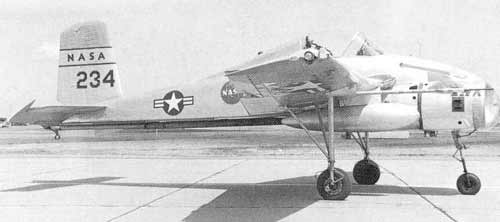 Specifications Company- Bell
Aircraft
Type- Testbed for Vertical Take Off and Landing (VTOL) aircraft and provided concept of thrust vectoring.
Goals- Test VTOL
technology.
Primary Testing Facility
Research- Moffet Field
Dimensions- Span- 34 ft, 10 in; Length- 25 ft, 0 in;
Height: 8 ft, 0 in
Max Speed- 172 MPH
Range-
300 miles
Max Altitude- 20,000 feet
Power Plant- Two Armstrong-Siddeley Viper 8 turbojets
Thrust-
3,500 lbf
Weights- Maximum: 4,269 lbs;
Loaded: 3,100 lbs
Payload- N/A
Flights- Unknown
Number of Prototypes Built- 1
Project Tenure- 1957-1981
Project Status- Cancelled Information
The Bell Aircraft Company constructed the X-14 as
an open-cockpit, all-metal monoplane. It was powered by two Armstrong
Siddeley Viper turbojet engines equipped with thrust deflectors sited at
the aircraft's centre of gravity. The engines are stationary during all
stages of flight. The transition from vertical to horizontal flight is
achieved with a system of movable vanes that control the direction of
engine thrust. Top speed is 180 miles per hour and a maximum ceiling of
20,000 feet. The X-14 was designed using existing parts from two Beech
aircraft. The wings, ailerons, and landing gear of a Beech Bonanza and
the tail sections of a Beech T-34 Mentor airplane.
The X-14 took its first flight on 19 February, 1957
as a vertical takeoff, hover, then vertical landing. The first
transition from hover to horizontal flight occurred on 24 May, 1958. In
1959, its Viper engines were replaced with General Electric J85 engines.
That year the aircraft was also delivered to the NASA Ames Research
Center as the X-14A. It served as a test aircraft with NASA until 1981.
The X-14 project provided a great deal of data on
VTOL (Vertical TakeOff and Landing) type aircraft. The X-14A also was
used by NASA for research on lunar landing maneuvers. The X-14A aircraft
flight control system was similar to the one proposed for the Lunar
Module. Neil Armstrong once flew it as a Lunar-landing trainer.
In 1971, the X-14A was fitted with new engines and
redesignated the X-14B. The two new powerplants were GE J85-GE-19s. An
onboard computer and digital fly-by-wire control system was also
installed to enable emulation of landing characteristics of other VTOL
aircraft.
The X-14B was used in this test role until it was
damaged beyond repair in a landing accident on 29 May, 1981. At the
time, there were plans to develop an X-14C with an enclosed cockpit.
There were also plans for an X-14T trainer. None of these further
versions got beyond the planning stage.
During all of its years of service, the X-14 was
flown by over 25 pilots with no serious incidents or injuries. It was
the only open cockpit X-plane.
** Information provided by Wikipedia ** |