X-32A/X-32B/X-32C Joint Strike Fighter (JSF)
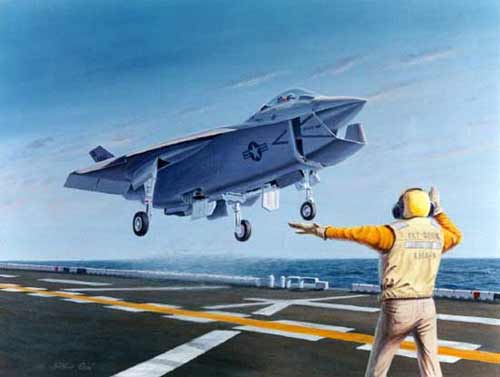 Specifications Company- Boeing
Type- Multi-service single-seat, fighter/bomber.
Goals- X-32A first
contractor team full-scale technology demonstrator aircraft intended to
validate technologies relevant to fielding a multi-service aircraft.
X-32B full-scale technology demonstrator aircraft intended to validate
technologies relevant to fielding a multi-service aircraft. X-32C Joint
Advanced Strike Technology (JAST) program full-scale technology
demonstrator aircraft intended to validate technologies relevant to
fielding a multi-service aircraft with catapult and arresting
capability.
Primary Testing Facility
Research- Edwards AFB
Dimensions- Span- 36 ft; Length- 47 ft; Height- 13 ft
Max Speed-
Mach 1.6
Range- 850 nautical miles
(USAF); 750 nautical miles (USN); 594 nautical miles (USMC/RN)
Max Altitude-
N/A
Power Plant-
One Pratt & Whitney F135 afterburning turbofan engine
Thrust- 39,800 lbf
Weight- Empty:
22,500 lbs; Maximum: 38,000 lb
Payload- Internally mounted single barrel
20-mm M61A-2 or 27-mm Mauser BK-27 cannon; Internal: 6 AMRAAM air-to-air
missiles or 2 AMRAAM air-to-air missiles and 2 2,000 lb class guided
bombs; External: 15,000 lb of full range stores including guided
weapons, anti-radiation missiles, air-to-surface weapons, and auxiliary
fuel tanks.
Flights- N/A
Number of Prototypes Built- 2
Project Tenure- 2000-2002
Project Status- Cancelled Information
The Joint Strike Fighter (JSF) is a multi-role
fighter optimized for the air-to-ground role, designed to affordably
meet the needs of the Air Force, Navy, Marine Corps and allies, with
improved survivability, precision engagement capability, the mobility
necessary for future joint operations and the reduced life cycle costs
associated with tomorrow�s fiscal environment. JSF will benefit from
many of the same technologies developed for F-22 and will capitalize on
commonality and modularity to maximize affordability.
The 1993 Bottom-Up Review (BUR) determined that a
separate tactical aviation modernization program by each Service was not
affordable and canceled the Multi-Role Fighter (MRF) and Advanced Strike
Aircraft (A/F-X) program. Acknowledging the need for the capability
these canceled programs were to provide, the BUR initiated the Joint
Advanced Strike Technology (JAST) effort to create the building blocks
for affordable development of the next-generation strike weapons system.
After a review of the program in August 1995, DoD dropped the "T" in the
JAST program and the JSF program has emerged from the JAST effort.
Fiscal Year 1995 legislation merged the Defense Advanced Research
Projects Agency (DARPA) Advanced Short Take-off and Vertical Landing (ASTOVL)
program with the JSF Program. This action drew the United Kingdom (UK)
Royal Navy into the program, extending a collaboration begun under the
DARPA ASTOVL program.
The JSF program will demonstrate two competing
weapon system concepts for a tri-service family of aircraft to
affordably meet these service needs:
USAF-Multi-role aircraft (primarily
air-to-ground) to replace F-16 and A-10 and to complement F-22. The
Air Force JSF variant poses the smallest relative engineering
challenge. The aircraft has no hover criteria to satisfy, and the
characteristics and handling qualities associated with carrier
operations do not come into play. As the biggest customer for the
JSF, the service will not accept a multi-role F-16 fighter
replacement that doesn't significantly improve on the original.
USN-Multi-role, stealthy strike fighter to
complement F/A-18E/F. Carrier operations account for most of the
differences between the Navy version and the other JSF variants. The
aircraft has larger wing and tail control surfaces to better manage
low-speed approaches. The internal structure of the Navy variant is
strengthened up to handle the loads associated with catapult
launches and arrested landings. The aircraft has a carrier-suitable
tailhook. Its landing gear has a longer stroke and higher load
capacity. The aircraft has almost twice the range of an F-18C on
internal fuel. The design is also optimized for survivability.
USMC-Multi-role Short Take-Off & Vertical
Landing (STOVL) strike fighter to replace AV-8B and F/A-18A/C/D. The
Marine variant distinguishes itself from the other variants with its
short takeoff/vertical landing capability.
UK-STOVL (supersonic) aircraft to replace the
Sea Harrier. Britain's Royal Navy JSF will be very similar to the
U.S. Marine variant.
The JSF concept is building these three highly
common variants on the same production line using flexible manufacturing
technology. Cost benefits result from using a flexible manufacturing
approach and common subsystems to gain economies of scale. Cost
commonality is projected in the range of 70-90 percent; parts
commonality will be lower, but emphasis is on commonality in the
higher-priced parts.
The Lockheed Martin X-35 concept for the Marine and
Royal Navy variant of the aircraft uses a shaft-driven lift-fan system
to achieve Short-Takeoff/Vertical Landing (STOVL) capability. The
aircraft will be configured with a Rolls-Royce/Allison shaft-driven
lift-fan, roll ducts and a three-bearing swivel main engine nozzle, all
coupled to a modified Pratt & Whitney F119 engine that powers all three
variants.
The Boeing X-32 JSF short takeoff and vertical
landing (STOVL) variant for the U.S. Marine Corps and U.K. Royal Navy
employs a direct lift system for short takeoffs and vertical landings
with uncompromised up-and-away performance.
Key design goals of the JSF system include:
Survivability: radio frequency/infrared
signature reduction and on-board countermeasures to survive in the
future battlefield--leveraging off F-22 air superiority mission
support
Lethality: integration of on- and off-board
sensors to enhance delivery of current and future precision weapons
Supportability: reduced logistics footprint and
increased sortie generation rate to provide more combat power
earlier in theater
Affordability: focus on reducing cost of
developing, procuring and owning JSF to provide adequate force
structure
JSF�s integrated avionics and stealth are intended
to allow it to penetrate surface-to-air missile defenses to destroy
targets, when enabled by the F-22�s air dominance. The JSF is designed
to complement a force structure that includes other stealthy and
non-stealthy fighters, bombers, and reconnaissance / surveillance
assets.
JSF requirements definition efforts are based on
the principles of Cost as an Independent Variable: Early interaction
between the warfighter and developer ensures cost / performance trades
are made early, when they can most influence weapon system cost. The
Joint Requirements Oversight Council has endorsed this approach.
The JSF�s approved acquisition strategy provides
for the introduction of an alternate engine during Lot 5 of the
production phase, the first high rate production lot. OSD is considering
several alternative implementation plans which would accelerate this
baseline effort.
Program Status
The focus of the program is producing effectiveness
at an affordable price�the Air Force�s unit flyaway cost objective is
$28 million (FY94$). This unit recurring flyaway cost is down from a
projected, business as usual, cost of $36 million. The Concept
Demonstration Phase (CDP) was initiated in November 1996 with the
selection of Boeing and Lockheed Martin. Both contractors are: (1)
designing and building their concept demonstration aircraft, (2)
performing unique ground demonstrations, (3) developing their weapon
systems concepts. First operational aircraft delivery is planned for
FY08.
The JSF is a joint program with shared acquisition
executive responsibilities. The Air Force and Navy each provide
approximately equal shares of annual funding, while the United Kingdom
is a collaborative partner, contributing $200 million to the CDP. CDP,
also known as the Program Definition and Risk Reduction (PDRR) phase,
consists of three parallel efforts leading to Milestone II and an
Engineering and Manufacturing Development (EMD) start in FY01:
Concept Demonstration Program.
The two CDP contracts were competitively awarded to Boeing and
Lockheed Martin for ground and flight demonstrations at a cost of
$2.2 billion for the 51-month effort, including an additional
contract to Pratt & Whitney for the engine. Each CDP contractor will
build concept demonstrator aircraft (designated X-32/35). Each
contractor will demonstrate commonality and modularity, short
take-off and vertical landing, hover and transition, and low-speed
carrier approach handling qualities of their aircraft.
Technology Maturation.
These efforts evolve key technologies to lower risk
for EMD entry. Parallel technology maturation demonstrations are
also an integral part of the CDP / PDRR objective of meeting
warfighting needs at an affordable cost. Focus is on seven critical
areas: avionics, flight systems, manufacturing and producibility,
propulsion, structures and materials, supportability, and weapons.
Demonstration plans are coordinated with the prime weapon system
contractors and results are made available to all program industry
participants.
Requirements Definition.
This effort leads to Joint Operational Requirements Document
completion in FY00; cost/performance trades are key to the process.
** Information provided by Federation of American
Scientists ** |