X-23A PRIME
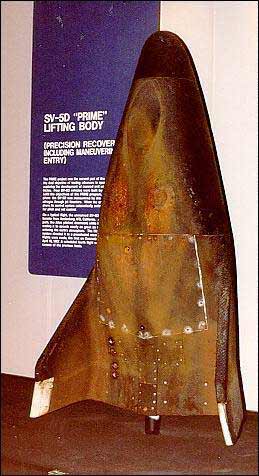 Specifications Company-
Martin Marietta
Type- Test ablative coatings, re-entry control surfaces, and lift body characteristics.
Goals- Test
configurations, control systems, and ablative materials for hypersonic
reentry vehicles.
Primary Testing Facility
Research- Vandenberg AFB / Pacific Ocean
Dimensions- Span-
3 ft, 10 in; Length- 6 ft, 9 in; Height: 2 ft, 1 in
Max Speed-
Mach 25 (16,500+ MPH)
Range- 710 miles
Max Altitude- 90 miles
Power Plant- Atlas ICBM
and nitrogen-gas reaction control thrusters
Thrust- N/A
Weights- N/A
Payload-
Loaded: 890 lbs
Flights- 3
Number of Prototypes Built- 4
Project Tenure- 1966-1967
Project Status- Cancelled Information
The Martin Marietta X-23A PRIME (Precision Reentry
Including Maneuvering reEntry) was a small lifting body re-entry vehicle
tested by the United States Air Force in the mid-1960s. Unlike ASSET,
primarily used for structural and heating research, the X-23 PRIME was
developed to study the effects of maneuvering re-entry, including cross
range maneuvers up to 710 miles (1143 km) off the ballistic track.
Each X-23 was constructed from titanium, beryllium,
stainless steel, and aluminium "where appropriate". The craft consisted
of two sections - the aft main structure and a removable forward "glove
section". The structure was completely covered with a Martin-developed
ablative heat shield 20 to 70 mm (0.8 to 2.75 inches) thick, though the
nose cap was constructed of Carbon-Phenolic.
Aerodynamic control was provided by a pair of
12-inch (30 cm) square lower flaps, and fixed upper flaps and rudders. A
nitrogen gas reaction control system was used outside the atmosphere. At
Mach 2 a drogue ballute deployed and slowed the vehicle's descent. As it
deployed, its cable sliced the upper structure of the main equipment
bay, allowing a 47-foot (16.4 m) recovery chute to deploy. It would then
be recovered by a specially-equipped JC-130B Hercules.
The first PRIME vehicle was launched from
Vandenberg AFB on 21 December 1966 atop an Atlas launch vehicle. This
mission simulated a low-earth orbit reentry with a zero cross-range. The
ballute deployed at 99,850 feet (30.43 km), though the recovery
parachute failed to completely deploy. The vehicle crashed into the
Pacific.
The second was launched on 5 March 1967. This
flight simulated a 654-mile (1053 km) cross range re-entry, and banking
at hypersonic speeds. Several stringers on the main parachute failed to
cut, preventing a successful recovery. It too was lost in the Pacific.
The final PRIME mission was flown on 19 April 1967,
and simulated reentry from low-earth orbit with a 710 mile (1143 km)
cross-range. This time, all systems performed perfectly, and the X-23
was successfully recovered. An inspection by a USAF-Martin team reported
the craft "ready to fly again", although no later mission was carried
out. The third X-23 is now on display at the National Museum of the
United States Air Force at Wright-Patterson Ohio.
** Information provided by X-Plane Data Site ** |