X-44A
MANTA
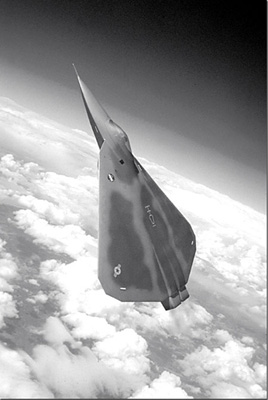 Specifications Company-
Lockheed Martin; The Boeing Company
Type-
Multi-Axis No-Tail Aircraft (MANTA)
Goals- Tailless flight
control demonstrator.
Primary Testing Facility
Research- N/A
Dimensions- N/A
Max Speed- N/A
Range-
N/A
Service Ceiling- N/A
Power Plant- N/A
Thrust- N/A
Weights-
N/A
Payload- N/A
Flights- N/A
Number of Prototypes Built-
N/A
Project Tenure- Unknown
Project Status-
Unknown Information
The X-44 designation is said to be reserved for
possible NASA full-scale manned tailless flight control demonstrator.
The X-44A has been referred to as the MANTA, or Multi-Axis No-Tail
Aircraft. A conceptual drawing of an X-44 is said to resemble a tailless
F-22, and is said to be based on an F-22 airframe, engines and systems.
The X-44A thrust-vectoring test aircraft would have pitch/yaw vectoring
nozzles and would not only be tailless but would have no moveable
aerodynamic surfaces.
The X-44 MANTA is a converted delta-winged F-22
which uses vectored thrust as its sole means of control. The plan is to
convert an F-22 so that it uses its thrust vectoring nozzles for its
flight control, without rudders, stabilitors, or ailerons. MANTA could
be used to validate the planform for the FB-22. MANTA flights could
begin by 2006.
Thrust vectoring -- the ability to turn the jet
exhaust -- allows an aircraft to create forces with its motors similar
to the forces created by aerodynamic surfaces such as flaps, rudders &
stabilators. The result would be a structurally simple, light airframe,
with increased fuel volume and fewer gaps to cause stealth problems. An
X-44A feasibility study is in progress, with a team including AFRL,
NASA, Lockheed Martin and Pratt & Whitney.
The X-44A is unlikely to fly before 2007, though
the F-22 program will retire the first and second flying prototypes in
2001-02.
** Information provided by GlobalSecurity.org ** |