X-38 Crew Return Vehicle
 Specifications Company- Scaled
Composites Inc.
Type- Space return vehicle.
Goals- Experimental
demonstrator for Crew Return Vehicle, dropped from a B-52. Concept model
for a crew return vehicle, a "lifeboat" for returning space crew members
to earth.
Primary Testing Facility
Research- NASA Dryden Research Center & Edwards AFB
Dimensions- Span- 14 ft,
6 in; Length- 25 ft, 6 in
Max Speed- N/A
Range- N/A
Service Ceiling- N/A
Power Plant- One Deorbit Engine
Thrust- N/A
Weights-
Empty: 16,000 lbs
Payload- N/A
Flights- 15
Number of Prototypes Built-
3 + 1 Incomplete
Project Tenure-
1997-2002
Project Status- Cancelled Information
The X-38 Crew Return Vehicle (CRV) was
a prototype for a wingless lifting body reentry vehicle that was to be
used as a Crew Return Vehicle for the International Space Station (ISS).
The X-38 was developed to the point of a drop test vehicle before its
development was cancelled in 2002 due to budget cuts.
The crew size for the ISS depends upon the crew
return capability: the crew is limited to three because the Russian
Soyuz TMA vehicle that will remain docked to the ISS can only hold three
people. Since it is imperative that the crew members be able to return
to Earth if there is a medical emergency or if other complications
arise, a Crew Return Vehicle able to hold up to seven crew members was
planned from the outset: this would have allowed the full complement of
seven astronauts to live and work onboard the ISS.
The current return capacity is three people per
vehicle, provided by the Russian Soyuz TMA vehicle. NASA has designed
several crew return vehicles over the years with varying levels of
detail.
X-38 was the program under leadership of NASA
Johnson Space Center to build a series of incremental flight
demonstrators for the proposed Crew Return Vehicle. In an unusual move
for an X-plane, the program involved the European Space Agency and the
German Space Agency DLR. It was originally called X-35. The program
manager was John Muratore, while the Flight Test Engineer was future
NASA astronaut Michael E. Fossum.
The X-38 design used a wingless lifting body
concept originally developed by the U.S. Air Force in the mid-1960s
during the X-24 program, and it was Muratore's brainchild.
The X-38 program used unmanned mockups to test the
CRV design. The flight models were:
- X-38 V-131
- X-38 V-132
- X-38 V-131R, which was the V-131 prototype
reworked with a modified shell
- X-38 V-201, which was an orbital prototype to
be launched by the Space Shuttle
- X-38 V-133 and V-202 were also foreseen at
some point in the project but were never built.
The X-38 V-131 and V-132 shared the aerodynamic
shape of the X-24A. This shape had to be enlarged for the Crew Return
Vehicle needs (crew of seven astronauts) and redesigned, especially in
the rear part, which became thicker.
The X-38 V-131R was designed at 80 percent of the
size of a CRV, and featured the final redesigned shape (Two later
versions, V-133 and V-201, were planned at 100 percent of the CRV size).
The X-38 V-201 orbital prototype was 80 percent complete, but never
flown.
In tests the V-131, V-132 and V-131R were dropped
by a B-52 from altitudes of up to 45,000 ft (13,700 m), gliding at near
transonic speeds before deploying a drogue parachute to slow them to 60
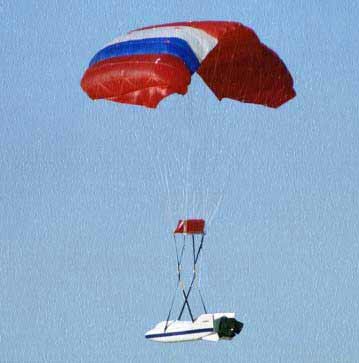
mph (95 km/h). The later prototypes had their descent continue under a
7,500 ft� (700 m�) parafoil wing, the largest ever made. Flight control
was mostly autonomous, backed up by a ground-based pilot.
The X-38 project cancellation was announced on
April 29, 2002 due to budget concerns.
Following the jettison of a deorbit engine, the
X-38 would have glided from orbit and used a steerable parafoil for its
final descent and landing. The high speeds at which lifting body
aircraft operate make them dangerous to land. The parafoil would have
been used to slow the vehicle and make landing safer. The landing gear
consisted of skids rather than wheels: the skids worked like sleds so
the vehicle would have slid to a stop on the ground.
Both the shape and size of the X-38 were different
from that of the Space Shuttle. The Crew Return Vehicle would have fit
into the payload bay of the shuttle. This does not, however, mean that
it would have been small. The X-38 weighed 10,660 kg and was 9.1 meters
long. The battery system, lasting nine hours, was to be used for power
and life support. If the Crew Return Vehicle was needed, it would only
take two to three hours for it to reach Earth.
The parafoil parachute, employed for landing, was
derived from technology developed by the U.S. Army. This massive
parafoil deploys in stages for optimum performance. A drag chute would
have been released from the rear of the X-38. This drag chute would have
been used to stabilize and slow the vehicle down. The giant parafoil�area
of 687 square meters�was then released. It would open in four stages (a
process called staging). While the staging process only takes 45
seconds, it is important for a successful chute deployment. Staging
prevents high-speed winds from tearing the parafoil.
The spacecraft�s landing was to be completely
automated. Mission Control would have sent coordinates to the onboard
computer system. This system would also have used wind sensors and the
Global Positioning System (a satellite-based coordinate system) to
coordinate a safe trip home. Since the Crew Return Vehicle was designed
with medical emergencies in mind, it made sense that the vehicle could
find its way home automatically in the event that crew members were
incapacitated or injured. If there was a need, the crew would have the
capability to operate the vehicle by switching to the backup systems. In
addition, seven high altitude low opening (HALO) parachute packs were
included in the crew cabin, a measure designed to provide for the need
to jettison the craft.
An Advanced Docking Berthing System (ADBS) was
designed for the X-38 and the work on it led to the Low Impact Docking
System the Johnson Space Center later created for the planned vehicles
in Project Constellation.
** Information provided by Wikipedia ** |