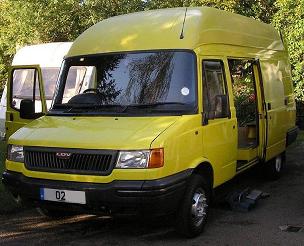
Van conversion - First steps
|
The plan was to replace both the Mondeo and the caravan with a camper van. The first steps were to decide what we wanted, find out if it were possible and then, did we still want to do it?
The first requirement was that we still need two vehicles. Living in a rural community, we have two cars at present and need two cars, less so as time moves on, but they are still needed. So the camper van needs to serve as the second car. This means that it must be small enough to be able to drive reasonably easily and handle in towns. Equally, we needed a van as small as possible to be able to get it into our drive which was not a lot wider than the caravan. (Curiously, having bought a van, the Master Builder widened the gates anyway - a job not included in the original plan! - Ed)
So we were looking for a van as small as possible, but able to take everything we want. This led to a discussion of what we didn't want. We knew a lot of what we don't use at present. We don't hook up to electricity, we don't use the shower and we don't use the heater (it has always been temperamental and we can wear more clothes). So we were not keen on buying a camper van which had these and other 'luxuries' that take space and add weight.
We did want a bed, a loo, some clothes hanging space, a cooker with grill, a sink and draining board, a fridge, a table and storage space - ie, a lot in a small space and no space wasted. We would also like at least the passenger seat to rotate, a solar panel to boost the battery and an awning to spread into for longer stops.
We found there were two sorts of camper vans, those which are coachbuilt and those that are van conversions. All the coachbuilt ones are larger than we wanted and the conversions don't fit the things we wanted in the space available, usually because other things we didn't want are included.
Then there was the cost. Camper vans come in units of �10,000 when we wanted to spend in units of �1,000. So a nice secondhand camper van could easily be �30,000 and a cheap old one unlikely to be under �10,000.
So we started to think of buying a van and converting it ourselves, 'cannibalising' the various units we wanted from the caravan. We had the time and the skills to do much of the work, but expected some things to be 'challenging'.
|
Having got this far, we did two things in tandem. We looked up the sizes of all the vans on the market to seek out those that were possibilities. At the same time we played with plans until we had a plan we liked. (To do this, we used Powerpoint and drew a rectangle the size of the van interior and rectangles for bed, fridge etc and simply moved them around - it is not perfect, but pretty simple and quick).
We decided that we wanted a fixed bed. The key reason was that we usually can't be bothered to make and unmake the bed each day and if you do so, you have to have places to put everything. The subsidiary reasons were that we wanted a comfortable bed, preferably without joins in cushions and we wanted to use the space under the bed for storage.
The bed could either go lengthwise or across the van. We could not find a design that worked with the bed lengthwise, without having to go for a bigger van than we wanted, so the bed had to go across. This meant that the van had to be wide enough to handle insulating the walls and still leave a bed long enough to sleep in (fortunately we're both of average height!). But it also meant that the designs had many of the options removed.
The conclusion was that we wanted a van 6 metres or less long, with an internal length of at least 3.15m, an absolute minimum width of 1.76m and height of 1.82m; ideally we'd like the width 1.85m.
Our planned layout became
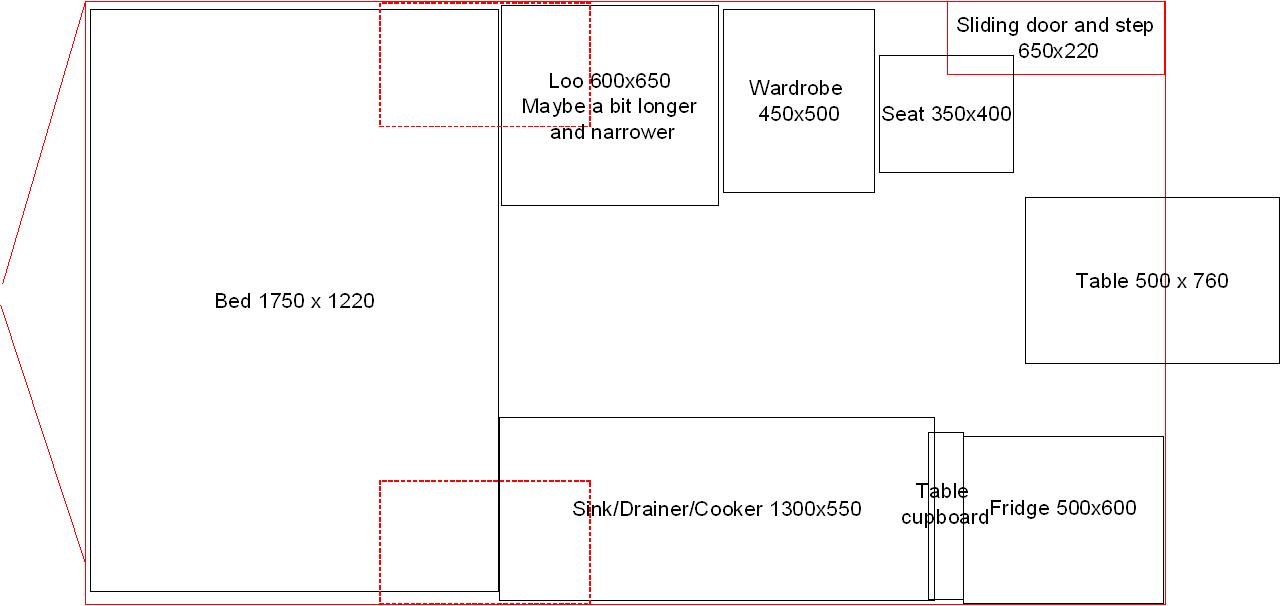
We focused first on the Ford Transit because there are lots of them about, but after a lot of investigation decided that our possible vans were
- Ford Transit LWB High roof
- Renault Master MWB or LWB medium roof
- Vauxhall Movano MWB or LWB high roof (as against maxi roof)
- Nissan Interstar L2 or L3 H2
- Fiat Ducato Maxi hi roof
- Peugeot Boxer L2 H2
- Citroen Relay L2 or L3 H2
- Mercedes Sprinter MWB (aka standard) high roof (as against super high)
- Iveco Daily 29L MWB
- LDV Maxus LWB XHR
Next job was to find prices for the vans and find where we could buy one. Having looked on eBay and similar sites, we began to get an idea of prices and we looked at some vans for sale locally.
We then digressed into bidding for a van in Wales on eBay, expecting to lose the auction because we were bidding low. We came second and the winner pulled out, so we had the opportunity to buy a Ford Transit 2000 LWB high roof for �2000. We nearly did, but pulled out in favour of more research.
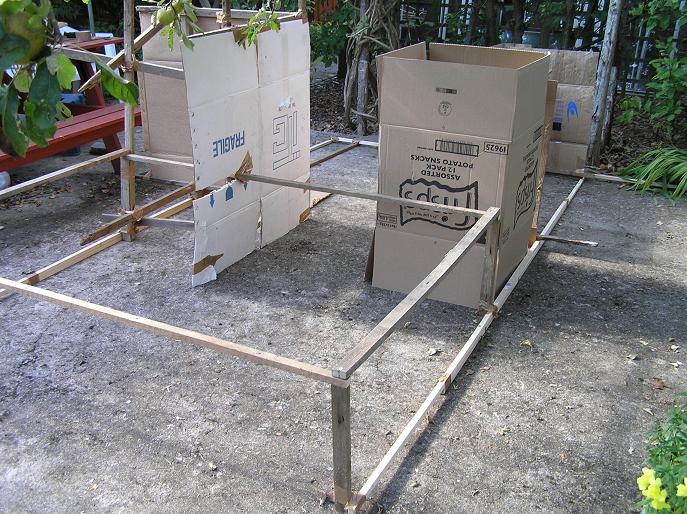
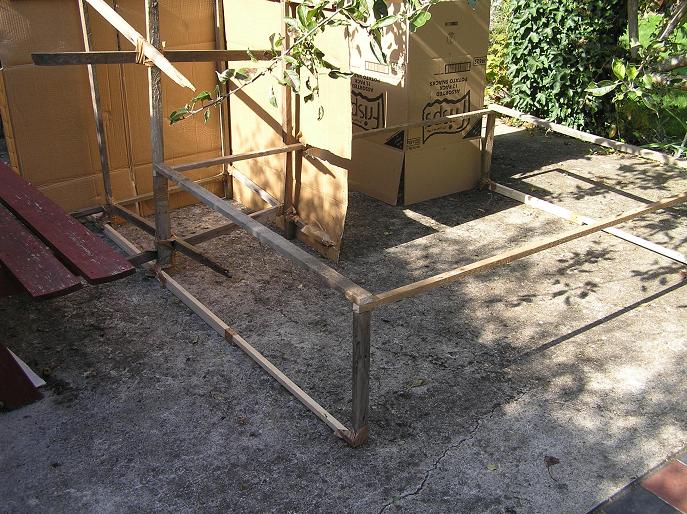
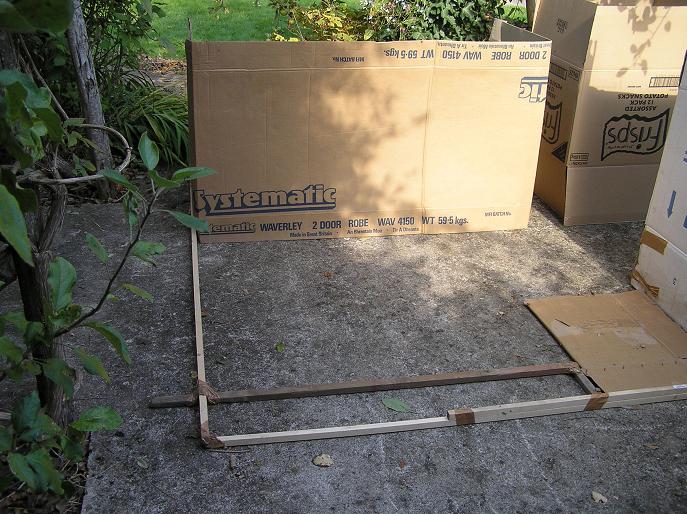
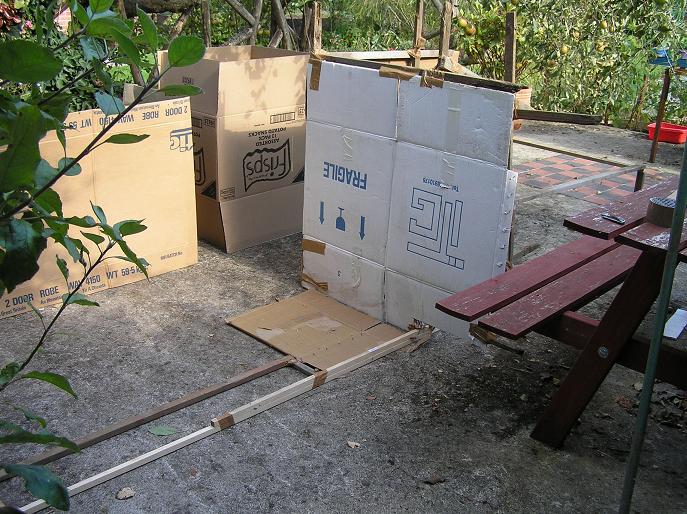
This spurred us on though and we mocked up our interior plan with wood and cardboard in our garden as below
Since my old job was in project management, now was the time for a budget....
| cost | cost if we reuse bits from our caravan
|
| van purchase | �5,000 | �5,000
|
| work on van engine, bodywork etc to get it running OK | �500 | �500
|
| solar panel | �500 | �500
|
| battery | �100 |
|
| gas bottles | �100 |
|
| side window | �200 | �200
|
| roof window | �100 | �100
|
| fridge | �500 |
|
| swivel seat(s) | �200 | �200
|
| new front seats | �200 | �200
|
| awning tent | �200 | �200
|
| blinds | �100 | �100
|
| electric fittings | �200 |
|
| folding door | �50 | �50
|
| reversing camera | �200 | �200
|
| water pump | �50 |
|
| sink | �100 |
|
| mattress | �150 | �150
|
| cooker | �300 |
|
| loo | �100 | �100
|
| bike rack | �100 | �100
|
| battery charger | �150 |
|
| misc wood, screws, cushions etc etc | �500 | �300
|
| gas/elecs check | �200 | �200
|
| total | �9,800 | �8,100
|
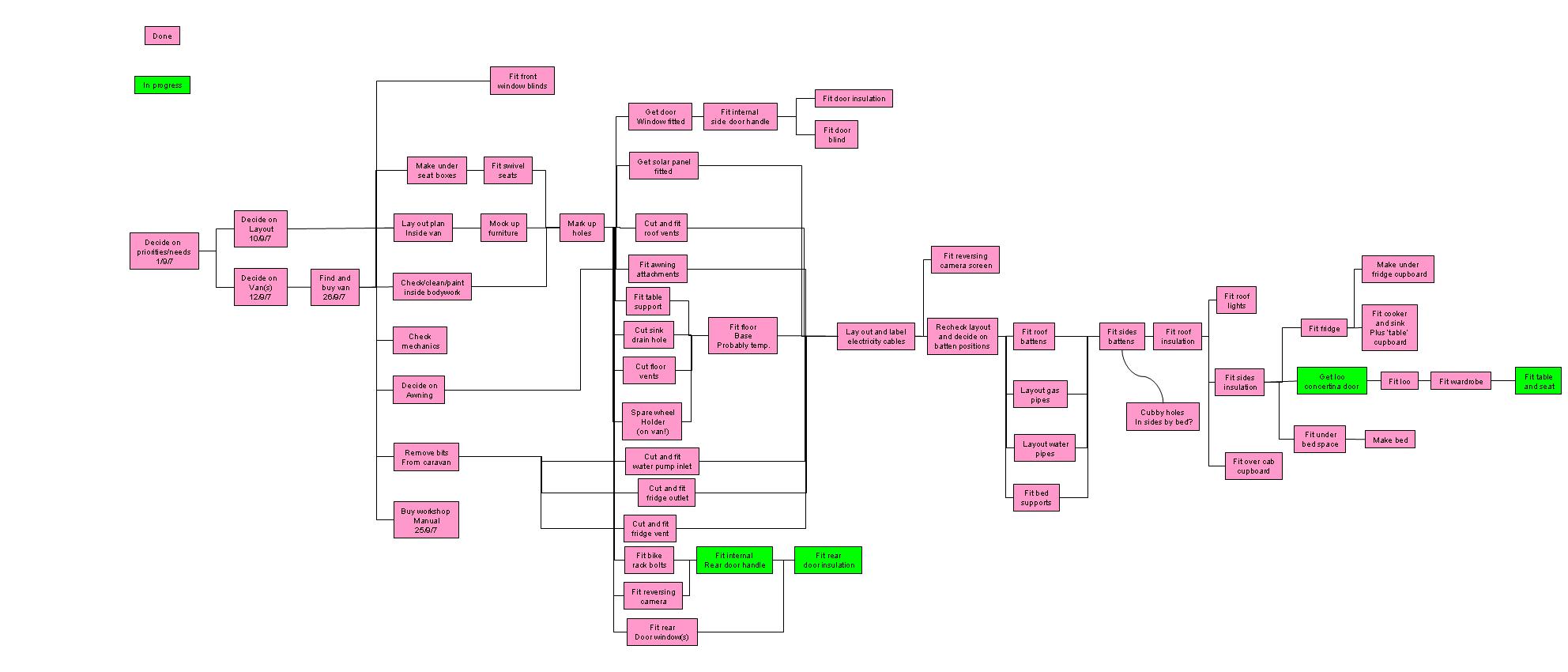
Next the plan. While there will no doubt be snags and things forgotten, the plan below was our attempt to get the sequence of activities sorted out.
Research is, as ever, the key (thank goodness for the internet but it is still amazing how much work is needed to sort out what is possible from what is too expensive). We found that the post 2001 Transits have a better shape than the earlier Mark 5 (Smiley), so we eliminated early Transits.
We then focused on the Ducato as it is slightly wider, but found that the door is in the wrong place on the LWB (something they fixed in 2006) so that eliminated the Ducato, Boxer and Relay since these are identical.
Next van to get our focus was the Maxus, only to find that it is recent, having replaced the Convoy in 2006. So we looked at the Convoy and quite liked the idea. It is slightly wider, which is good, but a slightly shorter van for the useable inside length. The shape of the front is a bit chunky, but we thought we could live with that (it's actually become quite endearing! - Ed)
In addition, there is a lot more solid metal to it, it is a double wheel van so the wheel arches take more room, but also rear wheel drive, so it is higher off the ground both allowing easier maintenance underneath and resulting in the wheel arches being lower (so less intrusive) inside. So the Convoy became favourite and there seemed to be some cheaper ones reasonably nearby.
We tried eBay, autotrader.co.uk, preloved.co.uk, local van dealers, Friday ads, looked at the auctions ... In the end we found eBay best, because the vans were either cheaper or more erratically priced and we eventually found some vans worth chasing.
The problem is that it's not easy to preview them. We did look at a few which were local enough (South Hampshire), to at least get a good feel of the van in general, but then ended up bidding unseen and further away.