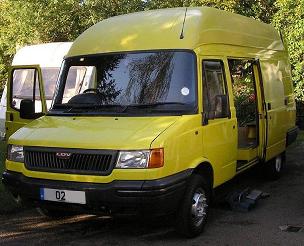
Some thoughts may be relevant at this stage.
First up is what a lot of time it all takes. Every day possible, from dawn to dusk (which is about 7am to 5pm at this time of year) there are tasks to progress. When one thing is held up drying or waiting for a part there are endless other jobs to do.
It is clearly a good idea to use a spare caravan as the source for lots of parts. If you haven't got one, I think seeking out a scrap one would be wise. But when I came to stripping ours, I found that the cabinets were screwed into the frame from outside, ie they built the inside first then added a thin skin. So to remove things is 'difficult' unless you fancy everything getting wet by removing the outside early.
The cost of the 'miscellaneous' items surprised me. It might have been better if I'd costed out the floor, cladding and insulation in their own right, but even so, �50 for some plywood and �100 for some insulation and another �50 for different plywood and �50 for glue, it went on and on. And there were endless larger items I realised I'd forgotten eg �80 for a step.
When measuring, it is important to measure at the right height. For example, we focussed on the floor area when getting the van, but actually the important 'floor' area is up at 2-3 feet high as that is where the bits of furniture actually fit and since the walls come in, this is likely to be a considerable reduction. As another example, after lots of discussion on where the loo walls were going to go, we decided to make them 720cm wide. So I got plywood cut to this size, but we were doing the measurement at the bed height ie c24" off the ground, so the plywood didn't then fit at the wider floor level.
And the rule of measure twice, cut once, is only just enough. I moved into variants such as measure thrice, cut once or measure, then measure a different way, then cut.
Listing them for amusement, I have used...
- an arc welder
- 4 different hammers
- an angle grinder
- 4 different cross head screwdrivers
- 7 different flat headed screwdrivers
- 2 socket sets
- a set of metric spanners and innumerable others
- an allen key
- a jigsaw
- 4 paint brushes
- 6 files
- 2 surforms and a rasp
- 4 drills (I wore out two!) and a brace and bit
- 2 shifting spanners
- 2 mole wrenches
- a wandering lead light and a torch
- 3 handsaws
- a tennon saw
- 4 hacksaws
- a bench grinder
- a circular saw
- 2 penknives
- 2 chisels
- a punch
- 2 workmates
- 8 G clamps
- 5 pairs of pliers
- a vice
- 2 glue guns (one wore out)
- tin snips
- 4 pairs of scissors (2 got tired and broke after cutting the insulation)
- 2 spirit levels
- a T square
- 2 sanders
- a circuit tester
- a soldering iron
- a gas sniffer pen
- a belt sander
And I have used 1 ply, 2 ply, 3 ply, 4 ply, 5 ply, 6 ply, 7 ply, 9 ply, 12 ply and 15 plywood