ANGER

Sounds like such a harsh word, eh? It is a normal emotion, a healthy one. It is
appropriate as long as you know how to express it properly. Coping skills are an important
thing to have that can help you through it.
Anger is one of the biggest reasons for cardiovascular disease, violence, broken or
alienated relationships and unresolved emotions. Anger is one of the first boundaries we
learn to set as children. Anger can be an effective boundary. When it is not dealt with
appropriately, it can lead us to hostility and bitterness, which ruins the quality of our
relationships and ultimately affects our physical and emotional well-being.
Anger can cause a lot of problems. It can destroy a
lot of relationships and lives. Anger can drive a person to do things one normally
wouldn’t do such as hurt or kill others. A lot of times people hold their anger in, as
they do other feelings. Many people are raised to not express their anger and may be told
that anger is not a good emotion. I grew up with so much anger towards so many people. At
times I let it all out and other times I held back. Most of the time when I finally
released my anger was after holding back for a long period of time.
I used to love to fight. It helped get rid of some of my anger. I use to start
fights for no reason. I did have an anger problem. I learned to turn it inwards and made
it depression. I quit taking it out on other people and just started taking it out on me.
Better to hurt myself than others, right? No. I wasn’t allowing myself to deal with my
feelings. Instead I was bottling them up and getting more upset at myself for doing so. My
anger caused a lot of problems in my life. It was one of the feelings at the root of my
self-mutilation problem, my suicide attempts, and my homicidal ideations. I had so much
hostility towards my family, my foster parents, DHS, school, others, and myself. The anger
and pain was all I could ever think about and when someone noticed and pointed it out I
would deny it. I didn’t want to talk about it, I didn’t know how. I didn’t know any
positive coping skills.
We
may experience anger for many of reasons, irritations, feelings of powerlessness,
violation of our personal boundaries, violation of our rights as human beings, a loss of
control, rejection and/or resistance. We may experience feelings of anger due to the
non-compliance of others, our inability to effect change in others or direct their
activities or behaviors, or lack of understanding. We may experience anger because we are
frustrated, feel violated, or feel that our needs are not being met. Angry people don’t
usually view themselves as being wrong, for their reactions or likes/dislikes. Resentment
may occur as a result of downsizing the situation. We initially decide we’ll just
overlook this item, but later on, we are unable to do so and now react strongly because we
chose to ignore the greatness of it before.

There
are two main types of anger. Anger directed inward and anger directed outward.
Anger
Inwards: This is feeling angry but directing
it toward oneself, or inwardly directed anger. It is depression or suppressed hostility.
Anger Outwards: This
is feeling angry and directing it toward other persons or things, or outwardly directed
anger. It is the showing of repressed hostility and resentment.
THE
ANGER CYCLE 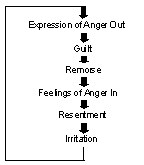
The open expression of anger out by one person on another person is almost always followed with guilt. Immediately the person may feel some elation for having "gotten it out" but the frequent normal response is guilt. Guilt then will lead to remorse that the person had been so hard or mean to the person upon whom the anger was vented. This remorse will function like a "self-checking" device and result in the anger being held in so that the anger becomes "anger in", which can lead to depression. This "anger in" over time will lead to resentment towards the original person towards whom the open anger expression was delivered. If this person down the road begins to irritate the "angry person", over time the anger person will not hold in any more and express anger out all over again. Leading to a repeat of the anger cycle of guilt, remorse, anger in, resentment, irritation and anger out expression. This is a maladaptive model of handling anger.
When
we reach the hostility stage, we begin blaming others; our needs are not being met, we may
experience feelings of being overwhelmed and helplessness. We may experience depression.
This failure to forgive will only deepen and add to the patterns and cycles of depression
this personality type will normally experience. Perfect Melancholies are highly
susceptible to depression. We often begin to feel sorry for ourselves and blame others.
Three
important things occur at the hostility stage as our needs are not being met and our sense
of well-being is threatened: 1. Feelings of threat or rejection of others begin.
2. A loss of identity occurs
3. A loss of belonging occurs
We have gone deep into our feelings and been reviewing and
nurturing it by the time we reach the repression, suppression, depression stage.
When we repress anger we deny it exists, ignore it
When we suppress anger we bury anger, minimize it
When we depress anger it is a result of repressing and
suppressing anger
What
can you do with anger?
·
Face the anger for what it is and
don't try to avoid it.
·
Identify feelings that are at the
root of the anger or depression.
·
Use ``I statements'' to express the
feelings of anger.
·
Identify the guilt, resentment,
rage, fear, embarrassment, depression, etc., involved.
·
Confront the ``issues'' that
stimulate the anger and analyze them for what they are:
stimuli drawing on deep-seated subconscious feelings of anger that indicate
unresolved emotional blocks from your past.
·
Use imagery, role playing, an empty
chair to confront past hurts and pains; express feelings, long since submerged, that come
out.
·
Inform people in your current life
of your need to analyze your anger responses; seek their assistance and understanding in
this exploration process.
·
If your current anger is not the
result of efforts to uncover submerged feelings of old anger, then treat the current anger
with rational ``I'' statements: ``I feel
angry because I...''
·Write about it
·Draw
·When feeling angry take a cooling off time out and then talk to the person
·Flush the toilet 10-20 times
·Exercise
·Clean
·Relax and breathe
·Scream into a pillow
·Go fishing
·Laugh
·Ride a bike
The list can go on and on forever depending on the person and what one
likes to do. Just remember, nothing gets resolved if not brought out into the open. It
NEEDS to be talked about and dealt with.
What is
the anger reaction to loss in a dysfunctional family?
·
Anger
at having to strive so hard and to be so good.
·
Anger
at living in a family that needs so much and gives back so little.
·
Anger
at parents for being so critical and irritable when one is trying so hard.
·
Anger
at self for constantly discounting one's own needs and selling out to other's demands.
·
Anger
at parents for not caring about me.
·
Anger
at a troubled person in the family for engaging in a dependency behavior.
·
Anger
at family members who conspire to belittle and manipulate the troubled person.
How
is anger often dealt with in a dysfunctional family?
·
To
maintain a ``good'' son or daughter image one must not show anger toward parents but must
bury the feelings (anger in), which feeds guilt and depression.
·
Anger
leads to feelings of inadequacy that lead to a belief that ``I never do good enough.'' This leads to resentment that leads to more buried feelings, resulting
in guilt and depression.
·
Intense
anger at self and others can become frozen into a chronic attitude of hostility.
·
Submerged
anger leads to being vigilant for any attacks (real or perceived) on self. This provides a
stimulus to draw the anger feelings to the surface, resulting in overreaction ``Your anger
in this situation is disproportionate to the importance of the event.''
·
Self-hatred
leads to turning off feelings, which can lead to projection and blaming others for the
problems.
·
Anger
leads to rage that leads to severe punishing of the troubled person or other family
members.

What
are some ways to redefine anger?
·
Anger
is a signal that things are not going our way.
·
Anger
is a motivator for us to change things or to rectify them.
·
Unresolved
anger is a block to our emotional growth.
·
Anger
is a sign that we must take an assertive stance to tune into how we are feeling and why we
are feeling that way.
·
Anger
is directly related to our thoughts. If we have angry thoughts we will become angry.
However, if we don't have angry thoughts, we won't become angry.
·
Depression
is anger that has been suppressed.
·
A
hostile attitude is often the sign of an individual with chronic, unresolved anger who
expresses the anger in passive and/or aggressive ways.
·
Aggressive
anger, which is verbal or physical, only intensifies one's anger once it begins to be
expressed.
·
Catharsis
of anger, which is the ventilation of anger, usually leads to an increase in anger, and
the expression of the anger usually intensifies.
·
Anger
is usually related to me and my reaction to something or someone. It is controllable by
teaching myself new ways to handle the ``anger provoking'' situations, events, or people.
·
My
angry reaction to a ``current situation'' may be because the situation is a ``trigger
event,'' one that drags up ``old'' anger that has never been resolved.
·
Anger
can be turned into a source of strength to change my ways of acting and reacting to
situations, events, or people.
·
Ventilating
anger directly on people is aggressive behavior and typically benefits no one. I usually
feel guilt, shame, or greater anger after such ventilation, and whatever provoked my anger
usually doesn't change.
·
Harnessing
anger into a productive force in my life will assist my emotional growth.
What are
some steps to take in handling current anger?
Step
1:
Relax yourself by using deep, natural breathing and muscle relaxation.
·
Take
deep breaths and silently repeat the words "relax'' until you are able to calm down.
·
Do
not say or do anything until you are calmed down.
·
Avoid
words or actions in the ``heat'' of the moment.
Step
2:
Recognize what arouses or provokes your anger:
·
Is
it a situation, an event, a person?
·
Is
it real or imagined?
Step
3:
Use a rational approach to ``rethink,'' ``reframe,'' and reason in your mind what
is going on and why you are angry.
·
Is
this a trigger event bringing up old unresolved anger or resentment in me?
·
How
is what is happening to provoke my anger a product of my past?
·
What
is really getting me angry?
·
Maybe
this person provoking my anger is having a bad day or needs more of my understanding.
·
How
am I feeling about this?
·
What
needs to be changed here?
·
What
alternatives could I use to get the best results in handling this situation?
Step
4:
Once you have a ``clearer'' idea of what is going on, take steps to change the
situation that is provoking the anger.
·
Use
``I'' statements. ``I feel angry when you Y''
·
Clarify
your feelings about the situation.
·
Point
out issues needing clarity.
·
Relate
to the person how what is happening now is triggering feelings from your past.
·
Identify
the unresolved anger, resentment, hostility, or depression and work on it.
· Inject some humor into the situation to defuse the anger or hostility.
What
are some steps to work out unresolved anger?
In
handling a ``current'' anger situation you may have come upon a ``trigger'' event that
brings up past feelings of hurt, pain, resentment, hostility, or anger. The trigger event
is not what you are actually reacting to, but rather it is the past situation, (one that
went unresolved) to which you are reacting.
The
following steps will assist you in working out this unresolved anger:
1.
Take a pillow or cushion and go alone to your bedroom or to a quiet location.
2.
Position yourself so that you are kneeling in front of the pillow or cushion, which
is either on a bed, a chair or the floor.
3.
Begin to visualize a scene or series of scenes surrounding the situation, event, or
person with which you have unresolved anger.
5.
Continue pounding the pillow and letting out your feelings until you feel satiated.
6.
At this point begin to use your reason
and rationality to reframe or restate the situation. Begin to allow yourself to forgive
those situations, events, or persons for what
happened to you. Do not proceed to the next step until you can come to a ``healing'' of
your spirit at this point. If you are stuck, repeat Steps 3 and 4.
7.
Once you feel as if you have been able to forgive and you feel healing beginning,
write down what it was that made the reframed or restated situation have less blame and
thus be able to be forgiven.
8.
If person(s) involved in the unresolved anger situation are still available (alive)
and capable of communicating on a healing, nonblaming, feeling level, share your
resolution with them and let the forgiveness and healing become alive.
If the person(s) involved are unavailable, let the forgiveness and healing take
hold in your heart.

ANGER PAGE 2