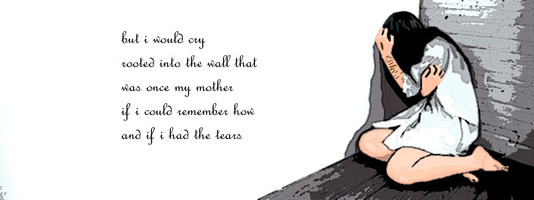
Self Mutilation

I am a recovering self injurer. I can tell you a thousand of reasons why I did it. I can tell you how it made me feel at the time and afterwards and now. I began self mutilating myself severely when I was 12 years old. I look back and realize that it actually began years before then. I was nine years old when I found the pleasure in it all. There is so much that millions of people do not understand about those who are self injurers and I have listened to them all and it almost makes me sick to see the ignorance and prejudices in people. It is TRUE, many people just don't understand and they might not ever see the point. It's ok though. As long as we speak out and try to help them learn about S.I. is all that matters. I have not cut or burned myself in a year now, but I do find myself engaging in similar behaviors without realizing it at the time. Is it easy for someone that has been smoking for 15 years to quit? No. I learn from myself and I watch myself use substitution methods as I did with other areas of my life. It takes time and time is always on our side.

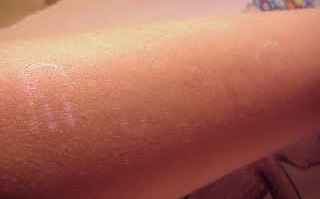
Parts of my old journal entries:
I don't always know why I self-injure. It is so confusing sometimes. Sometimes it's used as a distraction from the pain I'm feeling. Sometimes I use it as a way of using my body to express what I can't say with words. There are times when there are no words for what is going on inside me. It is just like a big tornado of feelings/emotions that I don't know what or why or which one is the main one. Other times I use self-injury as a way of releasing the pain or other emotions that I am feeling. The feelings are overwhelming--usually severe feelings of rejection, self-hatred or anger.
I use it as a way of punishing myself for whatever it is at that moment for which I feel I need to be punished. My dad use to hurt us when we were younger and would tell us that we needed to be punished and I see it now. I remember his words. Looking back I've noticed that some statements I made were: "I fukt up and did something I know I wasn't supposed to do and she grounded me. Why do I always fukk up? Why can't I do right? So now I'm sitting in my room and I just burnt my leg. I'm grounded for a week. I hate it here." I punished myself. I did that a lot in several different ways. I really didn't know it then but now I do.
"I have no control over my life!!! DHS tells me where to go and what to do. My foster parents tells me how to talk, when to eat, what I can't listen to, what to wear, and everything!!" I think self mutilation gave me a sense of control. "I feel like I'm in control of my body, they can't see what I do to it. If they do see it well, I know the consequences. I'll be moved to another home or I'll be put in the hospital again. So what, who cares." "I see the blood escaping from my skin, it's all trapped inside in those little veins. Only I can let it out now. Not my father, not the state, nobody but me."
"I do it because I get extremely angry at times and I feel like I can't do anything about it. I can't take my anger out on others sometimes, if I begin to feel that rage inside and feel like hurting someone, I just turn around and take it out on myself. When I was younger I found no problem in fighting with others, or hurting them, but I've learned that it was wrong to do so. I have learned to become passive and turn it all inwards. They've made me like this and I hate them for it. "He was standing so close. I could smell the beer on his breath. I told him to leave and stay out of my life. Yes, he's my father, but I don't care anymore. I hate him. He wouldn't leave so I grabbed the little knife and told him to leave again. I couldn't bring myself to hurt him with it and it just pissed me off more so I screamed and then slashed my arm open a few times. He turned around and walked outside."
I noticed that I began to fall in love with the blood itself. I felt so alive and that my feelings were being released. There are so many reasons. If you could actually see my old journals you would probably be grossed out. I would sit and watch the blood then put it on pages of my journal entries. I would be feeling so extreme that nothing was working. Then I'd cut myself and it would seem to instantly calm me down and I'd lay there and cry and just watch myself bleed.
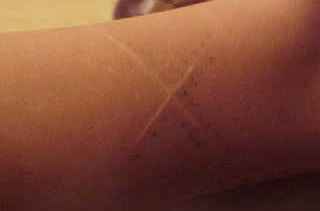
I am embarrassed about the scars on myself. Especially the ones on my arms. I can't wear t-shirts now without having to face the fact that I did that to my arms over the last 10 years. I've gotten to the point that I don't care who sees them, but it still makes me uncomfortable if someone does notice. Sometimes I feel as though that's what people focus on when they first meet me. It gives the wrong first impression. Going to job interviews, I have to double check before getting out of my car just to make sure the visible scars on my arms are covered up with watches, jewelry, or long sleeve shirts. I worked at a restaurant and I get young children that have asked me questions like: "Did you get branded?" "Why did you do that?" "Who did that to you?" "What happened?" etc... Then I get the older people that notice my arms and have to announce that they will be praying for me.
I worked at an adolescent girls home with teenage girls and they have asked me what happened. It is easier to talk about now. I use it to help them understand themselves and this type of coping skill. I like to focus on helping them figure out why they do it and what triggers it, so maybe they can realize it before they do it next time. That way they can then start finding other ways to deal with things. I use my past and mistakes to help guide others to finding new coping skills. It's not worth it in the long run.
Learn some self control.
A lot of times self mutilation happens without thinking. If one can accomplish that first little step of learning impulse control and can bring themselves to stop and think before acting can prevent a lot from happening. It is a big step for a self injurer to take.
Ask yourself:
- Why do I feel I need to hurt myself?
- What did I do to deal with it last time? How did I feel then?
- What other coping skills have I used before? What else can I do that won't hurt me?
- How do I feel right now?
- How will I feel when I am hurting myself?
- How will I feel after hurting myself? How will I feel tomorrow morning?
- Can I avoid this stressor, or deal with it better in the future?
- Do I really need to hurt myself?
 What Do I Do
Now?
What Do I Do
Now?
It is very difficult to recognize a person who self injures. They are professionals at covering up
the marks that are left behind from abuse, much like the anorexic or the abused woman."
self-injury is the act of attempting to alter a mood state by inflicting physical harm serious enough to cause tissue damage to your body. This can include cutting (with knives, razors, glass, pins, any sharp object), burning, hitting your body with an object or your fists, hitting a heavy object (like a wall), picking at skin until it bleeds, biting yourself, pulling your hair out, etc. The most commonly seen forms are cutting, burning, and head banging.
"Tissue damage" usually refers to damage that tears, bruises, or burns the skin -- something that causes bleeding or marks that don't go away in a few minutes.
A mood
state can be positive or negative, or even neither; some people self-injure to end a
dissociated or unreal-feeling state, to ground themselves and come back to reality.
It's a coping mechanism, just not one
that's as understandable to most people. Many other people use smoking, drugs,
food, gambling, shopping, alcohol, or screaming as their ways to cope with life
issues. Yes, they are looked upon in their own way but not like the self
injurers are.
"HEY HELP ME FIND OTHER WAYS THAT WORK! DON'T JUST LAUGH AND TURN YOUR BACK ON ME! I'M NOT ANY DIFFERENT THAN YOU ARE!"
People who intentionally harm themselves are special people who have felt a greater and more unique emotional pain than others will ever feel. When people see someone that self mutilates they tend to place labels on the person. The labels and words that are thrown at the self injurer makes them hide behind their scars for even longer and then the cycle never ends.
Is it a Suicide Attempt?
NO. People who inflict physical harm on themselves are often doing it to cope with stress that life is dealing out to them. They are looking to survive it and live. They release unbearable feelings through self-harm.
Unfortunately, some people don't
understand this and think that it is a suicide attempt. They think that psychiatric hospitals are the only way to deal with a
person who self-harms. Hospitalization can do more harm than good.
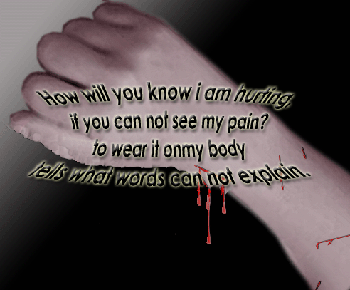
**There are different feelings and emotions one feels before they self harm. We need to learn how to identify the feeling and understand the different reasons:
Match what you do to how you are feeling at the moment. What is it that I am feeling?
Am I Angry? Frustrated? Sad? Numb? Depersonalized and unreal? Unfocused?
Next, match the activity to the feeling. A few examples:
- Try something physical and violent, something not directed at a living thing:
Tear up stuffed animals- Hit a pillow
Slash an empty plastic soda bottle or a piece of heavy cardboard or an old shirt or sock.- Throw pillows or stuffed animals at a wall
- Rip up an old newspaper or phone book.
Get a photo of yourself, mark in red ink what you want to do. Cut and tear the picture.
Throw ice into the bathtub or against a brick wall hard enough to shatter it.
Break sticks.
Crank up the music and sing/yell
Clean the house.
Go for a walk/jog/run.
depressed, unhappy, hurt, lonely
- I learned that writing down what I want to do and describing it and everything else helps.
- Do something slow and soothing, like taking a hot bath with bath oil or bubbles
- Read a good book.
- Light sweet-smelling incense.
- Listen to soothing music.
- Smooth nice body lotion into the parts or yourself you want to hurt.
- Call a friend and just talk about things that you like.
- Eat some chocolate.
- Make a tray of special treats and tuck yourself into bed with it and watch TV.
- Visit a friend.
- Hit a pillow
- Write about some happy things in life
-
FOCUS on how it feels to breathe
- Take a cold bath.
- Do something that creates a sharp physical sensation:
Put a finger into a frozen food (like ice cream)
Bite into a hot pepper or lemon
Rub Icy Hot on your arm
Squeeze ice hard- Slap a tabletop hard.
Snap your wrist with a rubber band.wanting focus
- Do a task (a computer/video games) that requires focus and concentration.
Choose an object in the room. Examine it carefully and then write as detailed a description of it as you can. Include everything: size, weight, texture, shape, color, possible uses, feel, etc.
Choose a random object, like a paper clip, and try to list 30 different uses for it.
Pick a subject and research it on the web.- wanting to see blood
- Ketchup!!
- Draw on yourself with a red felt-tip pen.
Take a small bottle of liquid red food coloring and warm it slightly by dropping it into a cup of hot water for a few minutes. Press its tip against the place you want to cut. Draw the bottle in a cutting motion while squeezing it slightly to let the food color trickle out.
Paint yourself with red tempera paint.- Draw on the areas you want to cut using ice that you've made by dropping six or seven drops of red food color into each of the ice-cube tray wells
- Take a cold bath.
Angry, frustrated, restless
Feeling depersonalized, dissociating, feeling unreal or numb
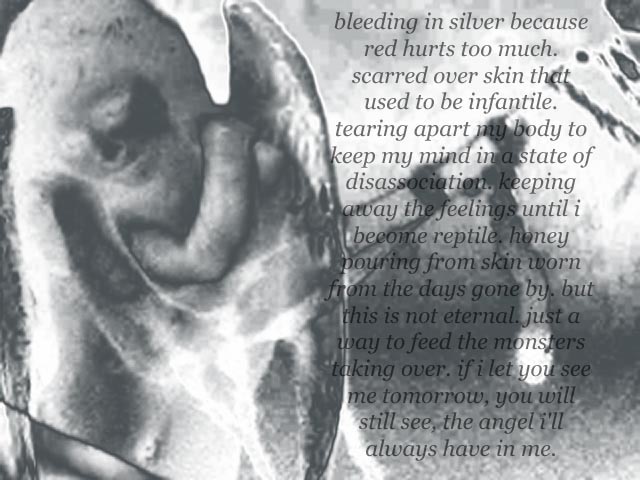
Self Mutilators need help. It is just the same as alcoholics, drug addicts, people who use food or shopping to cope with life problems. This is the tool that seems to help self injurers the most. It is a very difficult addiction to break and some may never recover.
Every
night I burn
Every night I call your name
Every night I burn
Every night I fall again
Burn - The Cure
MORE
INFORMATION
DBT-(Dialectical Behavioral Theory)-related skills
This is the psychosocial element.
It is a method attempts to change the patient's social behavior. It helps teach
the coping skills we need. Some people react abnormally to emotional
stimulation. The self injurer's level of arousal goes up much more quickly,
peaks at higher levels, and takes much more time to return to a stable
condition. This may be due to unknown biological factors or childhood
environments that were invalidating. The primary goal of DBT is to reduce
self-injuring behaviors. it is also to minimize behavior that interferes with
the therapy process.
Marsha Linehan's Skills Training Manual has several helpful worksheets for getting through crisis situations. Though they are best used as part of a DBT program with a trained therapist, you might find some of them helpful.
- Accepting Reality
- This concept focuses on learning to accept reality as it is. Accepting it doesn't mean you like it or are willing to allow it to continue unchanged; it means realizing that the basic facts of the situation are even if they aren't what you'd like them to be. Without this kind of radical acceptance, change isn't possible.
- Letting Go of Emotional Suffering
- In this worksheet, you learn ways to observe and describe your emotion, separate yourself from it, and let go of it. One of Linehan's basic principles is that emotion loves emotion, and this worksheet is designed to help you experience your emotions with amplifying them or get caught in a feedback loop.
-
- Distraction
- Distraction is simply doing other things to keep yourself from self-harming.You bring something else in to change the feeling. Using ice, rubber bands, etc, is substituting other intense feelings for the self-injury. Other things Linehan suggest substituting include experiences that change your current feelings, tasks (like counting the colors you can see in your immediate environment) that don't require much effort but do take a great deal of concentration, and volunteer work.
-
- Improve the Moment
- This worksheet focuses on ways to make the present moment more bearable. It differs from distraction in that it's not just a diverting of the mind but a complete change of attitude in the moment.
-
- Evaluating the Pros and Cons of Tolerating Distress
- As the name implies, this worksheet leads you through an evaluation: what are the benefits of doing this self-harming thing? What are the benefits of not doing it? What are the bad things about doing it? About not doing it? Sometimes writing this down can help you make a decision not to harm.
-
- Self-Soothing
- This, like improving the moment and distracting, is a distress tolerance technique. It's pretty straightforward: use things that are pleasing to your senses to soothe yourself. Some people find that active distraction works better for violent angry feelings and soothing is more effective for soft, sad ones.
-
- Reducing Vulnerability to Negative Emotion
- Prevention of states in which you are likely to self-harm is covered in this worksheet, which suggests ways of taking care of yourself in order to minimize the times when you feel the urge to hurt yourself. If you're balancing eating, sleeping, and self-care, you're less likely to be overwhelmed by emotion.
-
- Interpersonal Effectiveness
- Being clear about what you want and about your priorities in an interaction are crucial to good communication, and this worksheet offers a series of questions and steps to follow to help you determine how to approach a difficult interpersonal interaction. It is truly amazing how much going through these steps can help.
More information about Dialectical Behavioral Therapy can be found at DBT-Seattle.
Tammy Bucklew adapted these guidelines
The Dos
Do stand ready...- to give support.
- to give acceptance.
- to give love.
- to give time.
- to give understanding.
- to give help.
- to give interest
- to give validation.
- to give belief.
- to give prayer.
- to give encouragement.
- to give hope.
- to give honor.
- to give trust.
- to give forgiveness.
The Don'ts
- You have got to quit feeling sorry for yourself.
- Why can't you just forget it?
- That's in the past. Why keep bringing it up?
- Can't you just let go? It's not happening now.
- Why are you making such a big deal? You were only three.
- Just pray about it. Give it to God.
- You are the problem, not what happened.
- Why didn't you stop it?
- Stop thinking about it. It's a sin. The Bible says to think on things that are good.
- What did you do to cause it to happen?
- Why can't you hurry up and get over this?
- Forget the past and move on toward the future.
- You're not forgiving. You have to forgive or God won't help you.
- I am so sick of this. What about me?
- I don't believe that happened to you
"Life begins when you accept your fate."
-"The Process of Belief," Bad Religion
Websites:
http://www.focusas.com/SelfInjury.html
http://www.mhsanctuary.com/borderline/self_injury/why.htm
http://home.earthlink.net/~rebafan/HoldingHope2.html#About_SI
http://youngminds.org.uk/index.php
www.healthyplace.com/Communities/Self_Injury/healingtouch/index.html
www.healthyplace.com/Communities/Self_Injury/bloodred/index.html