



|
|
|
|
Uncertainty analysis and Sensitivity Analysis: In
order to complete the goal, the information on processes, which it would have
been desirable to include, is lacking for certain parts of the product system.
The significance of this lack of information and the magnitude of the
uncertainties in general are discussed in this section. Uncertainty analysis
The
stages that are included in the uncertainties analysis are listed below: ¨
Raw material + semi-products;
¨
Manufacturing stage. ¨
Use Stage (End User) ¨
Disposal ¨
Transport 1)
Raw material + semi products stage: The greatest lack of information in the hydraulic product system is in the extraction of raw material up to their production. Extraction of raw materials and production of materials is based on general data from the EDIP unit process database system and is based on data in the literature and estimations by LCI experts. The steel material is found to be a significant material in the product system. Ten different high quality steels are used to manufacture the product. It was impossible to collect data from subcontractors on the same qualities. Uncertainty in data for the manufacturing of different high quality steels is quite big, among other reasons because measurements were made on different quality steels through assumptions, estimations and discussions with LCI experts. The main reason was that no company in Denmark manufactures high quality steel. It was not possible to get data from manufacturing companies outside Denmark. The cast iron is also a significant material in the product system. Data on the production of sponge/pig iron is based on IDEA literature-data and further the data on ancillary materials that are used in the production of sponge/pig iron is based on general data given in the EDIP database system, which for most materials is based on data in the literature, which creates major uncertainties. The standard cast iron is supplied by a supplier (Dania A/S), therefore data for standard cast iron (lamellar and SG-cast iron) production is based on information from this supplier, which of course results in minor uncertainties. Data on the production of rubber and plastic come from the EDIP unit process database system (Frees, 1996). Of course data obtained from the EDIP database system is also literature based, it is further compared with case studies literature and average data is used in order to reduce the magnitude of uncertainties. But it should be noted that when average data are used, there are also some uncertainties involved. As the materials are bought from many different parts of the world, their origin can vary from batch to batch, which creates uncertainties in the product system. For example, it is unfair to compare Asian countries material production to the European countries metal production (example: the methodology and ancillary substances that may reflect the results significantly in the product system). Data on packaging material mainly derives from the EDIP unit process database system and literature, with the uncertainties, which this gives. The energy consumption for production of materials and further manufacturing of standard materials such as different quality steels, rubber, plastic and corrugated board is used from the different literatures and estimated, which is further found to be insignificant in the product system. It is discussed in detail later. The electricity on standard cast iron manufacturing process is based on information from the supplier, which results in minor uncertainties. The ancillary substances are not used in the raw materials extraction, but this stage includes manufacturing data on semi-products by subcontractors. The ancillary substances comprise various tensides, lubricating oils and chemicals and are used to manufacture different parts. Uncertainty in data for the ancillary substances used to manufacture parts is big, because calculations on different ancillary substances are made on the basis of Sauer-Danfoss related manufacturing processes data. The manufacturing of semi-products by subcontractors has been thoroughly mapped, and there are no significant deficiencies in the basic information here, with the exception of manufacturing of the parts, therefore insignificant. The impact potentials and resource consumptions play a significant role in the raw materials + semi products stages. The impact potentials derive from the raw material and involved transportation are discussed later in the ‘environmental diagnosis’ section. 2)
Manufacturing stage: There are no large gaps in the information of data collection on manufacturing processes at Sauer-Danfoss, as all the data are measured and calculated. Furthermore the collected data on ancillary substances is ranked and irrational substances are excluded amounting to 50%. Data on ancillary substances products provided by suppliers (Danfoss) was incomplete on ranked significant ancillary substances (oils products), which create uncertainty in the manufacturing stage. It should be noted that the production of the ancillary substances products themselves and further human toxicity are not included in the case study, only eco-toxicity is calculated. Most of the data on ancillary substances products is calculated based on literature. The substances are emitted to the water after use in the different processes. Data is not collected from the wastewater treatment plant in Nordborg, the standard data for the wastewater treatment plant is used to find the distribution to the different compartments after being treated, which creates great uncertainties in the product system. Very few experimental data on substance’s toxicity (that are used in the ancillary products) is found, the data are estimated with different models and critical values recommended by the EDIP method are used in eco-toxicity calculation, which results in a major uncertainties. The electricity consumption measurements are assessed as being reliable, and the uncertainty is small, because the data on electricity consumption is calculated on the basis of per kg production material and some data were available in the company’s electronic database system. 3)
Use stage: Data for the use stage are based partly on Sauer-Danfoss’s dimensioning criteria for operating torque, energy consumption, bars and rotations and partly on data from the literature for the combustion of diesel oil. There is some degree of uncertainty in using these data in place of measurements, but the use stage scenarios for a hydraulic motor strongly depends on the application in which it is used.
The use stage of the hydraulic motor leads to the most significant energy consumption and the consequent energy-related environmental impacts and resource consumptions (such as crude oil, natural gas etc.) in the product system. This means that the life span and daily energy consumption in the product system are important. The hydraulic motor’s dimensioning criterion for operating time, namely 8 hours a day, 5 days a week for 8.31 years, corresponding to 17284.38 hours of operation enters into the reference scenario. Choosing this age is very significant, which is made clear in section C.2.2, appendix C, where alternative choices are given in the different applications. The scenarios are shown in table (3.12) together with the reference of the applications, where the product is used. The operation time in the table is given in the number of hours for which the hydraulic motor is operated in its entire life in the application classified as “operating time”. The scenarios illustrated in table (3.12) are based on estimation and assumption, which results in major uncertainties in the use stage of the hydraulic motor. The energy consumption is estimated from the ten different applications and therefore seems to be reasonable, but it is too high. The energy consumption in the form of gasoline oil combustion data mainly derives from the EDIP unit process database system, with the uncertainties, which this gives. Furthermore the product system efficiency is also significant (see MECO system table (3.8)), and is discussed later. The estimated quantity of hydraulic oil is also estimated from the ten different applications storage capacity and therefore sounds reasonable, but it is also a too high consumption in the use stage of the hydraulic motor. The transportation during use in the use stage is also a significant parameter, which is estimated on the basis of operation time given scenarios also have high priority of uncertainties. The re-estimation on transport may reflect the results significantly in the use stage. The sensitivity to different life spans and patterns of use is discussed in detail in the later sections with the aid of simulations with EDIP PC tool. Distribution data in the countries is available, but data is missing on branches in different countries, which creates uncertainties in transportation and use estimation e.g. the motor is exported to Bombay, India and it is further exported to different states in the whole of India, for example from Bombay to Punjab, 2000 to 3000 Km transport is used by lorry, which creates high uncertainties in data estimation on transport. Similar scenarios can be applied for the USA. 4)
Disposal stage: The disposal scenarios of the hydraulic motor are considered to be similar to the disposing methods in Denmark, where the disposal is similar to household waste disposal. The data on incantation processes mainly derive from the EDIP unit process database system. Alternative scenarios are given in the next section under the simulation by replacing significant parameters and significance is discussed. The disposal assumptions are based on estimation and literature ranked materials of the hydraulic product. The fraction of recycled and recovery of material is estimated from the literature, which may have small uncertainties. The recovery material is estimated from the real company specific data, which is also has minor uncertainties in the product system. The 100% rubber, plastic materials and hydraulic oil are assumed to be incinerated after use, which have a high level of uncertainties in Asian countries. By replacing assumptions on incinerated hydraulic oil, it affects the impact potential significantly. 5)
Transport: Transport from cradle (raw material) to grave (metal recovery) is included in the product system. Estimated and company specific data are used, which may have small uncertainties in the system. The scenarios are changed and the significance of the transport in the product system is discussed under the simulation in the next section. 0.1.2 The environmental diagnosis (sensitivity analysis):(In
order to get a clear and quick estimation by changing the scenarios (improvement
by reducing/increasing values) in the product system, a model is developed under
title MECEEO (Material, Energy, Chemicals, Emissions,
Economy and Other)
(Please see user guide in later section (5.2)), which supports ecological
and economical parts of the product.) By changing optional data in the model,
the model calculates significant changes in the hydraulic product system. By
using the model, the user can easily find the problematic part of a product, and
s/he can able to see the changes in the product system by optimizing improvement
in a product. Please note that the model defaults values are recorded on the
basis of OMV/W-800 hydraulic motor and the model can be used only for different
hydraulic motors. It does not support other products.)
The sensitivity analysis is performed on the entire life span of the hydraulic product and individually on stages in order to give an impression of how tenable the conclusions are. This section describes the significance of changes in the parameters that are aggregated from the previous results to be significant in the hydraulic product system. The LCA in the previous section (3.3.3) shows where the most significant potential impacts are, including environmental impact potentials and resource consumptions, but it says nothing about what can be improved in the product system in order to achieve a green product system. This section designates the environmental points of focus in the product system i.e. to designate which of the resource consumptions and potentials environmental impacts shown by the LCA should be improved by making optimizations in the most significant parameters and those considered to be problematic, and to identify where they may reside in the product. By replacing different significant parameters simulations are made in order to gain a picture of what the various changes mean for the impact categories. The consequences of changes are illustrated in this section. The previous part of the LCA arises questions such as
whether material change can decrease the impact potentials; whether the life
span can change impact potentials; the importance of energy and transport in the
hydraulic product system etc. Such questions can be answered when the changes
are simulated. 0.1.2.1
Most significant parameters:
In order to gain an impression of which parameters
contribute to what resource consumptions and environmental impact potentials,
the parameters from the previously obtained results and found significant
parameters in the stages are aggregated, and are identified for improvement of
impact potentials. Illustrated below: ¨
Ancillary
substances ¨
Electricity/
energy consumption (gasoline oil combustion) ¨
Material ¨
Disposal
stage (Oil incineration) ¨
Life
Span (double age) ¨
Transportation. The classification gives a total of six parameters, which are found to be important in the further improvement and contribution in the product system. How much the impact potentials can be reduced by making optimization in the reduction of energy consumption, ancillary substances, and transportation, and by replacing materials and reducing lifespan means, is clear from the classification. At an aggregated level, the designer can see the consequences of the chosen solution in the product. 0.1.2.1.1
Ancillary substances:
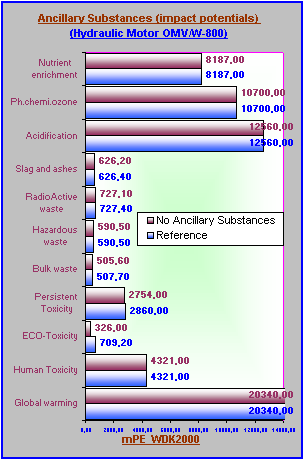
A sensitivity analysis is performed on ancillary substances (oil products) that are used in the manufacturing processes inside and outside Sauer-Danfoss. It is assumed that the ancillary substances are not used to manufacture different parts of the hydraulic motor, which are included in the LCA study. The model is set up to 100% reduction of ancillary substances in the manufacturing stage of the hydraulic motor (inside and outside Sauer-Danfoss) and the model is simulated as shown in figure (3.45). This results in the values of eco-toxicity and persistent toxicity in
environmental impact categories decrease rapidly (figure (3.45)). Ancillary substances do not reflect the rest
of the values of all other environmental impact categories and they are
decreasing very slightly, such as wastes categories and global warming. (it
is difficult to view changes in the results so, please check appendix A section
(5.4) and appendix B, section (B.5.4.1), sensitivity analysis results to view
the changes on other categories). This result The major effect is achieved by the changes of ancillary substances in the manufacturing stage for persistent toxicity and eco-toxicity potentials that are reduced significantly. The reduction of 100% ancillary substances is the reduction of 50% in eco-toxicity, which further reflects the persistent toxicity (see appendix A, chapter 5, section (5.4), appendix B, chapter 5, section (5.4.1)). Eco-toxicity is due to the ancillary substances chronic and acute toxicity through water compartment distribution to the different compartments (air, water and soil) after being treated in a wastewater treatment plant. Chronic eco-toxicity further contributes to persistent toxicity. (Persistent toxicity includes chronic eco-toxicity in the water and soil compartments: therefore the chronic eco-toxicity from the ancillary substances reflects the persistent toxicity significantly). Those ancillary substances that are incinerated after use, affect the rest of the impacts categories e.g. Petroleum and Tellus oils are incinerated after use. The human toxicity potential is unaltered, and this is attributed to the fact that the contribution to this impact mainly derives from the other parameters. But the human toxicity is not calculated, which could also influence results significantly from the ancillary substances. The 100% reduction of ancillary substances in the system
is not possible, but it can be seen that the reduction of 25% ancillary
substances will also reduce 12.5% of eco-toxicity and further persistent
toxicity in the product system. The optimization can be made in ancillary substances via
reduction. There are some solutions that seem to be valid: ¨
By
improving processes efficiencies ¨
By
replacing process methodology and machineries ¨
By
reducing used amount of those oils products, which contribute to toxicities
impact potentials. ¨
By
replacing machines to the new technologies machines, which do not use the oil
products in the manufacturing processes (so many on the market.) ¨
By
replacing the oil products containing, manganese and molybdenum substances (as
investigated above) such as product (Phos. Compound1), product
(miscellaneous2), and product (Phos. Compound2) contain large amount of
manganese, and molybdenum in the product in the form of manganese nitrate,
molybdenum disulphide and manganese phosphate. There are no significant changes in the resource
consumption profile, therefore the results graph and discussion is not included
here. 0.1.2.1.2
The energy consumption
A 25% energy reduction in the electricity (thermal
energy) and energy (gasoline oil energy) Now it important to know from which part of the
hydraulic product system the contribution comes from.
Two scenarios are applied in order to get a clear picture of the product: 1) By
reducing electricity consumption in the raw materials, manufacturing and
disposal, 2) A reduction of 25% of the energy consumption in the use stage. In
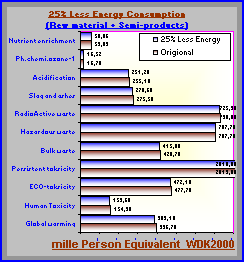
the first scenario; the electricity consumption reduction in raw material +
semi-products, manufacturing and disposal stages has a
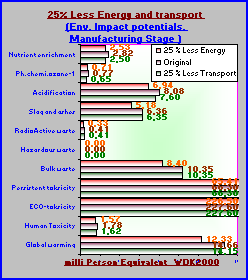
visible although small influence on the impact categories as shown in figure
(3.47) and in detailed discussed in appendix A, chapter 5, section (5.4),
appendix B, chapter 5, section (5.4.2) and appendix D, chapter 2, section (2.4).
The change is at the level 1-2%. The second scenario of the energy consumption is most
significant. The energy consumption in the use stage makes the greatest
contribution to the environmental impact potentials, a reduction in this
consumption makes significant changes in the environmental profile as discussed
in detailed in Appendix C. chapter 7, section (7.4) and results are shown
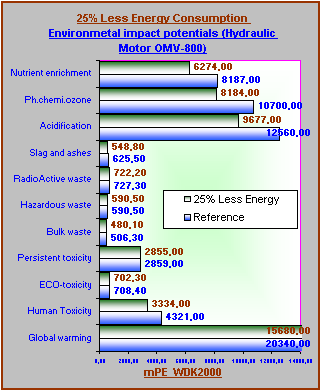
in figure (C7.5)). The figure (3.46) shows that a 25% reduction of the
electrical/energy in the hydraulic product system contributes almost 23% in
average of the quantities of main environmental impact categories i.e. global
warming, acidification, photochemical ozone creation and nutrient enrichment. Optimization
can be made in how energy and electricity consumption can be reduced. The
electricity consumption in the raw materials stage is almost a worldwide
consumption, therefore it is difficult to optimize. The one solution that seems
to be valid is by improving processes efficiencies and replacing process
methodology hereby reducing the energy consumption and impact potential.
Figure
(3.47): Sensitivity
analysis, by reducing 25% electrical/gasoline energy and transport in the raw
materials + semi-products and manufacturing stage of the hydraulic product
system. The electricity consumption in the manufacturing stage is
also significant if the use stage in not considered in the study.
71.890kWh electricity is used to manufacture one piece of the hydraulic
motor type OMV/W-800, which is quite a lot. 1 kg of manufactured material
consumes 1.910 kWh. By comparing the electricity consumption with manufacturing
of secondary raw materials that are used less than two times (0.769 kWh). The
large amount of electricity consumption directly influences the ecological
(impact potentials) and economical effects. Making optimal solutions can reduce the electrical energy
consumption in the manufacturing stage. ¨
by
replacing old machinery, it may effect the economy in the beginning, but it will
solve ecological affects and economical effects after a certain period of
time. ¨
by
improving production efficiency and accuracy. (Machines must be
stopped, when workers take a break, most of the machines have been seen running
during lunch breaks). ¨
the
hardening process consumes quite a lot electricity (2.018 kWh/kg material), the
processes can be replaced into others technologies.
In the second scenario, the gasoline energy consumption in
the use stage is found to be one of the most significant parameter of the
lifespan of the hydraulic product system. A total 189475MJ of energy (see
MECEEO model calculation) is lost in the entire line span of the hydraulic
motor OMV/W-800. By improving 1% efficiency of the hydraulic motor OMV/W-800,
13533MJ the energy (8,255 Kr/per product) consumption can be reduced. (It
should be noted that the drain system efficiency is not added in the LCA study).
The number of optimizations is made in
reduction of energy consumption in the use stage. ¨
The
volumetric efficiency can be improved by reducing roughness of the parts.
¨
Improving the
parts tightness and leaking fraction can reduce the volumetric efficiency.
For example, the gear set accuracy betweens rollers, wheel and rim. ¨
The
material replacement may help to improve parts efficiency. ¨
By
increasing hydraulic oils concentration, it may increase, because the
concentrated oil will reduce the leaking and will increase the efficiency.
¨
Making more
studies in displacement timing may help. ¨
Replacing
technology may help to increase the hydraulic product efficacy. For example, the
gear set and technology can be replaced into fan type systems, which may rotate
easily with low pressure. ¨
The distributor
can be replaced with an electronic system, which may increase the fraction. ¨
The
efficiency can be improved by improving the holes net complexity in the
hydraulic product.
Finally,
Sauer-Danfoss needs to make more detailed studies in order to understand the
factors that decrease the efficiency in the system. By choosing factors one by
one it may increase. 0.1.2.1.3
Materials
As illustrated in the previous results section (3.3.3.1), the materials stage is also important in impact potentials categories such as resource consumption and environmental impact potentials. It is very difficult to optimize impact potential reductions during raw material extraction and production because of worldwide processes. Furthermore, some optimizations are made in order to reduce the magnitude of the impact potentials as below: (Note: It was not possible to simulate the PC model again and again by reducing the quantity of materials and replacing the quality of materials because model simulation consumes more than 3-4 hours per simulation. It order to understand where the impact potential categories come from, the simulation is performed on one by one materials, processes and used ancillary substances). 0.1.2.1.3.1 Optimized material replacement: As discussed in detail in appendix A, chapter 5, section (5.4), on
raw materials, the raw material extraction creates significant impacts on the
environment. As mentioned above, results discussion on different impact
categories in section (3.3.3.1), the raw materials cast-iron and steel
are found to be contributing to environmental impact potentials categories i.e.
global warming, persistent toxicity, and human toxicity and wastes impact
potential categories and steel is a dominant material in consumption of
significant resources such as nickel and molybdenum. In environmental impact categories
reduction, the following solution seems to be valid: by improving processes
efficiency and replacing technology such as the increase in carbon dioxide
emissions (mainly due to the blast furnace (BF) process), a coal would replace
natural gas as a power source, where coal produces more carbon dioxide than
natural gas. The hazardous waste is produced mainly by raw material processes,
which can be improved by improving recycling technology. Of
course the raw material stage is a significant stage in material related
resource consumptions. Resources such as nickel, molybdenum, manganese and Fe
(iron) are the most significant resources, which are due to different qualities
of steel and cast iron used to manufacture hydraulic product. For example, the
steel qualities 18CrNi8, X45Cr13 contain nickel and steel quantity 20CrMn5
contains molybdenum, which are the most significant metal resources in the
product. The choice of material can improve the scarce materials consumption in
the hydraulic product profile. For example, high qualities of steel containing
scarce materials can be replaced with other high qualities of steel, which will
directly affect the ecological and economical effects in the hydraulic product
system. The designer needs to be aware that, when s/he is going to design
new/revised product, the designer can use environmentally friendly material in
the very beginning of the product design. 0.1.2.1.3.2
Optimized
solutions and benefits by weight reduction of the product:
The weight reduction
of the hydraulic motor affects results significantly in the hydraulic product
system. By using the “MECEEO model“, a reduction of 1 kg of material is seen
in the product and this makes major changes in electricity consumption as
mentioned above, as well as raw material extraction rates. This affects the
Sauer Danfoss’ economy positively. To answer the question, how and where the
weight of the hydraulic motor can be reduced, some areas in the product are
optimised and the benefits are as follows: ¨
The product’s parts such as the cast iron parts that
are designed with respect to shape and decoration. The weight can be reduced
with respect to the part’s function and capability. Here is one example on
motors: TMT type motor is also designed by Sauer-Danfoss with a weight of
approx. 30kg. The motor is different in shape, but it is used for similar
functions and capabilities as the OMV/W-800. In others words, the functional
unit of the TMT hydraulic motor is the same. By weighing both motors, a
difference of 7kg material is found. ¨
Material consumption can be improved by improving waste
in the manufacturing processes. For example, Sauer-Danfoss buys 5 m steel rods
from external companies in order to manufacture the parts. Almost ½ meter (10%)
rod is disposed because the machine is unable to handle rods that are only ½
meter long. The new technology machines can improve almost 10% materials in the
products system, which would be a significant improvement in the raw material
consumption. Another solution for the hydraulic product: the products parts,
which consume more material in the manufacturing stage, can be purchased in raw
part shape from the supplier. For example, the channel plate is manufactured
from steel rod. The rod is divided into required pieces (weight = 3.157 kg).
After manufacture the final weight of the channel place is 1.580 kg. 50% of
material is lost in the manufacturing stage. The cutting and grinding
methodology can be replaced with pressing methodology; the external company can
manufacture raw plates in a required shape during melting processes and hot
melted steel through pressing processes, which can be further manufactured in
the proper size.
¨
By improving 1 kg of material more than 5 kWh
electrical energy can be saved from the raw material extraction to recovery of
the hydraulic product system. ¨
Reduction of one kg of material will reduce impact
potentials in the product significantly ¨
Reduction of weight of the hydraulic motor will
decrease the transport in the entire life span of the hydraulic product system. ¨
Weight reduction will directly improve Sauer-Danfoss’
economy and will increase the market by providing cheaper price for the
hydraulic motor. 0.1.2.1.3.3
Optimised solution in
disposed material:
As mentioned in the
previous section, the disposed material also plays a significant role in
relation to impact potentials. The ecological and economical aspects can be made
by improving material-disposing methodology as follows: ¨ 10% of the material is disposed with use in the manufacturing stage e.g. the rod pieces which are unable to be processed by the machines and parts that are over-designed with machine settlement mistakes, can be improved by replacing and improving machine production efficiencies. ¨
Manufactured waste can be stored in different
marked containers. For example, different qualities of steel can be aggregated
in different containers, which will not impair the quality in the recycling
stage. ¨
The quality of the
material stamped on parts during the manufacturing stage will improve 100% of
the resource consumption. The different qualities of steel can be aggregated in
the shredder house and can be renewed, which will not impair the steel quality
and almost 100% of metal resources will be recovered. 0.1.2.1.4
Oil incineration in disposal
stage
100% of hydraulic oil consumption
and incineration after use contributes to impact potentials such as global
warming, acidification, photochemical ozone, toxicities, slag and ashes, and
crude oil resource categories significantly. By
performing a sensitivity analysis by reducing 25%
of the hydraulic oil, the hydraulic
oil incineration process is found to be significant in the hydraulic product
system. The hydraulic oil in the use stage contributes to 14 mPR for crude oil
resource and the hydraulic incineration contribution results are reported in appendix D, chapter 2,
section (D2.4)). Some solutions are
optimised in order to decrease the significant impact potentials categories as
follows: ¨
The hydraulic oil can be used as a second hand product
by filtering and cleaning technology. It can be cleaned and used in the
low-pressure system and in the other products for lubrication. ¨
The
hydraulic motor lifespan is very sensitive to the disposal and use stage also.
By adjusting the functional unit of the product it can affect environmental
impact categories significantly. ¨
The
disposal results can be improved by decreasing hydraulic oil consumption in the
use stage, by improving the drain system. ¨
Another
possible improvement would be to replace the hydraulic oil with another oil
(that cannot be incinerated) in the drain system, for example: the hydraulic
oil, which is used with water in concentration 3% to 10%. The hydraulic oil can
be treated in the wastewater treatment plant after being used, which will affect
results significantly. 0.1.2.1.5
Life span of the hydraulic
motor:
The life span is of
considerable significance for the relative weighting of all stages other than
the material +semi-products, manufacture stage, i.e. the use stage and disposal
stage. This is attributed to the LCA being expressed per unit of time, and
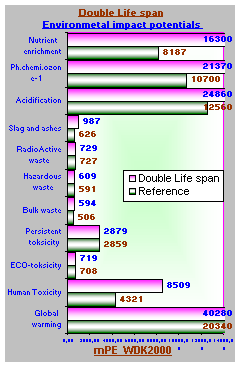
contributions therefore are normalized with the life span. Figure
(3.48) shows the significance of theoretical change in the life span namely: ¨
a life span of 16.62 (34568 hours) years (Double time) The found results are
compared to the reference results, as is clear from figure (3.48), the
significance of the life span is greatest in terms of the contribution to global
warming, acidification, photochemical ozone creation, nutrient enrichment, human
toxicity, slag and ashes, natural gas, crude oil, because they are most
significant during the use stage and disposal stage. The life span of the
hydraulic motor contributes almost 99% of the quantity of most significant
impact categories. By increasing the life span of the hydraulic motor, the most
significant parameters increased almost to the double i.e. the energy
consumption in the use stage, and the quantity of hydraulic oil in the use and
disposal stage, which are most significant in the hydraulic product system. By
increasing the life span of the hydraulic motor the most significant parameters
also increase at the same ratio, which affect the significant impact categories
in the hydraulic product system. The materials parameter affects results very
slightly when increasing the motor life span, because the replacement parts are
used with respect to functional unit, but are insignificant in the hydraulic
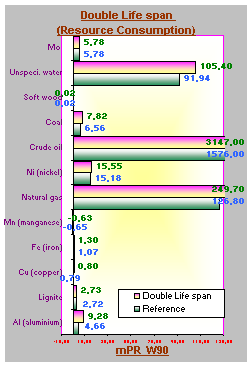
product system. The consumption of
significant resources i.e. crude oil and natural gas depends greatly on the use
stage and consumption of crude oil and natural gas therefore change, if the life
span changes. The impact potentials
for global warming, acidification, nutrient enrichment, human toxicity and
photochemical ozone creation categories are increased by 99% for life span 16.62
years (34568 hours) (double) relative to a life span of 8.31 years (17284
hours). Acidification, nutrient enrichment, human toxicity and photochemical
ozone formation follow the pattern for global warming. The figure shows a
decreased life span of the hydraulic motor results in environmental improvement.
Making all above
optimisations in the product can reduce the significant impact potentials. It is
difficult to optimise a lower age for the hydraulic motor because the age of the
hydraulic motor is adjusted by Sauer-Danfoss to10-20 years.
Figure
(3.48): The sensitivity
analysis by increasing the life span of the hydraulic motor.
0.1.2.1.6
Transportation:
The sensitivity analysis is
performed on transportation involved in the life span of the hydraulic product
by choosing 25% less transportation in the entire life span of the hydraulic
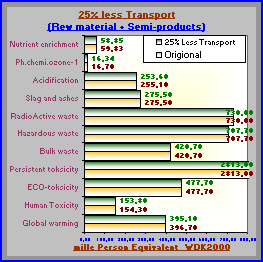
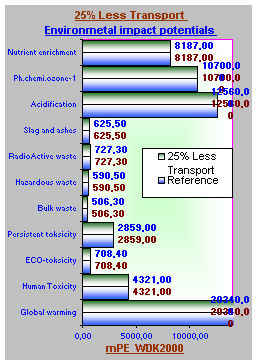
product system. Figure (3.47) shows that the transportation does not
affect the results significantly in the product system. Very slight changes in
global warming, human toxicity, photochemical ozone creation, and acidification
and nutrient enrichment categories can be seen (the main reason CO2,
NMVOC, NH3, CH4, CO, N2O, SO2 and NOX
emissions to air). Please note that the following figures do not show the
changes in the results, because of the very small impacts from the
transportation in comparison to other significant parameters i.e. energy
consumption, raw materials processes and oil incineration in the disposal stage.
For a detailed investigation of each stage of the hydraulic motor the
sensitivity analysis is performed and reported in appendix A chapter 5,
section (5.4) on raw material + semi-product stage, appendix B, chapter
5, section (5.4.2) on manufacturing stage, appendix C, chapter 7, section
(7.4) on use stage and the disposal material is found to be insignificant.
The rest of the categories such as waste categories, eco-toxicity and slag and
ashes, the transport does not contributes. The photochemical ozone and nutrient
enrichment categories are significant categories for transport, because of NOx
and NMVOC generation by oil combustion in the diesel engines. But it does not
contribute to the persistent toxicity, because transport affects human toxicity
on a local scale not regional scale.
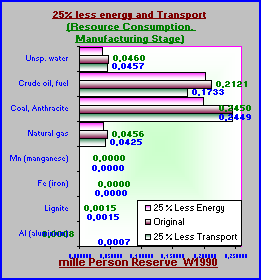
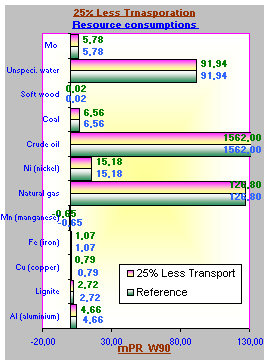
Figure
(3.49): Sensitivity analysis on environmental impact
potentials and resource consumptions categories by reducing 25% of the
transportation in the hydraulic product system. From this new model it can be seen
that a change in transport of 25% less does not contribute significantly in the
hydraulic product system. Presented results on different stages also demonstrate
that the transport in the hydraulic product system is an insignificant
parameter. There are no optimized solutions made on transportation. Note:
Data on transport 16>ton diesel lorry on motorway (ID O32758) is found to be
wrong. 0.294 kg gasoline oil consumption per km is recorded in the database,
which affects results most significantly. In the end, the model is modified and
all transport data is replaced to other data (ID 32693).
Summary The most significant environmental impact affected by the simulations is the persistent toxicity and eco-toxicity, global warming, acidification, photochemical ozone creation and nutrient enrichment. A reduction of ancillary substances in the manufacturing stage results in large reductions of potentials for persistent toxicity and eco-toxicity and a reduction of energy consumption in the use stage results in large reductions of significant impact potentials for global warming, acidification, nutrient enrichment and photochemical ozone creation and in the resource consumptions i.e. natural gas and crude oil. The energy consumption in the use stage has the greatest significance for the potential impacts. Optimization of the energy consumption in the use stage therefore has the highest priority. The hydraulic oil also contributes to crude oil resource consumption. A resource consumption of metals i.e. nickel and molybdenum can be reduced in the product system by making improvements in the recycling methodology i.e. by stamping the quality of material on manufactured parts and by collecting the company manufacturing waste of material in the different containers. The
life span and efficiency of the motor are most significant parameters, but not
unambiguous. Increased life span increases environmental impact potentials and
energy related resources consumptions in the product system. The lifespan of the
hydraulic motor is very sensitive to the hydraulic product system. By reducing
and increasing the lifespan of the hydraulic motor, it contributes to the
results most significantly. On
the other hand, increasing the efficiency decreases environmental impact
potentials and energy related resources consumptions in the product system
significantly. Finally,
a reduction of energy in the use stage is a significant parameter, which has a
visible and high influence on the impact categories as shown.
| |||||||||||||||||||||||||||||||||||||||
Send mail to [email protected] with
questions or comments about this web site.
|