



|
|
|
| Normalization (The magnitude
of the product’s contribution)
This
section describes the magnitude of the contributions to the various impact
categories from the hydraulic product system. To gain some perspective of
whether the hydraulic motor contributes a lot or a little to environmental
impact potentials, the contributions are ranked relative to a person’s average
annual contribution. In other words, in order to understand the magnitude of the contributions, the hydraulic
motor OMV/W-800 contributions to the various impact categories are divided by
the contributions, which a person makes on average during a year 1990 (the
reference year). The magnitude of the hydraulic motor’s contributions is
thus expressed in person-equivalents, or more correctly milli-person–equivalents
(mPE.), which are the product contributions in thousandths of an
average person’s contributions. This conversion makes it possible to compare
the various impact categories within resources and environment. The conversion
is called normalization. It should be noted that the weighted profile (next
section) is also expressed in the same unit (mPE), this does not necessarily
mean that impact potentials can be compared directly. For example, equally large
amounts shown in figures do not necessarily have equally significant
contributions. The significance of the impact categories depends on the
weighting factor of the individual impact. The weighting factors on all impacts
are illustrated in appendix F, table (F1.1).
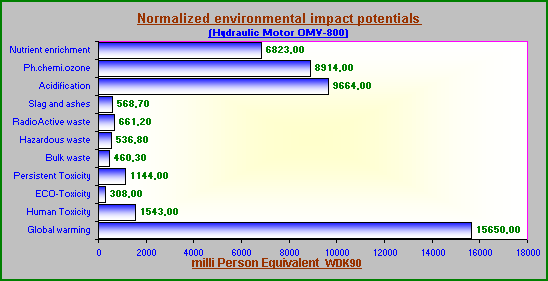
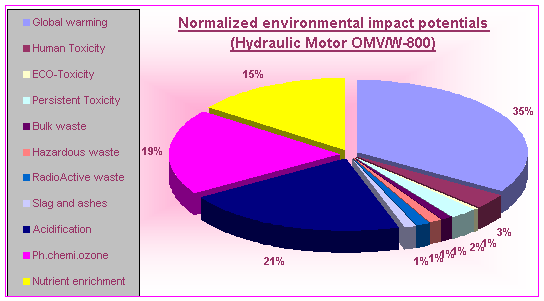
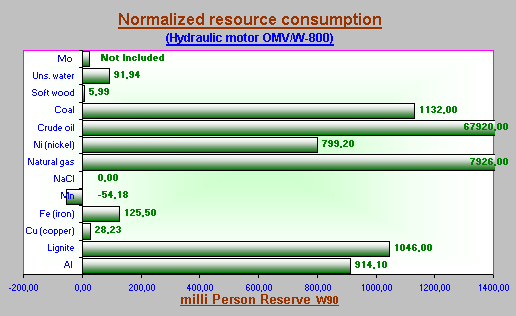
The figures (3.22), (3.23) and (3.24) show a normalized profile of the hydraulic motor OMV/W-800: a resource profile and an environmental profile. The profiles give the product’s contribution to a person’s average contribution, but these profiles don’t show the critical results of the impact potentials. This is however, described in the next section by using EDIP weightings methodology. From the figures it is clear that the hydraulic motor has a very high magnitude contribution to the potential impacts, including resource profile and environmental impact potentials. This is attributable to the fact that the use stage of the hydraulic motor consumes large amounts of energy consumption in the form of gasoline oils. The raw materials + semi products stage and use stage are significant stages in the consumption of resource and environmental impact categories. The manufacturing stage mainly reflects toxicity impact categories from the use of ancillary substances. The environmental characteristics for many of these ancillary substances have not been investigated thoroughly, and it may in any case be difficult to obtain information on them from suppliers and company employees.
Figure (3.22): Normalized environmental impact potentials for the hydraulic motor OMV/W-800 product.
Figure (3.23):
Normalized environmental impact potentials for the hydraulic motor OMV/W-800
product. The environmental profile, figure (3.22) and (3.23) shows that relative to a person’s average consumption, a hydraulic motor contributes especially to global warming, which is due to the oil combustion in the use stage of the hydraulic motor OMV/W-800 (see appendix C, chapter 7, section (C.7.3). The contribution corresponds to 1565% of a person’s contribution to global warming. Other main impact categories such as acidification, photochemical ozone creation and nutrient enrichment contributions are also significant in a hydraulic product system, and mainly derive from the use stage. Acidification contributes to 996%, photochemical ozone creation contributes to 691%, and nutrient enrichment is about 682% of a person’s in average. The human toxicity is also due to the high amounts of oil combustion in the use stage, which is about 154% of a person’s contribution to human toxicity. Furthermore the regional human and eco-toxicities generate persistent toxicity to the environment throughout the entire life span of the hydraulic motor, which contributes to 114% in the product system. The eco-toxicity contributes to 30% (308 mPEWDK90), which mainly derives from the ancillary substances in the manufacturing stage. It should be noted that for all contributions, 1990 is used as reference year.
Figure (3.24):
Normalized resource consumption for the hydraulic motor OMV/W-800 product. As shown in figure (3.24), the consumption level
for important resources is about 800 to 68000mPRW90, corresponding to
80% to 6800% of the contributions for an average person in 1990, the reference
year. The resource profile shows that a hydraulic motor has a relatively high
consumption of crude oil and natural gas. The consumptions amount to 67.920 PRW90
or 6792% and 7.926 PRW90 or 792.6% of a person’s average
consumptions of crude oil and natural gas in 1990, (the reference year), which
are large amounts of consumption in the product system. Crude oil and natural
gas consumption are due to large amounts of energy consumption in the use stage
of the hydraulic motor system (see figure (C7.4), chapter 7, appendix C).
The product uses coal and nickel amounting to 1132mPRW90 and 799m PRW90
of a person’s average consumption in 1990 (the reference year). For the
remaining significant resources the unit uses 50% in average or less of a
person’s average consumption. The resource profile does not specify the
normalized consumption of molybdenum, as only the figure for reserve is known
not the figure for a person’s average. The main reason being that the
normalization reference unit value is missing; therefore normalization of the
molybdenum is not included in this study. Furthermore, making a weighting
profile of the resource, the normalization reference unit is assumed to be 1.
The disposal stage profile of the hydraulic motor (figure
(D2.5), chapter2, appendix D) shows that the large amounts of manganese and
nickel resource are credited after use in the recycled materials such as
recycled steel and cast iron. It should be noted that the recycled material is
ranked on the basis of Dansteel A/S data (see appendix D, chapter 1, section
(1.2.1.1). The natural gas and coal anthracite are also credited after use,
but still the product consumes a large amount of coal and natural gas resources.
Crude oil is also credited in the recycled material, which is very low amounting
to consumption in the entire life span of the hydraulic product.
|
Send mail to [email protected] with
questions or comments about this web site.
|