



|
|
|
|
Data sources and data
collection
The preliminary aim of the case study was to gather data from different locations that were involved in the hydraulic product’s lifespan. Data sources were defined in three categories C, L and O to be entered in the questionnaires, these were: Company: Site specific measured or calculated data, Literature: Value based on literature information data, Other Data obtained from other sites sources e.g. data extrapolated from other steel sites, which were not involved in this study. Most
of the data on raw materials extraction is collected from literature and the
EDIP database system. On some processes data were compared between
literature-to-EDIP database and averages data are used to build up the database
system. Data on high quality of cast iron and steel is obtained partly from
suppliers and missing data is estimated from literature and questionnaires with
LCI experts. Data on recycled material especially on steel and cast iron is used
from site-specific data and remaining data is gathered from the EDIP-database
system, (especially electricity/energy supply data and transport data taken
primarily from EDIP database (Frees and Pedersen 1996)). The
data cover a large part of the manufacturing processes, which were not fully
available in the company’s electronic database system. Data collection is
attempted in the manufacturing stage from several manufactures of the hydraulic
product through the use of questionnaires. However, only few manufactures were
ready to disclose information for use. In order to reduce the uncertainties in
the estimated data on each process in the manufacturing stage, the
questionnaires are made with 2-3 manufactures on the same process and ancillary
substance estimation. Table (3.9) provides a brief overview of the sources of data for the individual stages in the product life.
Table (3.9):
Data source 0.1.2
Data Collection
Methodology
As
mentioned above, the manufacturing stage covers a large part of the data. In
other words, the manufacture stage was one of the source stages in the data
collection on all stages in the hydraulic product system As mentioned in the
scope definition, the full information on processes occurring in Sauer-Danfoss
are collected i.e. all parts, processes, electricity consumption, ancillary
substances. The following
strategy is used to collect the data: ¨
The required internal database system information (password
and user name) is collected from database responsible persons and one must then learn
how to use the important programs in order to get all related information.
¨
The Motor OMV/W-800 parts list is prepared from the internal electronic
database system by browsing the program and further data on processes on each
part of the hydraulic motor are collected from the company’ electronic
database system also. ¨
The machine names were collected from the database system on each
process. ¨
Parts’ material types were found from the company’s literature. ¨
The supplier addresses were found from the internal database system with
the help of the purchasing department. Further data on raw material and
semi-products (parts) locations is collected from subcontractors by phone calls,
emails and letters. ¨
Data was not available on the quantity of the ancillary substances that
are used to manufacture one piece of hydraulic motor. (Data was not available per kg
or per ton of material. The way of using ancillary substances e.g.: one pipe
from the main storage tank supplies oils to the different machines. The worker
can add more oil in the machine when s/he sees that the oil level is low).
¨
Names of the ancillary substances were collected from hanged “safety
sheets” on machines. ¨
The quantity of the substances is estimated from machine storage
capacity, concentration in the water and new daily amounts of added substance. ¨
The loss of ancillary substances is estimated from the machines by
making questionnaires answered by workers and machine controllers (Detailed
report in sub-appendix BB.) ¨
Furthermore substances are calculated per part weight and a detailed
calculation on each part is reported in sub-appendix BB. (Example:
Machine no 11996 has an ancillary substances storage capacity of 1100 liters.
The machine works 16 hours a day (5 days a week). 10 liters of ancillary
substances are added every day due to loss of water and ancillary substances.
The machine is washed after 4 weeks. The machine’s working capacity is 100
pieces per16 hours. The ancillary substances are used with water in a 3%
concentration. The total ancillary substance per piece is = 0,195 l/piece).
By performing sensitivity analysis in the manufacturing stage (appendix B, chapter 5, section
(B5.4.1)), the ancillary substances are found to be significant in toxicity
impact potentials categories therefore discussed in the “discussion” section. ¨
The
manufacturing processes waste is estimated substituting the raw material weight
and final parts weight. Raw material weight and final weight are recorded in table
(3.2)
above. ¨
Electricity consumption data is collected from each department. The
electricity consumption has slight, but visible changes in the results, and are
therefore included in the discussion. ¨
Transport is estimated on the basis of purchasing materials locations
and exporting market data in the whole world. This methodology is applied for
all stages of the hydraulic product. By checking the manufacturing stage by
performing a sensitivity analysis on the manufacturing stage, the transport is
found to be insignificant, with only slight changes in the results, which are
discussed in the later sections.
Included
manufacturing parts and processes in the inventory are marked (Ö)
in table
(3.2).
0.1.2.1.1
PC
tool Database configuration
The goal of this section is to describe the configuration of the PC Tool and the data entered into the tool. Collecting information on the many processes in the product system and entering into the database system has been a major task and it has taken a long time. The
entry data was calculated on the basis of one piece of the hydraulic motor
OMV/W-800. At each stage of the
life cycle, the input was calculated according to the weight of the material for
the respective stage. The detailed
listing of the inputs for each stage of the life cycle can be viewed
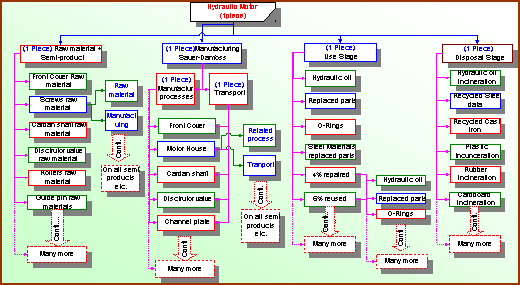
in Appendix E chapter (2). 0.1.2.1.1.1 ConfigurationThe life cycle of the hydraulic motor was divided into four main stages: ¨ Raw Material + semi-products ¨ Manufacturing Stage ¨ Use Stage ¨ Disposal Stage Each stage of the hydraulic motor OMV/W-800 was divided into sub-systems to include all the processes in the life cycle. The stages and sub-systems are explained below. (for details, see appendix E, chapter 2)
Figure (3.21): Database tree. (Note: Picture view is not clear, please see it in appendix E, figure (E2.1). The raw material + semi-products stage covers the data on raw materials, transport from raw material extraction to material production, and semi-products manufacturing. Data entry is made in the sub system on the basis of 1 piece of hydraulic motor and furthermore all data are entered on the basis of per piece. The manufacturing stage sub-system is divided into two sub categories: 1) 1 piece of hydraulic motor manufacturing processes data, and 2) Transport on 1 piece of hydraulic motor. The first category covers all entries related to manufacturing processes and used ancillary substances, and the second category covers data from subcontractors to Sauer-Danfoss including raw materials in the form of steel rods and raw parts (e.g. front covers, raw output shafts etc.) and semi-products from suppliers. Please note that processes occurred on parts are not divided into subsystems. Used ancillary substances are recorded under one subsystem e.g. the front cover is processed through cutting and drilling processes. All related information to 1 piece of front cover is recorded in the one sub system. The
used stage covers the replacement data, hydraulic oil, re-used motors, repaired
motors data under different sub systems. The
disposal stage covers the data on all incinerations processes and recycling
materials data under different sub systems.
| |||||||||||||||||||||||||||||||||||||||||||||||||||||||||||||||||||||||||||||||||||||||||||||||||||||||||||||||||||||||||||||||||||||||||||||||||||||||||||||||||||||||||||||||||||||||||||||||||||||||||||||||||||||||||||||||||||||||||||||||||||||||||||||||||||||||||||||||||||||||||||||||||||||||||||||||||||||||||||||||||||||||||||||||||||||||||||||||||||||||||||||||||||||||||||||||||||||||||||||||||||||||||||||||||||||||||||||||||||||||||||||||||||||||||||||||||||||||||||||||||||||||||||||||||||||||||||||||||||
Send mail to [email protected] with
questions or comments about this web site.
|