



|
|
|
|
0.1.1.1.1
Disposal
The
hydraulic motor is exported throughout the world as shown in figure (3.14)
on distribution locations. Disposing and recycling methodology varies from
country to country. It is difficult to get a real overview of the disposed product in
different countries. In order to achieve the target some scenarios are made on
recycling and disposing of the hydraulic product. ¨
The manner of disposal is assumed on the
basis of the method of disposing material in Denmark, which is applied to all
main markets that are involved in the present LCA. ¨
Raw material disposal is assumed to be 100%
deposited into landfills from the cast iron and steel manufacturing raw
materials. Plastic and rubber raw material waste after manufacturing is assumed
to be 100% incinerated with household waste. ¨ The oils in manufacturing and use stage are assumed to be 100% incinerated after used. ¨
The manner of incineration and disposal of corrugated board,
plastic, rubber, and oil is assumed on the basis of Danish incinerating methods
and further incineration data is used from the EDIP database system. ¨ It is assumed that cast iron and steel are recycled on the basis of steel scrap recycling methods in Denmark, which is applied to all main markets where the motor is disposed after use. These scenarios are applied for all other countries where the hydraulic motor parts and material is manufactured, used and disposed i.e. raw material stage disposal, manufacturing stage disposal, use stage disposal and life end disposal stage.
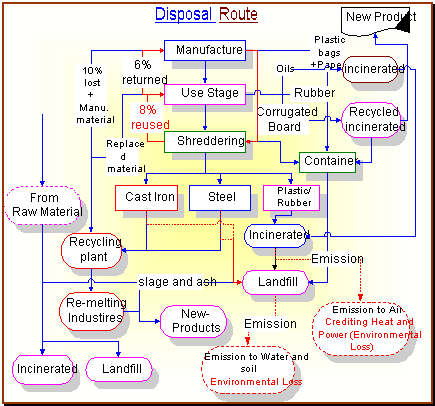
Figure
(3.15):
Disposal route of the hydraulic
motor. The disposal route on materials that are used to manufacture one piece of hydraulic motor is made as follows: 0.1.1.1.1.1
Steel
The
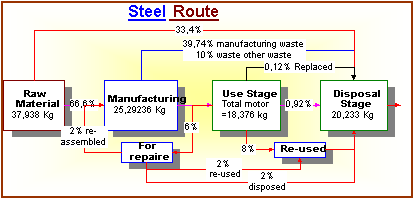
steel disposal route from cradle-to grave in the entire lifespan of the
hydraulic product system is illustrated in figure (3,16). Data are collected on the basis of Danish methods of disposing
and recycling steel materials and further metals recovery is made on the basis
of data provided by Dansteel A/S on recycling steel (see
appendix D, section (D.1.2.1.1.1)). Scenarios
on recycling and disposing of steel material are as follows: ¨ It is assumed that the steel is recycled on the basis of steel scrap recycling methods in Denmark, which is applied to all main markets where the motor is disposed after use. ¨ 80% of the steel is assumed to be recyclable after used (assumption based on table (21.6) EDIP, book, volume 1 and IISI, 1996). ¨ 99.99% recyclable steel is assumed to be recycled after the manufacturing processes, use disposal and reused disposal of the hydraulic product (this scenario is valid on 80% graded material) and a 0.01% fraction of recyclable cast iron and steel (in the form of small scrap in shredder processes, which are not able to be recycled) is assumed to be deposited into a landfill. Furthermore, cast iron and steel scraps are assumed to be recyclable on the basis of steel scrap recycling methods in Denmark ¨ Metals and alloying elements recovery is assumed to be based on recycling steel and cast iron methods by Dansteel A/S, Denmark. ¨ 1.2 grams stainless steel is used in the product, which is insignificant in the product. Stainless steel is neglected in this study.
Figure
(3.16): Steel
disposal route 80%
steel is recovered in its entire life (finishing, use and recovery etc.). The
total 20.230 kg steel in the form of steel scrap is credit, where 0.003
kg (0,01% fraction) steel is deposited in the landfill. Manganese,
chromium, molybdenum and nickel alloying elements are credited and reported in
MECO table (3.8) below (see in detail, appendix D, chapter 1, section
(D.1.2.1)). 0.831
kg of steel scrap is used to
manufacture 1 kg of low quality steel (see Dansteel A/S data, in appendix D,
chapter 1, section (D.1.2.1.1)). 24.347 kg of low quality steel can
be manufactured by Dansteel A/S from one piece of hydraulic motor.
0.1.1.1.1.2
Cast iron
Data
on recycling of cast iron is not available or not obtainable. In
order to achieve the target, assumptions are made on recycling and disposing
methodology of the cast iron. Furthermore it is assumed that these scenarios are valid to all main markets where the motor is disposed
after use.
¨
The cast iron is assumed
for recycling on the basis of the method of recycling steel scrap in Denmark.
¨
Cast iron scrap recovery is also graded 80%
similar to steel (table (21.6) EDIP book, volume 1, Michael
et. al. 1997). ¨
Cast
iron re-melting methodology is assumed to be similar to steel as mentioned in
the previous section and electricity consumption on re-melting
processes is assumed to be similar to steel processes, which is 0.769 kWh per kg
(DANSTEEL data). ¨
Data
on re-melting inputs/outputs processes is prepared on the basis of literature
and site specific data (EDIP database system, IDEA, report, 1991 and DANSTEEL
data). ¨
A total of 99.99% cast iron is assumed to
be recyclable after scrap recovery (It should be noted that this scenario is
valid on 80% graded material) a 0,01% fraction of
cast iron (in the form of small scrap, which is non-recyclable) is
assumed to be deposited into a landfill. 0.1.1.1.1.2.1
Cast
Iron Scrap Recovery
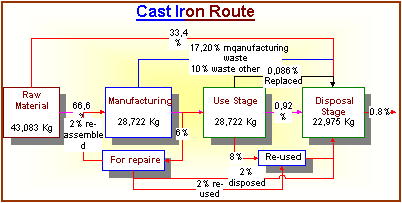
Figure
(3.17): Cast
iron disposal route A total of 22.975 kg cast iron is credited in the form of cast iron scrap from the hydraulic product, where 0.002 (0.01%) kg is in the form of unwanted scrap. The cast iron recycling is graded on the basis of Dansteel A/S data, where 0,831 kg of cast Iron scrap is assumed to be used as an input material in the re-melting process. On the basis of the given scenario, a total of 27.638 Kg of cast iron can be manufactured in a low quality renewed product. 0.1.1.1.1.3
Rubber
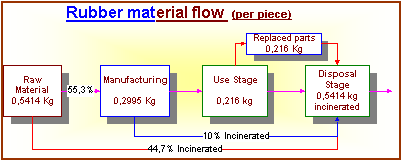
Figure
(3.18):
Rudder disposal route 0.1.1.1.1.4 Oils incinerationAs mentioned in the previous section, 100% of the oils are assumed to be incinerated after use in the use stage and manufacturing stage. A total of 387 liters of hydraulic oil is incinerated after use in the use stage in the drain system. 0.528 liters of petroleum is incinerated. The oil incineration is a significant process in the hydraulic product system, which is further included in the environmental diagnosis and final discussion (see in detailed appendix D, chapter 1, section (1.2.6)). 0.1.1.1.2
Packaging
material
The plastic bags are used to pack parts during manufacturing in order to protect them from dust and corrosion. One plastic bag is used to package the final product ready for export after assembly. The corrugated cardboard box is used to package the final product after assembly.
0.1.1.1.2.1
Plastic
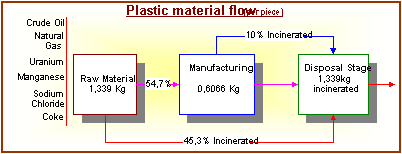
0.0115
kg plastic is used to manufacture hydraulic motor parts and 0.540 kg plastic is
used to manufacture plastic bags for packaging parts and product. A total of
1,339 kg plastic is incinerated in the entire life span of the hydraulic
product. In
order to achieve the target, assumptions are made on the disposal of
plastic material. Furthermore it is assumed that these
scenarios are applied to all main markets where the
plastic is disposed after use in the hydraulic product.
Please note that data was not collected from the plastic bag manufacturing
Figure
(3.19):
Plastic disposal route ¨
Plastic bags and motors
parts (plug) are assumed to be disposed in the household waste, which is
incinerated in the entire life span of the hydraulic product. ¨ 10% of the material is assumed to be lost in the manufacturing of plastic bags. A total of 0.606 kg material is consumed by one product of hydraulic motor. ¨ Plastic is made entirely from virgin material with the waste going to incineration. ¨
100% of the material is
assumed to be incinerated with household waste after use. Total used and wasted material in the entire life span of the hydraulic motor is illustrated in figure (3.19) (in detail see Appendix D, chapter 1, section (D.1.2.4)). The plastic material incineration does not contribute significantly in the product system, and therefore not discussed in the later sections.
0.1.1.1.2.2 Corrugated board (packaging box)
 The
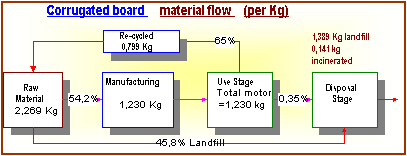
corrugated cardboard is almost disposed throughout world. The corrugated board
material flow is illustrated in the flow diagram (3.20). Furthermore
it is assumed that these scenarios are applied to all main markets where
the corrugated board is disposed after use in the hydraulic product.
Assumptions
are made on corrugated board disposing methods as follows. The
corrugated cardboard is almost disposed throughout world. The corrugated board
material flow is illustrated in the flow diagram (3.20). Furthermore
it is assumed that these scenarios are applied to all main markets where
the corrugated board is disposed after use in the hydraulic product.
Assumptions
are made on corrugated board disposing methods as follows.¨ Corrugated board is assumed to be 35% incinerated or deposited in the landfill and 65% recovered for recycling (assumption based on table (21.6) EDIP, book, volume 1). 70%-corrugated cardboard is recycled in Sweden (packaging and environment, Anne-Marie Tillman, et, al.,1991), which is very close to the above assumption. ¨
The
rest of the material is assumed to be incinerated and deposited in landfills. In
order to complete the database system for the model, 28½% material is assumed
to be deposited in landfills and 11½% material is assumed to be incinerated
with the household waste. A total of 0,141 kg material is incinerated (incineration
processes are used from the EDIP database system). Land filling
contamination from corrugated board is neglected in this study. Landfill
material is not included in the database
The
above assumptions are not important in the disposal stage (found by
performing sensitivity analysis on the disposal stage, appendix D, and chapter
2, section (D.2.4). The corrugated cardboard incineration does not
contribute significantly in the product system, therefore is not discussed in
the later sections. The impact potentials on the environment from waste are not
converted yet in the LCA, therefore the cardboard into the landfill is
neglected. |
Send mail to [email protected] with
questions or comments about this web site.
|