



|
|
|
|
The Life Cycle Assessment Framework (Theory)0.1
Introduction:
¨
collecting an inventory of relevant inputs and outputs of a product
system; ¨
evaluating the potential environmental impacts associated with
those inputs and outputs; ¨
interpreting the results of the inventory analysis and impact
assessment in relation to the objectives of the study. In
other words, Life Cycle Assessment is a tool/process to evaluate the potential
environmental impacts of a system (most often a product) through its
whole life cycle by collecting input and output data (together interventions)
from all units’ processes in the system and assessing the potential
environmental impact of these interventions. Many
definitions of LCA (Life Cycle Assessment) have been forwarded by various
institutions, but two organizations SETAC (Society of Environmental
Toxicology and Chemistry) and ISO (Industrial Standardisation
Organization) play a central role in the harmonisation of LCA methodology,
where the definition by SETAC is the most generally accepted. The SETAC “Code
of practise” defines LCA as: “a
process to evaluate the environmental burdens associated with a product, process
or activity by identifying and quantifying energy and materials used and wastes
released to the environment; to assess the impact of those energy and material
uses and releases to the environment; and to identify and evaluate the
opportunities to affect environmental improvements. The assessment includes the
entire lifecycle of the product, process or activity, encompassing extracting
and processing of raw materials; manufacturing, transportation and distribution;
use, re-use, maintenance; recycling, and final disposal.”
The
Life Cycle Assessment addresses environmental impacts of the system under study
in the areas of ecological health, human health and resource depletion (Consoli
et al. 1993). The
force of LCA is the ability to create a holistic overview of the environmental
impacts of a product system. A product in itself cannot have an environmental
impact. Only processes have input from and/or output to the environment. The
subject of evaluation in LCA is therefore a product system or more specifically
a chain of processes. LCA
has limitations and doesn’t provide the “truth”. However, the LCA
framework can provide the valuable inputs at different levels in the industry as
following: (Christiansen et al. 1995; Elkington et al. 1993; Ryding 1993): ¨
Conceptually
as a way of thinking when designing or improving products and system. ¨
As
qualitative assessments based on key environmental burdens or releases at stages
of the life cycle of the product/system. ¨
Methodologically
as a set of standards and procedures for the assembly of quantitative
inventories of environmental burdens or releases- and for assessing their
impact, and ¨
Managerially,
with the inventories and –where available –impact assessments serving as
platform on which priorities for environmental improvement can be set.
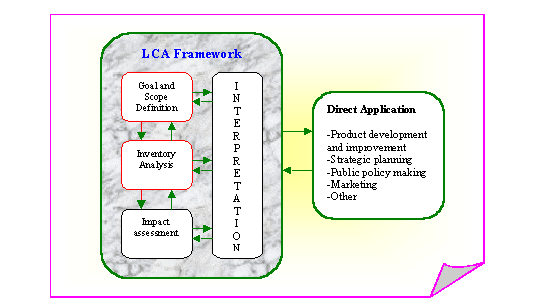
Figure
(2.1):
The phases of an LCA (ISO 14040).
¨
Identification
of processes, ingredients, and systems that are major contributors to
environmental impacts. ¨
Compare
different options within a particular process with the objective of minimising
environmental impacts. ¨
Providing
guidance in long-term strategic planning concerning trend in the product design
and material. ¨
Evaluate
resource effects associated with particular products, including new products. ¨
Help
to train product designers in the use of environmentally sound product
materials. ¨
Compare
functionally equivalent products. LCA
methodology comprises a set of different methods and approaches within a general
framework. As mentioned in ISO 14040 “there is no single method for
conducting LCAs…” It is not possible to define the rigid methodological
rules for all aspects of LCA because the scope, the boundaries, and the level of
detail will depend on the subject and intended application of the study. The ISO
14040 and subsequent standards distinguish four interrelated phases in the LCA
framework as illustrated in figure (2.1)
and reported below: ¨
Goal and Scope
definition ¨
Inventory ¨
Impact
assessment ¨
Interpretation 0.2
Goal and Scope definition
The goal and scope definition phase may be the most
critical of the LCA (Lindfors et, al., 1995a) because this is where the
detailed framework of the study is designed to tackle the goal. An important
function of the scope is to distinguishing “nice to know” and “need
to know” information for tackling the goal. 0.2.1 Goal definition
“The
definition consists of clarifying what the LCA can and cannot be used for,
including the decisions which it must support and the environmental consequences
to which these decisions can lead” (Hauschild and Wenzel, 1997a). 0.2.2 Scope definitionThe
objective of the scope definition is to identify and to define the object of the
assessment and to limit it to include that which is significant for the goal of
the LCA. The scope definition typically involves identifying the function(s) of
the assessed systems, system boundaries, functional unit, data requirements,
alternative products or services, key assumptions and limitations of the
product. In others words, the scope must be defined to sufficiently address the
goal of the study. The ISO 14040 basically identifies the same items, which
should be considered when defining the scope of an LCA study: ¨
¨
The
system boundaries; ¨
Allocation
procedures; ¨
Impact
types and methodology of impact assessment and subsequent interpretation to be
used; ¨
Data
requirement; ¨
Assumptions
and limitations: ¨
Type
of quantity assurance of the study, e.g. critical review; ¨
The
type and format of the report required for the study; According
to Hauschild and Wenzel, (1997a), the scope definition includes: ¨
Defining
the object of the study ¨
Selecting
one or more reference(s) product(s), which are important for the goal of the
LCA. ¨
Identifying
the environmentally significant processes in the product system, paying respect
to the goal of the LCA. ¨
Define
the time horizon, which the decision(s) based on the LCA, is to apply. ¨
Allocation
of the environmental exchanges that occur in the product system between the
object studied and the other user services to which the product systems
processes contribute, because they are part of other product systems.
0.2.2.1
Functional unit:
The
concept of a functional unit is very important in LCA. It defines the function
of the product in relation to fulfil the society or consumer requirements. It
provides the reference to which the environmental interventions of the system
are related. For example 1: a functional unit defined as packaging of 1,000
kg of milk to the consumers is a more societal relevant parameter then 1 kg of
glass vs. 1 kg coated cardboard. Example 2: The functional unit defined
for a paint system as the unit surface protected for a specified period of time
is much more relevant then I kg of paint, because the properties of the paint
differs significantly between different paints. The functional unit is
therefore necessary for comparability of LCA results (Stig Irving Olsen,
1997). In
the functional unit, quality is a very important criteria (e.g. if the
functional unit is settled to 1 kg of clean clothes, it must be specified how
clean the clothes should be). Such quality specifications may be determining
for the choice of processes and materials in the life cycle and thus have a
great influence on the total environmental effects of the system (Pedersen,
1993). The
functional unit includes both quantity and quality of the product, where the
quantitative description must specify the magnitude and duration of the product
and service, and qualitative description must define the quality level for the
product (Furuholt, 1995). For example: the comparison of three or more
fuels for cars should in principle be related to the function of transport.
Thus, the functional unit would naturally be ton-km, persons-km or car-km.
However properties that are unrelated to the fuel product (the car type, engine
technology and driving conditions etc.) have no great influence on the emission
and energy consumption in the use phase.
“The
environmental comparisons of alternatives, the duration of the service must be
the same, and the service must be experienced as comparable by user with respect
to both the quantitative and qualitative characteristics” (Hauschild and
Wenzel, 1997a). 0.2.2.2
System boundaries
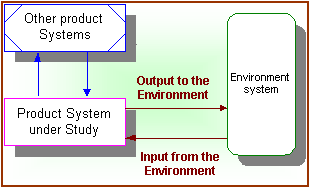
Figure
(2.2):
The product system will have
boundaries to other product system and to the Environment (Guinee
et al., 1993a) The
SETAC “Code of Practice” recommends the use of process flow-charts showing
how the subsystems are interlinked, as the best way to represent the related
products of the system and visualise the system boundaries (Consoli et al.,
1993). The
choice of system boundaries determines which unit processes are included in the
study and is therefore of tremendous importance for the results. According to ISO
(1997b) the sole criterion for setting system boundaries is “the degree
of confidence that the results for the study have not been compromised and that
the goal of a given study has been met”. The
system’s boundary separates the system from its surroundings, which acts as a
source of all inputs and the recipient of all outputs. To facilitate the
identification of the inputs and outputs of the product system, it should be
divided into unit processes, the boundaries of which are determined by the level
of detail that is necessary to achieve the goal and, in some cases, by the
availability of data. 0.2.2.3
Reference Product:
The
reference product is selected to represent provision of the service. A
distinction is made between two types of reference; a service reference
also called the “reference product” and data reference, most often
simply called “data”, where the reference product is the general
representative of the service and the data reference is to represent the
exchanges with the surroundings from selected processes in the life cycle to be
modelled (Hauschild and Wenzel,
1997a). Selections
of reference products depend on the life cycle to be represented. A reference
product can be one of the company ‘s own products or it can be several
references, including products from outside the company’s product range. 0.2.2.4
Parameter
selection for the inventory
The
three conditions for the inventory to be effective as input for future
assessments (Heintz &
Baisnee, 1992): ¨
The
inventory should be adapted to the purpose of study. ¨
Every
item in the inventory should be possible to translate into environmental impacts
categories. This condition is directly linked with the way boundaries of the
system are defined. It must be possible to interpret all the inputs and outputs,
in items of environmental impacts. ¨
The
list of impact factors must be complete and sufficiently detailed. The level of
detail and completeness are determined by the goal and scope of the study. The
choice of parameters to include in the inventory is important because the
results are never more accurate then the data input. The major heading under
which data may be categorised, comprise (ISO 1997b): ¨
Energy
inputs, raw material inputs, ancillary inputs. ¨
Products,
waste for treatment. ¨
Emissions
to air, emission to water, emission to land, other releases. 0.2.2.5
Scope definition of the
product system
The
objective of the scope definition is to set a model for the product (reference
product) system and assess the environmental exchanges expected to occur for
this product. It is noted that since a product system contains many processes,
it is necessary to rank them before going into details: “the scope
definition requires assessment of the product system before data for the
assessment are collected” (Hauschild and Wenzel, 1997a). The
scope definition means including the most significant processes from an
environmental perspective, and excluding the insignificant ones, so that the
data collection can be focused on the most important. In other words, it is a
phase where it must be possible to know what is the most significant part in the
product system before data are collected and assessed.
The
parts list. The product system to and including product manufacturing: Hauschild and Wenzel, (1997a) recommends four
significant elements in the parts list structure, which should be emphasized: 1)
Hierarchical construction, 2) use of key units, 3) processes sequence, and 4)
grouping of small items. The company’s parts list for the product must be
transformed into a form, which can be used in the LCA, and it then forms the
basis for scope definition of the product system to and including the
manufacturing stage (Hauschild and Wenzel, 1997a).
0.2.3
Allocation
Most
industrial processes especially of the manufacturing companies have more than
one output. The interventions of such unit processes must be allocated between
product and functions provided. Traditionally, allocation problems are
associated with (Lindfors et. al., 1995a):
¨
Multi-output “black box”
processes. ¨
Multi
input processes such as waste treatment, where a strict quantitative causality
between input and output seldom exist. ¨
Recycling. The
draft ISO 14041 recommends the following priorities for allocation procedures: ¨
Where
possible allocation should be avoided or minimised. ¨
If
allocation cannot be avoided, the allocation procedure should reflect the
physical relationship between the products or functions. ¨
If a
physical relationship cannot be established as a basis for the allocation, the
procedure should reflect the economic relationship between the products and
function. One
of the following routes can be used to do the avoid allocation: ¨
Disintegrate
“black box” into sub processes. ¨
Expending
the system boundaries include function associated with all flows.
The
general principle of allocation is to express the joint environmental exchanges
per functional unit. The
exchanges per functional unit express the primary task of the LCA, and therefore
continue to be the primary principle in the allocation. 0.3
Inventory
¨
Generation
of unit data and the setting up of unit processes. ¨
Inventory
of the environmental exchanges from the complex product system or for parts
thereof. ¨
Presentation
of the information in a transparent form. In
other words, the inventory concerns data collection and calculation of results
for the functional unit. The issues of great concern for the inventory analysis
are (Stig Irving Olsen, 1997): ¨
Functional
unit ¨
System
boundaries ¨
Allocation
procedure ¨
Data
quantity ¨
Sensitivity
analysis An
important goal of the data collection may be to establish a database, which can
be used on an on-going basis for LCAS at the company. Some issues
need to be further acknowledged in the collection (and interpretation) of data: ¨
Much
of the information needed for the analysis is available only from the company
involved in the life cycle. ¨
Most
available information is confidential; it is provided under the conditions that
it will not be included in the LCA report for publication. ¨
Because
of the large amounts of data, qualitative comments are easily lost.
0.3.1
Data Collection
¨
A
process description that specifies the operating conditions for the process. ¨
An
inventory of the interventions of the process, and ¨
A
characterization of the information (delimitation of the process, quality
characterization of the data) (Hauschild and
Wenzel, 1997a). The
data collection must be made in the area, which is selected in the scope
definition to be significant. A
data collection can be made as follows (Lindfors et al., 1995b): ¨
Calculate
data from material and energy balance. ¨
Collect
easy accessible measured data for emission to air and water and accounting data
(from invoices) raw materials and energy demand. ¨
Estimate
data for streams that are not measured from budget figures, design and
engineering data. ¨
Estimate
data from questionnaires and LCI experts’ discussions. ¨
Estimate
data from experience and process knowledge. ¨
Use
data from literature and databases and data from comparable production units. ¨
Use
other types of related data. The
data collection should be validated in an iterative procedure during the
collection. Such a procedure could involve establishing mass balances, energy
balances, and/or comparative analysis of emission factors (ISO, 1997b).
In order to limit the data handling to focus on these interventions which are
significant for the goal of the LCA, a sensitivity analysis should be used to
revise the system boundaries defined in the scope by excluding and including
flows and/or unit processes (ISO. 1997b). All data collected from each unit process must be related to the functional unit defined by calculation. Finally, the interventions can be aggregated to present the whole system. The current document for ISO 14048 describes the data documentation format for LCI (life cycle inventory) as described in ISO 14041. LCI data documentation according to ISO 14048: ISO 14048 prescribes and structures relevant aspects of documentation of LCA data. In regards of LCI data, i.e. data about technical activities, the relevant aspects focus around models of technical processes and their environmental properties. Such a model is in the ISO 14048 document referred to as a Process. “A
process can describe a unit process or any combination of unit processes, e.g. a
production plant or production line, cradle to grave life cycle inventory, a
transport process or route, or any single process equipment”
(http://deville.esa.chalmers.se/spine_eim/iso14048/iso14048.htm). 0.3.2
Uncertainties and
sensitivity analysis
A
critical issue in LCA is the use of a uncertainty and/or sensitivity analysis to
improve the reliability of the results. The main objective of the uncertainty
analysis is to assess whether the data quality is sufficient to support the
intended application of the study, and in some cases to assess if inventory data
shows a significant difference between studied systems (Lindfors et. al.,
1995a). The
uncertainty of the LCA lies in estimated analysis results and how much the
results can vary. The uncertainty analysis covers three types of elements, such
as: ¨
The
model of the product system: Assumptions concerning the processes that enter
into the product system e.g. data on process related ancillary substances,
energy, used input and output material in the processes. Product system’s
lifespan assumptions e.g. manufacturing, marketing, pattern of use, distribution
routes and disposal routes assumptions etc.
¨
The processes’
environmental exchanges: Actual data input and outputs to the environment etc.
¨
The assessment factors: the
equivalency factors, normalization reference and weighting actors etc. The
uncertainties analysis thus consists of estimating the uncertainties in the
scope definition, the inventory and the impact assessment, and resulting
uncertainty results of the LCA.
Both
uncertainty and sensitivity analysis are carried out after the assessment phase
of the LCA. The knowledge of the various environmental exchanges’ potential
contributions to impacts is used to assess the uncertainty and sensitivity
analysis on the LCA. By assessing the uncertainty and sensitivity analysis, it
is possible to decide which exchanges are the most significant and which are
insignificant in the product system. Several
approaches proposed by Lindfors et al., (1995a) for evaluating the
reliability of study results can be used: ¨
What-if-scenarios Estimates of
reasonable minimum and maximum values for different inputs may be used in order
to assess whether or not a reasonable deviation from the default value is likely
to affects the results. ¨
Use
life and mass balance Energy
or mass input and output flows in subsystems are not likely to balance in a
“key issue identification” LCA. Derivation between input and output total
mass and energy will however give an indication of data quality or data gap.
Mass balances can only be used for simplified estimates of information gaps and
only for major mass flows. ¨
Worst case checking
procedure The
key issue hidden by a specific data gap may be found by using reasonable
worst-case data. Data gap should never be treated as “zero” contributions (Pedersen,
1993; Lindfors et al., 1995a). ¨
Omitted
information The
justification of omissions made in the study should be assessed in relation to
the goal and scope of the study, by a sensitivity analysis as suggested by ISO
(1997b). In this case study, the data were typically either supplied from manufacturers without any indication of uncertainty (some were asked but were not able to give a confidence margin) or collected from Sauer-Danfoss’ literature and electronic database. The detailed description on uncertainties is included later. 0.4 Impact assessment
The main purpose of the impact assessment is to interpret the data obtained in the inventory, where the interpretation must be based on the available background knowledge of the environment and resources, and it must show which of the exchanges are significant, and how great contributions can be.
0.4.1 The impact assessment frameworkThe SETEC working group on Life Cycle Impact Assessment (LCIA) defines life cycle impacts assessment as “a quantitative and/or qualitative process to identify, characterize, and assess the potential impacts of the environmental interventions identified in the inventory analysis” (Udo de Haes, 1996). Ideally, impact assessments should list and quantify all potentially adverse effects involved in the life cycle of the studied system. The life cycle assessment framework puts constraints on the level of assessment, which can be performed, primarily for three reasons (Udo De Haes, 1996). ¨ The inventory is related to a functional unit, which is typically chosen arbitrarily. Thus, the magnitude of the impact is a relative value not related to actually occurring impacts at the given sites of the unit processes considered. ¨ The actual impacts at a given site are related to the nature and number of processes influencing that site. Many others products will generally be produced by these processes. Therefore, only some of the interventions at the site will be allocated to the product under study. ¨ The inventory is generally aggregated over the entire life span thus abstracting from temporal and spatial characteristics of the emission. The conceptual framework for the impact assessment was developed by SETAC in 1992 (Consoli et al., 1993) and basically has origin in the environmental theme method. Three stages were identified in the impacts assessments: ¨ Classification ¨ Characterization ¨ Valuation An additional sub-component “Normalization” situated between the “characterization” and the “weightings” is proposed.
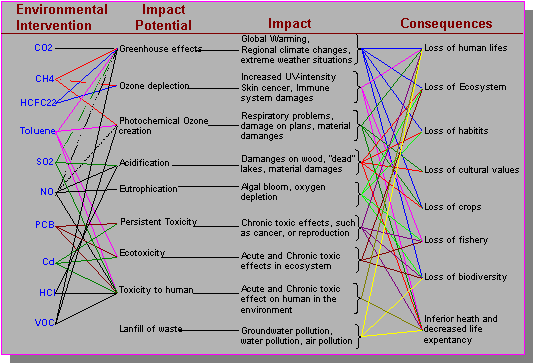
0.4.2 ClassificationThe classification is a qualitative step in which the different inputs and outputs of the system are assigned to different impact categories based on the expected types of impact on the environment. The classification should be based on a scientific analysis of the relevant environmental processes (rather then administrative criteria). The classification should thus answer the question: what are the expected environmental impacts of each input and output of the system? (Lindfors et al., 1995a). SETAC identified three main categories of environmental impacts: ¨ Resource depletion ¨ Human health ¨ Ecological Health As shown in figure (2.3), each of the inventory items are linked to these ultimate impacts by chains of intermediate impacts, each of which is introduced by a stressor e.g. SOX produces acid rain leading to fish death, which is ultimately an impact to ecological health. As illustrated in figure (2.3), interventions may have to be assigned to more than one impact category; these are “interventions with multiple impacts”. The impact of one substance may be parallel, series, indirect or combined. In the case of parallel impact e.g. sulfur dioxide, has an impact on human health, acidification, and material corrosion.
Figure (2.3):
Interrelationships between emissions, environmental impact potentials and the
various impacts and their consequences (Hauschild and Wenzel, 1997a).
0.4.3 CharacterizationThe characterization is mainly a qualitative step in which the relative contributions of each input and output to their respective assigned impact categories is assessed, and the contributions are aggregated within the impact categories. The characterization should be based on a scientific analysis of the relevant environmental process (Lindfors et al., 1995a). The classification results in each inventory item are assigned to one or several impact categories. In the characterization sub components, the potential contribution of the intervention to each impact category is assessed and qualified. Subsequently, all contributions to the same impact category are aggregated. The EDIP methodology (Hauschild and Wenzel, 1997a) tool provides different impact categories: 0.4.3.1
Global warming
0.4.3.2
Acidification
Hausechild and Wenzel (1997) emphasize the fact that a prerequisite for protons to be acidifying, is that the accompanying anion is reached from the system. In the EDIP methodology SO2 is used as a reference compound for the acidification. The effect of acidification depends on the buffering capacity of the recipient. Therefore EDIP suggest the use of site-factors reflecting the sensitivity of the recipient (Hauschild and Wenzel, 1997a). The equivalency factors can be calculated in different ways such as [mol H+/g emitted compound] or [mol H+/mol emitted compound] or as [gSO2 equivalent]. Two scenarios, a minimum and a maximum, should be used because the contribution to the acidification from nitrogen compounds depends on different processes in the terrestrial system. Two scenarios present the two extremes (Lindfors et al., 1995a). The EDIP methodology (Hauschild and Wenzel, 1997a) proposes to use a default of 80% of nitrogen compounds contributing to acidification. 0.4.3.3
Photochemical Ozone
formation
Different hydrocarbons react at different rates and with different efficiencies. The ozone formation varies in different regions and different times as a result of varying background concentrations and intensities of sunlight. The approaches suggested for characterizing emissions of VOCS (Volatile organic compounds) with respect to ozone formation are based on the concept of POCP (photochemical Ozone Creation Potentials). The POCPS are often expressed in ethane-equivalent. The Nordic Guideline suggests dividing impact categories into two subcategories (Stig Irving Olsen, 1997): ¨ Nitrogen oxide, aggregated as g NOX. ¨ VOCS, aggregated with POCPS as equivalency factors. However, even though it is considered that for larger parts of the northern hemisphere, a reduction in NOX would have a greater effect on troposphere ozone concentration than similar reduction in VOC-emission, apart from the high and low NOX scenarios, normally only VOCS are included in POCP calculations. For conditions corresponding to the Nordic countries data for “typical Swedish Environment”, low NOX is preferred (Stig Irving Olsen, 1997). For conditions corresponding to the European continent, the scenario “high NOX” should be used. The EDIP-methodology also recommends the same POCPS. Additionally the EDIP-methodology (Hauschild and Wenzel, 1997a) has proposed a methodology for calculating POCPS. 0.4.3.4
Eco-Toxicity:
Chemicals emitted as a consequence
of human activities contribute to eco-toxicity if they affect the function and
structure of the ecosystems by exerting toxic effects on the organisms, which
live in them. If substance toxic effects can occur as soon as possible after
release, it is called acute eco-toxicity. This type of toxic effect,
which first appears after repeated or long-term exposure to the substance is
called chronic eco-toxicity (Hauschild and Wenzel, 1997a).
0.4.3.4.1
Calculation of Equivalency
Factor (EF(et):
The requirements of the method of
calculation of eco-toxicity potentials of actual risk characterization is not
immediately suitable, as it makes excessive demands on the availability of data
on the individual substances in the inventory. The equivalency factor EF(et) is
determined as the product of three factors (air, soil and water), which
represent the substance’s dispersion in the environment. To calculate the
equivalency factor (EF), it is necessary to calculate or determine (Hauschild
and Wenzel, 1997b): 1)
The faction (f) of the emission, which reach the
different environmental compartments after dispersion. 2)
The biodegradability factor (BIO) for the substance 3)
Calculate eco-toxicity factor (ETF) representing the
substance’s potential eco-toxicity in the three compartments.
0.4.3.4.1.1
Determining
the fraction (f) of the emission:
The inventory may include emissions
to water, air and soil, even if a substance is emitted to one compartment. The
redistribution calculations decides (Hauschild and Wenzel, 1997b):
1)
for which parts of the environment eco-toxicity potentials are to be
calculated. 2)
The quantity of the substance contributing to the eco-toxicity potential
in each of the compartments.
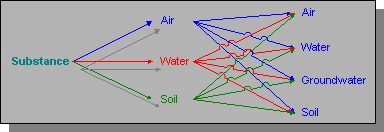
Figure
(2.4): Substance
redistribution in the different compartments. For each individual emission, the redistribution calculations results in the distribution factors fSC, fWA and fWC, which specify how large a fraction of the emission eco-toxicity potential should be calculated in the compartments soil and water. Detailed estimation methods on each department is reported in appendix B, chapter (4).
0.4.3.4.1.2 Biodegradability in the final compartment
If a substance is biodegradable, this is of significance for exposure to the substance in question. The quantity emitted to the compartment under consideration must therefore be corrected for this property. This applies to both water and to soil in the final compartment. The substance’s biodegradability in the final compartment is represented in the expression for the equivalency factor by the factor BIO, the magnitude of which is determined on the basis of the substance’s biodegradability, as it is expressed in standardized biodegradability tests. The description of biodegradability in the environment expressed via the BIO should not be more differentiated than justified by the empirical data. The BIO is therefore determined as described in table (2.1) (Hauschild and Wenzel, 1997b). 0.4.3.4.1.3 Calculate eco-toxicity factor ETFEquivalency factors for eco-toxicity can be calculated
as (Hauschild and Wenzel, 1997b):
Where: FC
is the distribution factor which indicates how much of the quantity
emitted ends in compartment ‘c’. ETFC
is the substance’s eco-toxicity factor for compartment ‘c’ BIO
is the biodegradability factor, an expression for the substance’s
biodegradability. 0.4.3.5
Nutrient enrichment
The substances that contain nitrogen (N) and phosphorous (P) compounds, lead to nutrient enrichment categories impacts on the ecosystem. The nutrient enrichment can be caused by emission to air, water and soil. The nutrient enrichment is an impact, which affects the environment on both local and regional scales (Hauschild and Wenzel, 1997a). Distinctions are made in this category between terrestrial and aquatic systems. In aquatic systems, input of nutrients may lead to increased biomass production. The biomass will, then decomposed, require oxygen. 0.4.3.6
Resource consumption, energy
and material
The aggregation of raw materials has been suggested without any weighing on the basis of mass. Such an approach would imply a definition that all raw materials are equally valued to be something useful that should be conserved. Guinee & Heijungs (1995) have developed a method, where a general equivalency factor approach has been conserved. The method distinguishes between biotic and abiotic resources and defines the abiotic depletion potential and the biotic depletion potential. Both are defined relative to a reference resource and are some modification of a reserve to use ratio, e.g. the amount of useful reserves divided by yearly amount used. The EDIP-methodology proposes to collect data on the use of useful raw material and not use any characterization. The inventory of raw material is the direct input to the normalization (see later). The considerations concerning reserve-to-use ratio is made in the valuation (normalization and weighting) step (Hauschild and Wenzel, 1997b). For renewable resources the use is related to the regeneration of that resource. 0.4.4 Normalization and Weighting (valuation) MethodAfter characterization and the presentation of the standardized results as a single parameter for each subcategory, there will usually be a need for further interpretation and discussion of the results in term of the relative importance of ecological impacts (different environmental impacts). The normalization step has two purposes (Hauschild and Wenzel, 1997b): · To give an impression of the magnitude of impacts and resources used connected with studied system e.g. related to the total magnitude of that particular potentials impacts. · To present and prepare the result for a final weighing (valuation) and decision-making. 0.4.4.1
Normalization Method
The characterized information of the normalization most frequently proposed, concern relating the product system’s potential contribution to an impact category to the total contribution to that impact category in a reference year. As a normalization reference, the EDIP method uses the impacts, including resource consumption and the potential impacts, which society imposes on the environment each year. If the resource consumptions for two resources are equally large on normalization, this does not automatically mean that the two resource consumptions are equally serious. In order to be able to compare the various impacts directly, an assessment must first be made of how scarce the resources are relative to one another. This is the objective of the final weighting step in the LCA, which is described in the next section. The normalization impact potentials and resources consumption NP(j) can be calculated as follows:
Where: P(j) is the impact potential or resource consumption (j) per product. T is the duration of the service as defined in the functional unit. R(j)90 is the normalization reference for one year (1990). Normally, the EDIP method operates with 1990 as a reference year for the normalization. The normalization reference is a measure of the average impact imposed by one person in one year (usually 1990.) For environmental exchanges applying on a global scale, the EDIP uses the total global impact as a normalization reference (W) for the world. For regional and local exchanges, Danish impacts are used (DK) for Denmark. The global, regional and local exchanges in the normalization are calculated as impact per person in the reference year to make a common scale between all three impacts as:
The
impact potentials are expressed in person equivalents (PE) in normalization. For
example: with
The normalized environmental impact potentials contribute by dividing the impact with the normalization reference (Wenzel et al., 1997). 0.4.4.2
Weighting (Valuation)
Method:
In the EDIP methodology, valuation takes its origin in
exiting political reduction goals for the different impact categories. This is
done by multiplying the normalized impact potential and resource consumption
with a weighting factor, WF(j). The weighting aim is to weigh the relative importance
of the different environmental impact categories. The methodology behind this
method is as follows: the resource quantitatively as calculated by dividing the
known content in the product with the known reserve per person in unit % or
0/00 of the resource in relation to what is the reserve per person through
time. This figure or unit is in the EDIP-methodology called person-reserve (PR).
In detailed methodology, the resource consumptions are weighted by the following
formula:
WR(j)
is the product’s weighted consumption of the resource (j) expressed as
the fraction of the known reserve per person in the year 1990. NR(j)
is the product’s normalized resource consumption for resource (j). RC
(j)
is the consumption of resource (j) per product. WF(j)
is the reciprocal supply horizon for resource (j) e.g. RR(j)90/RES(PE)90
or 1/WRLI90. RES(PE)xx
is known reserve per person in year xx Then the product’s weighted
consumption is:
According to the above explanation calculations can be
made on each resource. For example: 1,130 kg crude oil
consumption is the product divided by 25600 kg per person reserve = 0,0441 mPR (milli Person Reserve). The weighting factor, (WF) for environmental impact potentials indicate the percentages of the person equivalent which can be expected in the year 2000 if reductions are achieved due to the political targets for reduction of environmental impacts. The unit is given in PE_WDK2000, which stand for person equivalents based on target emission in the 2000 in the world respectively (Hauschild and Wenzel, 1997b). Weighting factor for environmental impact potentials:
The weighting factor thus expresses how much the normalized reference must be reduced by the year 2000 to be in accordance with the political reduction target. 0.5 InterpretationThe ISO 14043 International
Standard provides requirements and recommendations for conducting the life cycle
interpretation phase in LCA or LCI studies. This International Standard does not
describe specific methodologies for the life cycle interpretation phase of LCA
and LCI studies (http://www.inem.org/htdocs/iso/iso14000_intro.html#Anchor-14043). The information from all previous phases and elements, including qualitative information and information on uncertainties, is included together in this phase. This compassing information is compared with the goal of the study and conclusions are drawn on the environmental implications of the results. Recommendations to decision makers may be formulated. The framework for interpretation is still under development, but comprise a critical discussion of the possibilities and limitations of the study. Elements are: identification of major burdens, checking the data background and the assumptions for constancy, and completeness, ensuring stability of the finding through sensitivity analysis; deriving conclusion and recommendations (ISO, 1997d; Sauer, 1997). In all studies, the sensitivity analysis and uncertainties are probably necessary in the interpretation phase. Sensitivity analysis may be performed intuitively or more systematically. In adequate data, the methodology proposed by Heijungs (1996), may be used to evaluate the significance of each unit process’s contribution to the result. This methodology uses margins of uncertainty (i.e. confidence limits) for all parameters as an input. Then it identifies those parameters for which the margins of uncertainty for these parameters are involved. The following steps are included in the methodology: ¨ Define the margins of uncertainty required for the sufficient final results. ¨ Find the individual uncertainty margins for all input parameters. ¨ Calculate the influence of individual parameters to identify issues for further investigation. ¨ Choose the issues to improve. List the contribution to uncertainty from highest to lowest. Start improving the ones that have the largest influence on the parameters. ¨ Repeat the above procedure until the overall margins of uncertainty are acceptable. | |||||||||||||||||||
Send mail to [email protected] with
questions or comments about this web site.
|