Click on the buttons to navigate the site.
Cataag Compound, San Joaquin St., Ormoc City, Leyte, Philippines 6541
Tels. 63-053-255-3516 & 63-053-560-6441; Email: [email protected]
PFI Services
Community and Sectoral Organizing
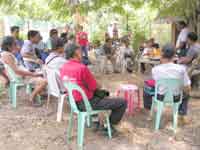
PFI believes that organized groups and sectors have better chances of solving their common problems rather than as individuals. The problem is how to get people organized. Historically and because of the nature of their economic activities, farmers and fishermen are difficult to organize. Getting them to agree on common solutions to common problems is a task that can be achieved only in a medium to long-term program. They can at best temporarily agree on certain issues but sooner than expected they are back to their individual selves.
Thus, we always claim that organizing is a long and arduous process since it involves changing attitudes and cultural beliefs which have taken roots since birth. The prevailing social practicies in the family and larger community only reinforce these practices. At this point in our experience, we can only say that unless production patterns are changed simultaneously with the change in cultural practices, we cannot hope to create real changes in the lives of people in our rural and urban villages.
Trainings for Community Development
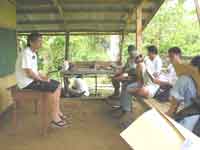
These trainings are usually conducted for recognized leaders in the communities, the initiators of change. First to be trained are the community organizers themselves who must be able to understand the social and political dynamics in each particular communities. In this activity, we require our workers to be immersed in the communities they are supposed to be working with. This part of the training provides them with skills to gather relevant information from the communities and synthesize these into a logical whole. We call that process our social investigation. Others prefer to call it social research.
Next the development workers are trained how to feed back the information to the community. They start to meet selected potential leaders in the community and discuss the synthesized. The community worker tries to arrive at a consensus as to what to do about the issues that crop up in the discussion. The results of such discussions usually provide the potential leaders insights about the possibilities of organizing sectoral groups that would seek the solution to the problems identified.
Each major problem undergoes a similar process of discussion and consensus and eventually brought to the larger community assembly for decision and action.
Leadership Development
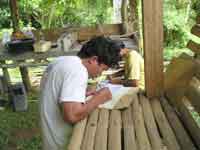
We invited selected potemtial leaders and those that are elected in a bigger community assembly to our leadership training sessions to better equip them with the basics of handling organized groups. The topics include an analysis of current political leadership, leadership conceepts, basic leadership philosophy, conflict resolution, how to handle meetings and group discussions.
In our experience, the community leaders who undergo these trainings usually make better leaders. When they become formal leaders and are elected to political positions in the community, they are able to use their stock knowledge in the practice of leadership.
ICT for Development Planning 
Information and communication technology (ICT) is a fairly recent phenomenon among groups involved in social change. IN the early years, there was "social investigation" which was roughly social research, minus the statistical mumbo jumbo. Today, those involved in social change need more accurate data. We need to pinpoint what exactly are the problems and who exactly are involved.
Thus there is no substitute for a database if we want to be more accurate and precise in our interventions. A more thorough household survey is needed, with its results configured in a database software for more efficient storage and data retrieval.
We are also in an age when information is better stored in computers and made available to partners halfway around the world. Thus, it makes a lot of sense to build one's own website for everybody to know who we are and what we are doing for social change.
Through the years, PFI has developed an efficient database application which can be used in development planning either by NGOs or LGUs in their planning offices. Its staff can provide consultancy services for the various stages of database development - from the design of the survey instrument, to the conduct of the survey, the development of the database application as well as tutorial for the use of the database application.
PFI also has the capability to design fully functional webpages for NGOs, LGUs and other interested parties. Contact here.
Home Leyte Map Sign Guestbook View Guestbook Contact