| Effective Classroom Instruction |
 |
 |
| This site is optimized for viewing at 800 x 600. |
 |
| Electronic Course Portfolio |
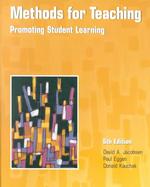
| The purpose of this course portfolio is to demonstrate my increased competence in the TExES Competencies as a result of this course, EDUC 5314. The TExES Frameworks and Competencies for grades 8 - 12 Pedagogy and Professional Responsibilities may be found at: http://www.sbec.state.tx.us/SBECOnline/standtest/texes/8-12ppr.pdf This is a "defense" of my learning and takes the place of a final examination. Our course text, Methods for Teaching, is pictured at left. All chapter references on this page are from Methods for Teaching, and each "Reader Response" is my reflection on one of its chapters. |
| TExES 8-12 Pedagogy and Professional Responsibilities Domain I, Competency 003: The teacher understands procedures for designing effective and coherent instruction and assessment based on appropriate learning goals and objectives. |
| TExES 8-12 Pedagogy and Professional Responsibilities Domain I, Competency 004: The teacher understands learning processes and factors that impact student learning and demonstrates this knowledge by planning effective, engaging instruction and appropriate assessments. |
|
| TExES 8-12 Pedagogy and Professional Responsibilities Domain II, Competency 005: The teacher knows how to establish a classroom climate that fosters learning, equity, and excellence and uses this knowledge to create a physical and emotional environment that is safe and productive. |
| TExES 8-12 Pedagogy and Professional Responsibilities Domain II, Competency 006 The teacher understands strategies for creating an organized and productive learning environment and for managing student behavior. |
| TExES 8-12 Pedagogy and Professional Responsibilities Domain III, Competency 008 The teacher provides appropriate instruction that actively engages students in the learning process. |
| It isn't enough, particularly in this era of accountability, simply to teach our favorite bits from the textbook or whatever else comes to hand. In Chapter 2, "The Goals of Instruction", I learned that the teacher must first consider long-term (yearly), medium (unit), and short-term (individual lesson) goals. It is important to consider district and departmental goals for each grade level; otherwise, students may repeat, or worse, miss, important material. Texas teachers must also consult the Texas Essential Knowledge and Skills (TEKS), which form the basis for the Texas standardized exams, the Texas Assessment of Knowledge and Skills (TAKS). When writing unit and lesson plans, teachers must construct meaningful objectives that are aligned with the TEKS and any appropriate national standards (such as the NCTE standards) and for which student performance can realistically be assessed. Chapter 3, "Formulating Goals and Objectives" taught me several different types of objectives, including Mager's behavioral objectives, goals objectives, and Gronlund's instructional objectives. I also learned how vital it is to specify observable performance and got some valuable practice in identifying, writing and rewriting objectives through the chapter exercises and Adprima content. |
| Having written good objectives which specify observable behavior, the teacher must then develop assessments that accurately measure student progress. Chapter 11, "Assessing Student Learning" taught me how to measure different types of student learning, such as facts, concepts, generalizations, and inquiry skills. I also learned some methods of alternative assessment, such as rubrics and portfolios. I learned that I must keep these and many other considerations in mind while planning instruction. I feel I made great progress in this area by writing and teaching several lesson plans this semester. Evidence: - Chapter 2 Reader Response - Session 2 Field Experience Report - Chapter 3 Reader Response - Session 3 Field Experience Report - Session 4 Field Experience Report - Session 6 Field Experience Report - Session 7 Field Experience Report (with chart) - Chapter 11 Reader Response - "Teaching to the test" - Facts and abstractions - Standardized testing - Assessment |
|
 |
| So many factors impact student learning that it is hard to know where to begin. For example, Chapter 1, "Introduction: A Model for Teaching" helped me learn more about motivating students. Other factors such as the learner's developmental level, the learner's prior experiences in school and life, and the learner's cultural and economic background play a big part in student learning. Chapter 5, "The Affective, Psychomotor, and Cognitive Domains" was also very helpful. I learned a lot about the various levels within each and how to gear my instruction to make the most of each domain. For example, I learned the different levels of the cognitive domain, such as knowledge, comprehension, application, and analysis. Having studied some of the factors that affect student learning, we then learned how to construct effective, engaging lesson plans. From Chapter 7, "Teaching Strategies", I learned about the most common types of teaching strategies: expository, guided discovery, discussion, and problem-based learning. Chapter 8, "Utilizing and Building on Learner |
| Differences: Instructional Strategies" offered more teaching models, such as mastery learning and cooperative learning. I feel this is the competency in which I have grown the most this semester. Although it will take some time and practice to really master these teaching strategies, I feel ready to begin planning and teaching creative lessons. Evidence: - Chapter 1 Reader Response - Session 1 Field Experience Report - Session 2 Field Experience Report - Chapter 5 Reader Response - Session 5 Field Experience Report - Chapter 7 Reader Response - Session 7 Field Experience Report (with chart) - Chapter 8 Reader Response - Session 8 Field Experience Report - Chapter 11 Reader Response - Exercise 1.1 - Societal values and motivation - Assessment |
|
| I think this competency speaks largely to the classroom management issue. "Respect and rapport" pretty well sums up what should be happening in a well-run classroom. Chapter 9, "Classroom Management: Prevention" addressed the elements of classroom management, including rules and procedures, managing transitions, planning the physical environment, and communicating with parents. I think it is important for the teacher to treat each student with respect and firmness. She should also not be seen favoring some students more than others. Most disruptions can and should be handled with a minimum of fuss, and with the right touch, a student perceived to be the biggest behavioral problem can be turned into a classroom or school leader. Two other major factors in classroom climate are |
|
| From what I have learned this semester, I believe it is crucial for the teacher to plan out her rules and procedures before the school year begins, then actively teach these to the students in the first week. Some teachers like to hold class discussions about their rules and procedures, while others prefer to let the students propose and defend class rules themselves. Although I don't think I will use the latter approach in my first year of teaching, I like it because the students feel they have more of a stake in how the class will run. Also, simply by participating in the discussion, students tacitly agree to abide by the rules. In Chapter 10, "Classroom Management: Intervention", I learned that by far the most common behavioral problems are minor things like whispering or passing notes. Some problems, like not paying attention, can be considered teacher-caused. In those cases, the teacher should consider making adjustments to the lesson plan |
|
| I think there is still a place for the traditional lecture in today's classrooms, but in the media age, our students want more to look at and more to do. Research also shows that active involvement in a lesson increases a student's learning and comprehension, as well as higher-order thinking skills. I learned this semester that it is important to use a variety of teaching strategies, including expository, guided discovery, and problem-based learning. While writing creative and engaging lesson plans, it is important not to lose sight of state standards. Although "appropriate instruction" should not be focused entirely |
|
| diversity and inclusion. A classroom that is heterogeneous as to race, religion, abilities, and interests presents a wonderful opportunity for the teacher and students to learn about those different from themselves and find ways to work together productively. It is important for the teacher to model a positive and encouraging attitude so that no student feels left out or singled out in a negative way for his or her difference. Evidence: - Session 8 Field Experience Report - Chapter 9 Reader Response - Session 9 Field Experience Report - Philosophy of Education - Classroom climate |
| to make it more interesting or include more visuals or hands-on activities. Other problems are student-caused (like writing on the desk) or emotionally-caused (like refusing to respond to questions). Chapter 10 suggested a number of useful techniques for managing behavioral lapses in the classroom. Characteristics of effective intervention include "withitness" and overlapping; consistency and follow-through; brevity, firmness, and clarity; and elimination of arguments, threats, and ultimatums. Evidence: - Chapter 9 Reader Response - Session 9 Field Experience Report - Chapter 10 Reader Response - Session 10 Field Experience Report - Record-keeping and misbehavior |
| on getting students through standardized tests, it should nevertheless prepare students in such a way that they will succeed on the tests. Evidence: - Chapter 2 Reader Response - Chapter 5 Reader Response - Chapter 6 Reader Response - Session 6 Field Experience Report - Chapter 7 Reader Response - Session 7 Field Experience Report (with chart) - Chapter 8 Reader Response - Philosophy of Education |