|
 NGV
fleets are a step closer in the Philippines
following agreements reached between the
Department of Energy and upstream gas
suppliers. The government and the Malampaya
Consortium, representing Shell Philippines
Exploration, Chevron Texaco and Philippines
National Oil Company (PNOC), have settled on
pricing for CNG for the next seven years,
providing a basis on which bus fleet operators
can commit to purchasing CNG buses. NGV
fleets are a step closer in the Philippines
following agreements reached between the
Department of Energy and upstream gas
suppliers. The government and the Malampaya
Consortium, representing Shell Philippines
Exploration, Chevron Texaco and Philippines
National Oil Company (PNOC), have settled on
pricing for CNG for the next seven years,
providing a basis on which bus fleet operators
can commit to purchasing CNG buses.
The
CNG price is in line with a commitment made by
the Consortium to keep CNG pricing at 50% of
diesel prices to make the switch to CNG
affordable for operators. CNG prices will
commence at 8.46 pesos per liter equivalent,
rising to 10.11 pesos in five years time, an
average of about 9.5 pesos/liter over the
duration of the program. At these prices,
fleet owners are expected to recover the
premium on CNG vehicle purchases through fuel
cost savings within a three year time frame.
|
|
|
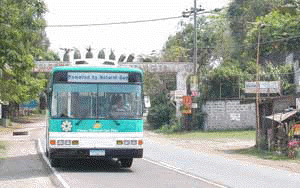
Daewoo
bus, re-powered by NGVI of Korea,
operates in Tagaytay City.
|
As
early as 2004, four major bus operators were
believed to have considered purchasing a total
of 160 CNG buses in the near term, using
funding from the Philippines Development Bank
and other sources. Once the initial orders
were confirmed by the Department of Energy,
the Malampaya Consortium was expected to
establish a 'mother' refueling facility at
Batangas, about 100kms north of Manila to
provide fuel for the Manila based fleets.
Daughter facilities will be established by a
downstream supplier at a location to be
determined once the fleet commitments are
known. The consortium is also constructing a
pipeline from Batangas to Manila to establish
a natural gas pipeline network but this is not
expected to be completed until 2008.
|

|
|
CNG
vehicles on display in Manila at
last December's ANGVA Industry
Development Workshop. The Ashok-Leyland
bus (centre) was especially
converted to left hand drive for the
Philippines demonstration project.
|
Two
demonstration CNG buses, one a Daewoo
repowered by NGVI of Korea, and the other an
Ashok Leyland from India, have been
operating routes in Metro Manila, Laguna and
Rizal. The buses arrived in Manila last
December 2003, where they were inaugurated at
ANGVA's (Asia Pacific Natural Gas Vehicles
Association) NGV Industry Development
Workshop. A Department of Energy
representative says the buses have proved
popular with commuters. Fuel for the buses
have been supplied by PNOC, which manufactured
a CNG refueling trailer especially for
demonstration projects.
Though
the NGV programs in the Philippines are
primarily to improve urban air quality, the
government is also keen to reduce imports of
crude oil. High crude prices and a devalued
Philippine Peso are putting stress on the
local economy. Former Energy Secretary,
Vincent Perez went to Amsterdam last May 2004
as an observer of the OPEC talks, and tried to
make representations for OPEC countries to
increase output.
The
Department of Energy also spearheaded a
program to introduce coco-methyl-ester (CME)
bio-diesel blends into Philippine vehicle
fleets. Toyota was to send a vehicle to the
Philippines for testing with the CME blends
following the announcement by Philippines
President Arroyo that government fleets are to
operate on a 1% CME/diesel blend. Other
manufacturers participating in trials include
ISUZU and BMW.
|




 >>
>>
 >>
>>