|
 Emissions
from motor vehicles have been identified as the major cause of air
pollution in Metro Manila area. Almost
4.2 million motor vehicles that ply the various roads and thoroughfares
in the country are diesel and gasoline fed. The Government of the
Philippines
through the Department of Energy (DOE) has focused on developing an
aggressive program on the use of clean fuels, that is facilitated
through the intensive promotion and utilization of alternative fuels and
technologies. Emissions
from motor vehicles have been identified as the major cause of air
pollution in Metro Manila area. Almost
4.2 million motor vehicles that ply the various roads and thoroughfares
in the country are diesel and gasoline fed. The Government of the
Philippines
through the Department of Energy (DOE) has focused on developing an
aggressive program on the use of clean fuels, that is facilitated
through the intensive promotion and utilization of alternative fuels and
technologies.
 The
discovery of Malampaya natural gas in 1989 paved the way for the country
to expand its energy resources. The
first initiative of the DOE towards the use of natural gas in the
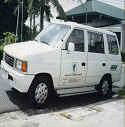
transport sector was through a conversion of a diesel-fed Isuzu
Hi-Lander to natural gas, which was completed in 1999.
The first Compressed Natural Gas (CNG) refueling station was also
constructed in 1999 at the San Antonio Gas Plant in Echague, Isabela to
fuel the converted Hi Lander. The
discovery of Malampaya natural gas in 1989 paved the way for the country
to expand its energy resources. The
first initiative of the DOE towards the use of natural gas in the
transport sector was through a conversion of a diesel-fed Isuzu
Hi-Lander to natural gas, which was completed in 1999.
The first Compressed Natural Gas (CNG) refueling station was also
constructed in 1999 at the San Antonio Gas Plant in Echague, Isabela to
fuel the converted Hi Lander.
In
several countries the use of CNG in the transport sector as an
alternative to diesel and gasoline is becoming quite important.
Natural Gas Vehicles (NGVs) have a history of more than 50 years
and are presently getting more popular in the Asian region.
Argentina
has the largest number of NGVs totaling to 926,352.
India
has a total of 137,000 NGVs and has been successful in implementing a
CNG program in the public transport sector by mandating the conversion
of diesel vehicles to natural gas. South
Korea
is also striding ahead with 3,028 NGVs. In the Philippines, from the
first NGV in 1999, the number has grown to twelve now. After the Isuzu
Hi Lander, three more vehicles were converted i.e., two shuttle buses
and another service vehicle.
The four
vehicles are experimental and are undergoing further testing.
PNOC acquired six Original Equipment Manufactured (OEM) CNG taxis
from Petronas
Malaysia
in 2001. The latest addition are
the two demo NGVs acquired by DOE from
India
and
Korea. Ashok
Leyland Ltd. of India
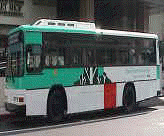
provided DOE with a brand new CNG-OEM bus while NGVI, Inc. of Korea
provided DOE with a re-powered CNG bus through Memoranda of
Understanding and Agreement, respectively.
 The
CNG demo buses are presently undergoing on-road testing to assess the
technical viability to local conditions. These buses will also be used
for information, education and communication (IEC) campaigns to educate
the public on CNG technology, including its benefits and safety.
On-road testing routes includes Tagaytay City–Lipa City round,
Isabela-Banawe round, and in various Metro Manila routes.
IEC campaigns on the other hand include tours in various Metro
Manila schools, cities as well in Batangas where commercial CNG will be
sourced. Demo NGVs will also
participate in exhibits and events relating to clean air. The
CNG demo buses are presently undergoing on-road testing to assess the
technical viability to local conditions. These buses will also be used
for information, education and communication (IEC) campaigns to educate
the public on CNG technology, including its benefits and safety.
On-road testing routes includes Tagaytay City–Lipa City round,
Isabela-Banawe round, and in various Metro Manila routes.
IEC campaigns on the other hand include tours in various Metro
Manila schools, cities as well in Batangas where commercial CNG will be
sourced. Demo NGVs will also
participate in exhibits and events relating to clean air.
The DOE
Undersecretary Jocot de Dios, in his address during the first
Asia-Pacific Natural Gas Vehicle Industry Development Workshop held last
December 15 – 16, 2003 at the EDSA Shangri-La Hotel, mentioned that
the government is pushing for the widespread utilization of natural gas
as an alternative fuel for public transport to achieve cleaner air.
The demo
NGVs bear the markings NGV: Para sa Mas Malinis na Hangin (For
Cleaner Air) to induce public awareness and acceptance of the
new technology.
 The
National Government’s Natural Gas
Vehicle Program for Public Transport (NGVPPT), launched on
October 16, 2002
by the President, aims to promote the use of natural gas as a clean
alternative fuel for transport. The
NGVPPT through DOE has undertaken various initiatives, in coordination
with other government agencies, to create a conducive environment by
offering a portfolio of incentives for the introduction of the CNG-NGV
businesses. The
National Government’s Natural Gas
Vehicle Program for Public Transport (NGVPPT), launched on
October 16, 2002
by the President, aims to promote the use of natural gas as a clean
alternative fuel for transport. The
NGVPPT through DOE has undertaken various initiatives, in coordination
with other government agencies, to create a conducive environment by
offering a portfolio of incentives for the introduction of the CNG-NGV
businesses.
Among the government agencies that have been helping the DOE in the
effective implementation of the NGVPPT include, the DOTC by providing
preferential franchise for NGVs, the DENR by fast-track issuance of
Environmental Compliance Certificate (ECC), the DTI-BPS by setting the
national standards for natural gas utilization in transport, and the
DTI-BOI for providing income tax holidays and tariff reductions for NGVs
and NGV related equipment.
 To
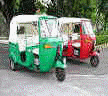
sustain the momentum of the program implementation, the Department has
been pursuing the acquisition of CNG three-wheeler demo units in
cooperation with BAJAJ (India).
Likewise, exploratory talks on the construction of CNG refueling
stations, and acquisition of CNG buses and CNG engines for local
jeepneys are on-going activities. To
sustain the momentum of the program implementation, the Department has
been pursuing the acquisition of CNG three-wheeler demo units in
cooperation with BAJAJ (India).
Likewise, exploratory talks on the construction of CNG refueling
stations, and acquisition of CNG buses and CNG engines for local
jeepneys are on-going activities.
It is
envisioned that Metro Manila will have a much cleaner environment in the
near future through NGVs.
|
