|
 The
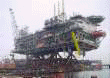
discovery of natural gas in 1989 at the Camago
structure in the offshore deepwater area of
northwest Palawan paved the way for the
Philippines to expand its available energy
resources. The discovery is the single largest
investment in an energy project and marks the
birth of a natural gas industry in the
Philippines. An endeavor with immeasurable
significance, it typifies an effort to search
for alternative indigenous energy resources to
fuel our country's economic activities at an
affordable cost with minimal impact to the
environment. The
discovery of natural gas in 1989 at the Camago
structure in the offshore deepwater area of
northwest Palawan paved the way for the
Philippines to expand its available energy
resources. The discovery is the single largest
investment in an energy project and marks the
birth of a natural gas industry in the
Philippines. An endeavor with immeasurable
significance, it typifies an effort to search
for alternative indigenous energy resources to
fuel our country's economic activities at an
affordable cost with minimal impact to the
environment.
 The
Malampaya Gas-to-Power Project not only
provides a foundation for sustainable
development but likewise opens up unparalleled
investments through expansion of gas markets
to non-power applications particularly for the
transport sector to take advantage of the
benefits natural gas offers to improve our
local air quality. The
Malampaya Gas-to-Power Project not only
provides a foundation for sustainable
development but likewise opens up unparalleled
investments through expansion of gas markets
to non-power applications particularly for the
transport sector to take advantage of the
benefits natural gas offers to improve our
local air quality.
Natural
gas as an alternative fuel in vehicles has
many desirable qualities such as abundance.
However, its most desirable characteristic is
its clean burning properties. This inherent
characteristic offers a solution to the
pressing environmental problem in urban areas
like in Metro Manila. Natural Gas Vehicles or
the technology of using natural gas as fuel in
vehicles (through conversion or procurement of
an original engine manufactured for its use)
is technically proven and already available in
the world market. It has the potential to
produce substantially lower pollutant
emissions than conventionally fuelled
vehicles. Natural gas also has compiled an
excellent safety record around the world, not
only on board a vehicle but also during its
production and pipeline distribution as well.
Natural
gas is stored on board a vehicle as Compressed
Natural Gas (CNG). It is compressed to a
pressure range of 16 to 20 MPa due to its low
energy density and is stored in specially
designed steel or aluminum cylinders.
Rapid
development of an NGV industry has occurred in
economies where environmental protection is of
major concern and where a large difference
between the price of CNG and conventional
liquid fuels exist. New Zealand, Italy, USA,
Canada and Australia have all had considerable
experiences in the development and use of
NGVs, together with more than 40 other
economies in Europe, Asia, the Americas and
the Middle East.
Development
of NGVs is therefore, perceived by government
as an initiative to address existing and
emerging air degradation problems in Metro
Manila. |




 >>
>>