|
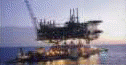 In
October 1989, Occidental Philippines, Inc. (Oxy), a
subsidiary of Occidental Petroleum Corporation, discovered
natural gas in a deep-water well (the Camago well) located
within a 350,000 hectare area
75 km. northwest offshore Palawan province and 500
km. south-SW of Luzon. While this was not the first natural
gas discovery in the country - in 1980, the Philippine
National Oil Company Exploration Corporation (PNOC-EC)
discovered natural gas in Isabela, Northern Luzon sufficient
to generate about 3MW of power � it seemed a promising
find which augured well for the establishment of a
Philippine natural gas industry. In
October 1989, Occidental Philippines, Inc. (Oxy), a
subsidiary of Occidental Petroleum Corporation, discovered
natural gas in a deep-water well (the Camago well) located
within a 350,000 hectare area
75 km. northwest offshore Palawan province and 500
km. south-SW of Luzon. While this was not the first natural
gas discovery in the country - in 1980, the Philippine
National Oil Company Exploration Corporation (PNOC-EC)
discovered natural gas in Isabela, Northern Luzon sufficient
to generate about 3MW of power � it seemed a promising
find which augured well for the establishment of a
Philippine natural gas industry.
After
a year,  Oxy�s
exploration contract was
converted into a service contract (SC38) with Shell
Philippines Exploration B.V. (SPEX) farming in to the extent
of a 50 percent interest. As
part of its investment commitment, SPEX took over operation
of the field and drilled three more wells, the second of
which resulted in the discovery of the Malampaya gasfield in
1992,which is connected to the Camago structure. Continuing
with its drilling program over the next two years, SPEX was
able to ascertain proven recoverable reserves of about 2.5
trillion cubic feet (TCF) of gas Oxy�s
exploration contract was
converted into a service contract (SC38) with Shell
Philippines Exploration B.V. (SPEX) farming in to the extent
of a 50 percent interest. As
part of its investment commitment, SPEX took over operation
of the field and drilled three more wells, the second of
which resulted in the discovery of the Malampaya gasfield in
1992,which is connected to the Camago structure. Continuing
with its drilling program over the next two years, SPEX was
able to ascertain proven recoverable reserves of about 2.5
trillion cubic feet (TCF) of gas  and
some 85 million and
some 85 million  barrels
(MMB) of condensate. The Malampaya gasfield was declared a
commercial find in May 1998. In September the same year,
SPEX acquired full ownership in SC38
and then formed a consortium with Texaco Philippines,
Inc. (now ChevronTexaco) and PNOC-EC. barrels
(MMB) of condensate. The Malampaya gasfield was declared a
commercial find in May 1998. In September the same year,
SPEX acquired full ownership in SC38
and then formed a consortium with Texaco Philippines,
Inc. (now ChevronTexaco) and PNOC-EC.
This
SC 38 consortium set about making the largest single foreign
investment in the country�s history by developing the
Malampaya gasfield, laying 504 km. of pipeline through some
of the world�s best undersea vistas and building an
on-shore gas facility in Tabangao, Batangas Province
(Southern Luzon) that now processes the natural gas that is
drawn from the gasfield. In
October 16, 2001, President Gloria Macapagal-Arroyo (shown
with former DOE Sec. Vince Perez in right photo below) inaugurated the
Malampaya Deep Water Gas-to-Power Project which now supplies
gas to fuel three combined cycle gas turbine (CCGT) power
plants with a combined capacity of 2,760 MW, comprising
about 19 percent of the country�s total installed capacity
in 2002. The gasfield has a potential capacity to produce up
to 4.3 TCF of gas.
inaugurated the
Malampaya Deep Water Gas-to-Power Project which now supplies
gas to fuel three combined cycle gas turbine (CCGT) power
plants with a combined capacity of 2,760 MW, comprising
about 19 percent of the country�s total installed capacity
in 2002. The gasfield has a potential capacity to produce up
to 4.3 TCF of gas.
The
project was completed in little over three years, landing
gas for power plant commissioning and commercial operations
in January 2002. With the project�s completion, the
orientation has shifted to bringing this new energy source
to where it could be of most benefit. While the three power
plants are all located within a 12 km. radius from the
Batangas onshore gas plant, they are certainly not the only
potential users of the gas. It therefore became critical to
prepare a blueprint for this emerging downstream industry
which would encompass both physical and regulatory aspects.
<<<<
RP
Attends World Gas Conference for the First Time |
