|
 Natural
gas resources in the Philippines total 25.7 - 39.5 trillion
cubic feet (Tcf), of which 3.4 - 5.4 Tcf are discovered
recoverable reserves. They are classified into four types,
namely: oil and gas, coal gas, water-associated gas
(includes marsh gas), and inorganic gas. The major deposits
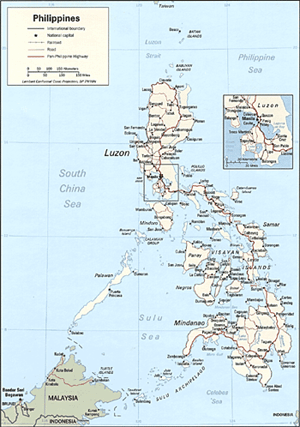
are oil-gas types including Camago-Malampaya in NW Palawan
offshore area, San Antonio in Cagayan Valley and Libertad in
Cebu. Natural
gas resources in the Philippines total 25.7 - 39.5 trillion
cubic feet (Tcf), of which 3.4 - 5.4 Tcf are discovered
recoverable reserves. They are classified into four types,
namely: oil and gas, coal gas, water-associated gas
(includes marsh gas), and inorganic gas. The major deposits
are oil-gas types including Camago-Malampaya in NW Palawan
offshore area, San Antonio in Cagayan Valley and Libertad in
Cebu.
The current
Philippine gas industry development initiative is anchored
on the Camago-Malampaya deposit which is estimated to
support the operation of 3,000 MW gas-fired power plants for
over 20 years with its 2.5-3.2 Tcf maximum recoverable
reserves. Commissioning of these plants is programmed by
2002. Gas-fired power plants programmed beyond 2002 require
additional gas discoveries or importation of LNG. Conversion
of the Bataan Nuclear Power Plant to a 1,500 MW gas-fired
plant has been offered on the expectation of more
recoverable gas reserves to be delienated shortly. Assurance
of gas supply for the Philippines, including those for
non-power uses, are, however optimistically provided by the
LNG option and the Trans-ASEAN Gas Pipeline Project.
Opportunities
for investment are wide open under strong government
commitment for a private-sector led natural gas industry
development from upstream to downstream. The establishment
of a nationwide gas infrastructure is expected to work
towards maximizing the gas potential of the country through
extensive exploration, coupled with development of natural
gas markets sparked by a galloping economic growth.
p
Top
I.
INTRODUCTION
 Petroleum
exploration in the Philippines, from its inception in the
1890's until late in the 1980's, regarded gas as an unwanted
associate of oil. It was only in the early 1990's when
natural gas was given serious consideration, largely because
of the discovery of the Camago-Malampaya deposit in offshore
West Palawan. In 1994, the government-owned Philippine
National Oil Company established the first gas-fired power
plant Petroleum
exploration in the Philippines, from its inception in the
1890's until late in the 1980's, regarded gas as an unwanted
associate of oil. It was only in the early 1990's when
natural gas was given serious consideration, largely because
of the discovery of the Camago-Malampaya deposit in offshore
West Palawan. In 1994, the government-owned Philippine
National Oil Company established the first gas-fired power
plant  utilizing the small gas deposit discovered in late 1950's
onshore Cagayan Valley, Northern Luzon. This 3 MW plant
demonstrated the practicability of utilizing natural gas for
power. Hence, the long term Philippine Energy Plan (PEP),
drafted in 1994, accorded a substantial share for natural
gas in power development. Enough assurance are now in place
for the first large-scale gas-fired power plants in the
country to be installed by 2002. By 2005 this would increase
to 4500 MW.
utilizing the small gas deposit discovered in late 1950's
onshore Cagayan Valley, Northern Luzon. This 3 MW plant
demonstrated the practicability of utilizing natural gas for
power. Hence, the long term Philippine Energy Plan (PEP),
drafted in 1994, accorded a substantial share for natural
gas in power development. Enough assurance are now in place
for the first large-scale gas-fired power plants in the
country to be installed by 2002. By 2005 this would increase
to 4500 MW.
p
Top
II.
NATURAL GAS RESOURCES IN THE PHILIPPINES
a.
Classification
Natural gas
deposits in the Philippines may be classified into four
types, namely: oil gas, coal gas, water-associated gas and
inorganic gas.
Oil gas deposits
are gaseous hydrocarbon accumulations evolved in association
with liquid hydrocarbons or oil. The other deposit types, on
the other hand, are mainly methane accumulations in
association with coal, water and inorganic materials, as the
case maybe. Water-associated gas includes "marsh
gas" which is generated during the decay of vegetable
matter in bogs and swamps at the early stage of
petrification. The gas is usually dissolved in water along
with other elements of economic importance such as iodine.
Inorganic gas is formed through inorganic processes such as
hydrothermal processes, contact metamorphism and
serpentinization.
p
Top
b.
Quantitative assessment
Using McKelvey's
(1973) mineral resource assessment scheme, natural gas
resources in the Philippines are classified in this paper
into "Discovered" and "Undiscovered".
"Discovered natural gas resources" refer to those
that have been adequately delineated by seismic and other
means and measured by drill-stem test in at least one hole
per closure. On the other hand, "Undiscovered natural
gas resources" are those that have been estimated by
various means but not measured by drill stem test, although
reached by a drill hole.
Essentially,
quantitative estimates reported as reserve, recoverable
reserve and gas-in-place generally fall within the category
of "Discovered". Reported potential reserve,
target reserve, resource potential and untested recoverable
reserves are in the category of "Undiscovered".
However, the
commerciality of a gas discovery is established when field
reserves is confirmed with confidence and the conditions for
gas utilization and marketing is defined for the life of the
field.
Table 2 lists
the quantified natural gas deposits and prospects in the
Philippines and their corresponding estimates in trillion
cubic feet (TCF). The total natural gas resources in the
Philippines thus stand at 25.7 -39.5 Tcf of which 3.4-5.4
TCF is discovered recoverable reserve.
p
Top
c.
Description of major deposits
c.1 Camago
- Malampaya Gas Deposit
Petroleum
exploration in Northwest Palawan started in 1971 with the
drilling of Pag-asa 1 which proved unsuccessful. After a
series of disappointment wells in the area, Nido-1 well made
the first significant oil discovery. Destacado A-1X and San
Martin were drilled in 1982 and encountered gas columns in
the carbonate reservoir. Although they flowed gas to the
surface they were declared sub-commercial. The Octon well
was tested for gas but was also sub-commercial.
In 1989, the
thick column of gas and condensate in the Camago-1 was
drilled at a water depth of 2,365 feet. This discovery
renewed interest in the area and led to the giant
Malampaya-1 in 1991 a water depth of 2,746 feet. A total of
five (5) wells have been drilled in the Camago-Malampaya
Field delineating an estimated recoverable reserve of 2.5 -
3.2 TCF of gas. The Camago-Malampaya gas contains about 90%
methane (DeGolyer and Macnaughton, 1996) and its heating
value is viable as power plant fuel. However being a wet
gas, it also contains small amounts of heavier hydrocarbons
such as ethane and propane. Other gas prospects in the
vicinity were to be drilled by late 1997.
p
Top
c.2 San
Antonio Gas Deposit
The San Antonio
gas deposit in Cagayan Valley was first drilled as Ipil -1
in 1958. Subsequent drilling of three more wells to
delineate the gas deposit failed to encounter any
hydrocarbon, and the area was abandoned. In May 1980, the
San Antonio-1 well confimed the 1958 discovery. The well
flowed up to 11.4 million cubic feet gas (MMSCFG) per day of
gas reserves were volumetrically estimated at 0.0063 to
0.010 TCF of gas-in-place which was still uneconomic at the
time.
A seismic survey
was done in 1981 to further evaluate the gas deposit. This
resulted in the extension of the reservoir thereby
increasing the estimated reserves to 0.024 TCF of
recoverable gas. A reservoir evaluation was conducted in May
1989 leading to the identification of three gas reservoirs
and justifying the drilling of San Antonio-2 well. This well
encountered technical problems and was plugged and
abandoned. San Antonio 1A was subsequently drilled and this
confirmed an extension of the gas deposit. Today, the San
Antonio gas field is currently producing at an average rate
of 1 MMSCFG per day supplying the power requirement of a 3MW
power plant in Echague, Isabela.
p
Top
c.3
Libertad Gas Deposit
The Libertad
deposit is one of the several prospects and leads in
Northern Cebu. Exploration in this region started in 1958,
drilling 21 wells in the Libertad area. The first well that
flowed sub-commercial gas was Libertad-13. This was retested
in September 1993 and flowed at a rate in excess of 2.5
MMCFG per day. With the successful testing of this well,
four (4) of which only Libertad 95-1 flowed gas at an
estimated rate of 6 yo 8 MMSCFG per day. Small scale
commercial production of the Libertad gas field now seems
viable with the demonstrated success of the 3 MW San Antonio
gas-fired power plant in Isabela.
p
Top
c.4 Other
Gas Resources
c.4.1
Iloilo Basin
Oil exploration
in the Iloilo Basin started in 1953 with the drilling of the
Oton-1 well. This encountered oil and gas shows. Drilling of
eight (8) more wells followed from 959 to 1980. Five (5) of
these wells encountered gas and water from the Upper Miocene
to Pliocene strata.
In 1981, a study
was conducted on the potential of the Iloilo gas,
considering its similarity to the Kyosui-sei-gasu
(water-associated gas) deposit in Japan which formed in Late
Cenozoic marine deposits. The brine on the other hand, is
kept from flowing out or kept from being flushed by meteoric
water in an enclosed structure. The study confirmed a high
methane content in formation brine with iodine.
p
Top
c.4.2
Central Luzon Basin
Exploration
effort in the Central Luzon Basin was punctuated in 1979 by
a minor gas flow from Victoria-1, an onshore well located in
Tarlac. In 1995 a well was drilled in Manila Bay, a prospect
area well was drilled in Manila Bay, a prospect area well
within the Central Luzon Basin. This well tested positive
for gas and showed a fairly thick limestone reservoir.
Geophysical data shows other structures favorable for
petroleum accumulation in the basin. These prospects are
being targeted by three exploration consortia for drilling
within 1997 and 1998.
p
Top
III.
GAS INDUSTRY DEVELOPMENT PLAN
a.
Camago-Malampaya gas development
Primary energy
consumption from 1984 to 1996 increased at an average rate
of about 6.5% per year. Liquid fuel provided 80% of the
total consumption; hydropower and geothermal power provided
15%; and solid fuels provided the rest. This fuel mix will
be drastically changed with the development of the
Camago-Malampaya gas field in order to ensure the attainment
of energy self sufficiency of 40% under the Philippine
Energy Plan 1996-2025 (PEP 1996). The plan ensures the
setting up of the initial gas infrastructure, especially the
required 500 km undersea pipeline. The natural gas produced
is allocated for about 3,000 MW installed capacity by 2002.
 The
development program includes: (a) drilling of production
wells, (b) setting up production platform, and (c)
construction of the 500-kilometer undersea pipeline.
Production will yield 400 to 500 MMSCFG per day, plus
substantial quantities of oil and condensate. The production
system will include a facility to separate the oil, the
condensate, and production water from the gas, after which
the dry gas will be piped all the way to users. The current
plan calls for a 24" undersea pipeline all the way to
Luzon. The
development program includes: (a) drilling of production
wells, (b) setting up production platform, and (c)
construction of the 500-kilometer undersea pipeline.
Production will yield 400 to 500 MMSCFG per day, plus
substantial quantities of oil and condensate. The production
system will include a facility to separate the oil, the
condensate, and production water from the gas, after which
the dry gas will be piped all the way to users. The current
plan calls for a 24" undersea pipeline all the way to
Luzon.
p
Top
b. Gas-fired
power plant development
 To
develop the market for natural gas in the country, the
government has prioritized 3,000 MW for gas-fired power
capacity development beginning 2001. The National Power
Corporation (NPC) and the MERALCO group of Companies will
each have 1,500 MW. NPC has recently awarded, through
bidding to Korea Electric Power To
develop the market for natural gas in the country, the
government has prioritized 3,000 MW for gas-fired power
capacity development beginning 2001. The National Power
Corporation (NPC) and the MERALCO group of Companies will
each have 1,500 MW. NPC has recently awarded, through
bidding to Korea Electric Power  Corporation (KEPCO) a BOT contract for the construction of
the gas-fired power plants with total capacity of 1,200 MW
at Ilijan, Batangas.
Corporation (KEPCO) a BOT contract for the construction of
the gas-fired power plants with total capacity of 1,200 MW
at Ilijan, Batangas.
On the other
hand, Meralco has assigned First Gas Holdings Corporation, a
joint venture company between First Gas Holdings (MERALCO
Group Member) and British Gas Corporation, to put up
gas-fired power plants, starting with a 990 MW greenfield
plant at Sta.Rita, Batangas to be commissioned in 1989/1999.
This will be followed by a 510 MW plant in the CALABARZON
area.
In addition, the
620-MW Bataan Nuclear Power Plant has also been programmed
by government for conversion into a 1,500 MW gas-fired power
plant by 2005. In this regard, the Pilipinas
Shell-Occidental Petroleum (Shell-Oxy) joint venture has
offered to implement the conversion to a 1,500 MW plant
using the Malampaya-Camago deposit and other deposits the
joint venture expects to delineate shortly within its
service contract area in NW Palawan.
Beyond 2015, a
2,000 MW gas-fired power generating capacity expansion is
programmed for Mindanao, possibly in Zamboanga (PEP, 1996).
Possible gas discoveries in Sulu Sea are being eyed for this
expansion.
p
Top
c. LNG Option
Realizing the
limitations of discovered natural gas resources in the
country and the time it would take for the development of
these resources, the government encourages the importation
of LNG. First Gas Holdings may opt for LNG at the initial
phase of its 990 MW plant at Sta. Rita, Batangas so that it
can be commissioned in 1998/99.
To complement
indigenous gas supply, the Department of Energy encourages
the use of imported LNG which may be competitive in combine
cycle gas turbines and if ever with Camago-Malampaya gas.
p
Top
d.
Development of natural gas market for other uses
The Philippine
government also encourages the development of other uses of
natural gas. Thus, the Philippine Energy Plan projects
substantial gas markets for industries (cement, food, and
steel) beyond 2005 especially for the industrial centers in
Luzon (CALABARZON) and Mindanao (Iligan-Cagayan de Oro).
Natural gas can
also be used as feedstock for chemical industries. The
Camago-Malampaya gas contains low quality cracker feedstock
making it unsuitable for ethylene plant. The development of
the gas market for these industries will be contingent on
the discovery of gas with suitable gas composition such as
higher ethane and heavier hydrocarbon contents.
Between 2010 and
2020, the plan projects the household sector as a major gas
market. Approximately 400,000 commercial/residential
customers are expected in Metro Manila, Batangas and Cavite
in Luzon; and Cagayan de Oro areas in Mindanao. Use of
natural gas for the transport sector is also envisioned to
be a major market in Luzon. Compressed natural gas is
threfore projected to be made available in Luzon by 2010.
p
Top
e.
Trans-ASEAN gas pipeline
The plan for a
Trans-ASEAN gas pipeline is viewed by the Philippine
government as an assurance that the gas infrastructure being
planned will not run short of natural gas supply over the
long-term. The scheduled phasing of the Trans-ASEAN pipeline
development, as proposed in the recently concluded
feasibility study by the ASEAN Energy Management and
Training Center (AEEMTRC) and the European Union, is
considered in consonnance with he Philippine gas industry
development plan.
p
Top
IV.
ROLE OF PRIVATE SECTOR AND INDEPENDENT POWER PRODUCERS
Strong
Philippine commitment towards the full development of
globally oriented market economy corollarily requires a
private-sector generated development of the natural gas
industry. The farming out to the private sector of the
responsibility to develop a major portion of the gas market
is a candid demonstration of this point. Even the 500 MW
market allocated for  NPC is expected to be turned over to private interest with
the impending privatization of this government corporation.
It shall be noted that the government has maintained its
commitment to leave business in the hands of the private
sector when it discouraged the Philippine National Oil
Company (PNOC) from getting involved in the business of
providing the submarine gas pipeline from the
Camago-Malampaya field to the city gate.
NPC is expected to be turned over to private interest with
the impending privatization of this government corporation.
It shall be noted that the government has maintained its
commitment to leave business in the hands of the private
sector when it discouraged the Philippine National Oil
Company (PNOC) from getting involved in the business of
providing the submarine gas pipeline from the
Camago-Malampaya field to the city gate.
This policy is
explicitly embodied in Executive Order 215 issued in 1987
which provided the ground rules for private sector
participation in power generation. Early this year, an
amendment to EO 215 expanded the accreditation of all IPP's
in the special economic zone and non-utilities that generate
their power for own use. The department has also issued
guidelines which allowed customers of 2 MW and above to
contract directly with any power generating companies. The
government also promotes the setting up of small gas-fired
power plants by those involved in indigenous onshore gas
exploration and development using their own gas.
 The
Department of Energy also favors open access to the offshore
pipeline from the Camago-Malampaya as long as the access is
acquired on commercial terms. This exercise permits other
gasfield operators to gain access or tap into the pipeline
for gas transport with corresponding tariff or charge. Open
access is also encouraged for onshore pipelines to promote
diversification in the growth of the natural gas industry. The
Department of Energy also favors open access to the offshore
pipeline from the Camago-Malampaya as long as the access is
acquired on commercial terms. This exercise permits other
gasfield operators to gain access or tap into the pipeline
for gas transport with corresponding tariff or charge. Open
access is also encouraged for onshore pipelines to promote
diversification in the growth of the natural gas industry.
The Omnibus
Power Restructuring Bill being deliberated in Congress
provides the milestones for the eventual privatization of
the power industry. NPC's restructuring, as provided in this
bill, entails the following: (a) power generation to be
transferred to independent power producers (IPP's); (b)
distribution plants with capacity up to the optimum
percentage of total demand in the distributors' franchise
area; and (c) hydropower generation facilities and
transmission facilities will remain government owned.
p
Top
V.
OPPORTUNITIES FOR INVESTMENT
a. Indigenous
oil and gas exploration/development
Potential
hydrocarbon areas in the Philippines assessed to be
"gas-prone" have now become highly prospective due
to government assured development of the domestic natural
gas industry. Prospects in the known gas fields in offshore
northwest Palawan, and the Reed Banks, which were not viable
on their due to size and distance from the market could now
become viable. Thus, they deserve priority in exploration.
In the Central
Luzon Basin the gas potential was recently enhanced with the
result of the Manila Bay well drilling in 1995. This
prompted local exploration companies to acquire new contract
areas or expand their holdings in the Central Luzon Basin.
These companies would welcome foreign technical and
financial investment participation.
In the Cagayan
Basin in northern Luzon, PNOC and another local company have
contract areas prospective for more gas discoveries in
addition to San Antonio. In the Cotabato Basin and
Agusan-Davao Basin in Mindanao, extensive geophysical
exploration activities are being carried out by two
consortia for eventual identification of drillable targets.
Natural gas is a major target for these activities.
Certainly, the
room for foreign investment is natural gas exploration in
the country is wide open. This maybe down through
participation in the activities of the established service
contractors. Alternatively, areas not covered by existing
contracts may be applied for at the Department of Energy.
Foreign equity may be 100% for any of the service contract
modes.
p
Top
b. Gas
infrastructure
To provide the
vital link between the sellers of natural gas and the
market, the government will actively promote the setting up
of gas distribution networks in Luzon. For the 500-kilometer
pipeline from northwest Palawan to Luzon, Shell and
Occidental Petroleum have committed to build and operate the
pipeline themselves. They have not closed the door, however,
to new partners.
The Luzon
network will primarily depend on the pipeline connecting the
Camago-Malampaya field to power plants in the Batangas and
Cavite areas. This pipeline system will be expanded to cover
Metro Manila and Bataan and later the rest of Central Luzon
and Southern Luzon. The onshore pipeline from the beach at
Batangas (at the end of the 500-kilometer offshore pipeline
from Camago-Malampaya) to Manila will be about 110 km. When
this is continued all they way to Bataan via Bulacan and
Pampanga provinces up to 250 km in length. In addition, an
LNG receving facility will be built in Bataan or in
Batangas.
On the onshore
pipeline, it is very likely that those who will be building
the power plants will themselves build the onshore pipelines
to their plants and they will probably be seeking partners
for the pipeline construction. First Gas Holdings has in
fact announced that it will build the onshore pipeline to
its power plants. This company has awarded the construction
of an 990 MW gas-fired power plant on turn-key basis to
Siemens of Germany.
Over the long
term, the expansion of the Philippine gas industry into the
rest of Luzon and Mindanao will entail extension of the
transmission pipelines and the construction of distribution
pipelines. These constitute big opportunities for companies
who have the necessary capital and technical expertise in
pipeline construction and operation.
p
Top
c.
Independent power production and power transmission
The most
attractive and immediate opportunity for investment is in
the construction and operation of the power plants that will
use Camago-Malampaya gas.
The next
important opportunity after 2003 is the conversion of the
Bataan nuclear plant into a 1500 MW gas-fired combined cycle
plant. This may even be accelerated if FGh decides to use
LNG for its plants and give up its 1500 MW allocation. In
this case, NPC would accelerate the conversion of the
nuclear plant which together will provide the 3000 MW market
for Camago-Malampaya gas by 2000/2003. Beyond 2010, other
major gas-fired power plants totaling 2000 megawatts in
Mindanao will likewise be offered to the private sector.
Notably in
relation to IPP opportunities, the Department of Energy has
recently approved the sale of sub-transmission facilities to
local power distribution utilities in line with the
government program to dismantle NPC's monopoly of power
distribution and generation. This means that private
distributors and power producers can now avail of this
facilities. The department will oversee the transfer of the
transmission assets to the power distributors.
p
Top
d. Other gas
markets
One immediate
opportunity is for foreign private companies to look at the
potential of the state-owned Manila Gas. This company has
existing old gas distribution network in Manila that can be
rehabilitated and expanded. It is currently being privatized
and whoever takes over would be in a position to develop
markets for gas in the metropolis.
Major industrial
and commercial gas users, particularly in the industrial
zones in Luzon and northern Mindanao, will undoubtedly
switch to gas as the price becomes competitive and as the
country's emission standards get even more stringent. They
will likewise need partners who have expertise in gas
conversion and utilization.
Finally, a
potentially large market is the transport sector. A major
shift to gas in this sector would substantially reduce the
current heavy pollution in Metro Manila. Currently, the
Department of Energy is conducting studies towards
formulating a definitive policy on the utilization of
natural gas in this sector.
p
Top
VI.
SUMMARY
In summary, the
most abundant gas occurrence in the Philippines is
associated with oil. Although the discovered reserves are
still insufficient to supply future demand, LNG and gas
supply from a projected Trans-ASEAN pipeline provide
necessary assurances for the sustainability of the
Philippine Gas Industry Development Plan. This plan is, of
course anchored on the Camago-Malampaya gas development at
the moment. To provide more indigenous gas resources to the
natural gas industry, the government promotes very strongly
the exploration, development and utilization of natural gas.
The establishment of a nationwide gas infrastructure is
expected to work towards maximizing the gas potential of the
country through extensive exploration, coupled with
development of local gas markets sparked by a galloping
economic growth. Opportunities for investment are wide open
under strong government commitment for a private sector led
natural gas industry development from upstream to
downstream.
Source:
Journal of the Geological Society of the Philippines,
Centennial Issue, January - June 1998
|
