gis 520 portfolio
advanced geospatial analysis - spring 2014

Editorial Staff:
Steven Mohr - [email protected]
RALEIGH, THURSDAY, APRIL 24, 2014
"All the News
That's Fit to Print"
Image Classification
Problem
In this project, the Black Water National Wildlife Refuge is attempting to develop a management plan for their grounds. However, to do this, they need know the exact land cover data that makes up their grounds. They ask me as a GIS analyst to perform supervised classification using an aerial photograph of the grounds. Using this picture, my job is to find, label, and build the proper shapefiles needed to make understand this data and build this analysis.
Analysis Procedures
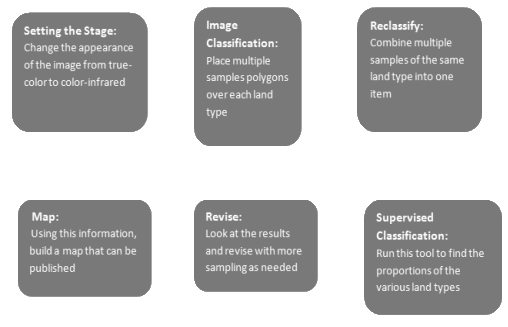
Strategies: To perform the needed functions, it is important to first utilize ESRI’s vast database of free informational materials. In this case, their website contains a seminar on the topic called “Visualizing and Analyzing Imagery with ArcGIS 10”. This seminar teaches that in an analysis such as this, tools to use include the Image Classification tool to build samples of each terrain type, the Supervised Classification tool to make a new layer out of these sampled terrains, and the Field Calculator tool to develop the proper numbers needed in this analysis.
Methods: In this analysis the user must place multiple sample polygons over each land cover type. In doing this, the Supervised Classification tool will be able to properly predict what the other land types are based on the data it was given. Certain types will need more data than other types.
Application & Reflection
Problem description: This same procedure could be used by cities in order to get a rough estimate on the proportionality of their city’s land. Maybe they only have a small account of data to work with, yet they would like to see how well this fragment of data could be used to make a quick/rough estimation of the percentages of land types in the city.
Data needed: In order to do this analysis, the person doing this would need an aerial photograph of the grounds he was analyzing. Also, the analyst would need a list of the land cover type being used in this analysis. Finally, with the property GIS tools, such as the Supervised Classification tool, the analyst will be able to take this information and build an analysis.
Analysis procedures: To perform this analysis, first the GIS analyst will use the land type headings to make samples of each type of land cover. After this is finished, he will develop a new layer bases on these samples using the Supervised Classification tool. With the information this new layer provides, an analysis can be done on the proportions of coverage by each land type.
Additional Assignment Reflection
This is one of the great tools that make ArcGIS such an efficient and affective suite of software. Very often governments or private organizations deal with large amounts of information, enough for it inefficient to be overly detailed. For those situations, statistical devices that take samples and apply them to larger pieces are nearly invaluable. Tools such as these can save hours of time and thousands of dollars for even smaller city of private projects.
Results
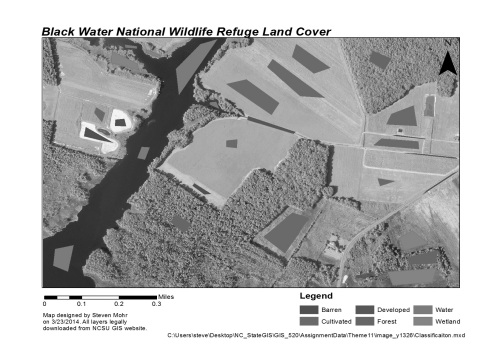
This screen shot shows the land cover samples taken.
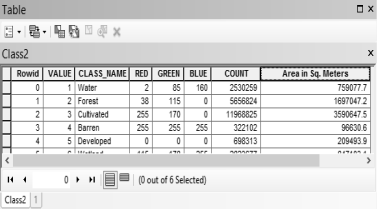
This screen shot shows the area of the various land cover types.
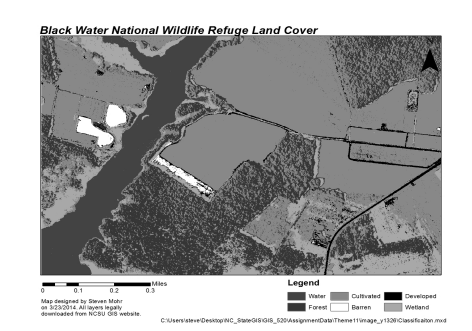
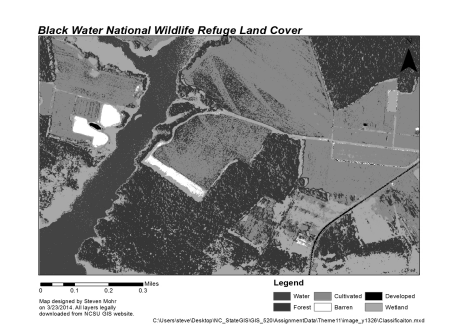
This screen shot shows the first supervised classification based on the samples.
This screen shot shows the second supervised classification based on the samples.
World News

Local Traffic
Environmental News
Regional Weather