
|
|
|
Menu |
Merry Meet and Welcome to The Paganus Website |
|
�Home |
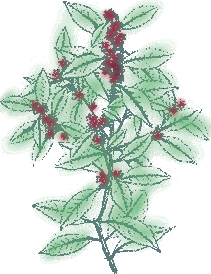
Family: Aquifoliaceae Common Names: Yerba Mate, Paraguay herb, Ilex mate, Houx mate, Gon gouha, Paraguay tea, Mate, Jesuit's Brazil tea, St. Bartholomew's tea Occurrence: Brazil, Argentina and Paraguay, most of South America Cultivates it. Information: This is one of the best stimulants in Soth America. Consumed mainly in Argentina, Uruguay, Paraguay and southern Brazil. It is brewed from the dried leaves and stemlets of the perennial tree Ilex paraguarensis (Yerba Mate). The name Mate derives from the quichua word mat� that names the gourd (Lagenaria vulgaris) that is traditionally used to drink the infusion. The scientific name Ilex paraguarensis was given by the French naturalist and botanist Auguste de Saint Hilaire in 1822. The tree belongs to the family Aquifoliaceae and grows between the parallels 10� and 30� (South) in the Paran� and Paraguay rivers basins. It is a plant typical of the Alto Paran� region, Alto Uruguay region and the Argentine NE. It is a tropical or subtropical plant, needing high temperatures, high humidity and up to 1500 mm of annual rain. On average, 300,000 tons of Mate are produced each year. In the wild, the plant needs about 25 years to develop completely, reaching in that case a height of up to 15 meters. The leaves are alternated, cuneiform, elliptical or oval, with the border slightly serrated. It flowers between the months of October and December. The flowers are small, polygamous, dioicous, with calix and corolla in a tetrameric disposition. The fruit resembles a pepper berry. Among several varieties, there are three that are the most important: angustifolia, longifolia and latifolia. Mate has a characteristic mature flavor which is somewhat sweet, bitter, withered leaf like, and alfalfa-like, similar to that obtained from tea (Camellia sinensis). Of the 196 volatile chemical compounds found in Yerba Mate, 144 are also found in tea. The infusions of Ilex paraguarensis are less astringent than those made of tea. It is used in popular medicine and employed in commercial herbal preparations as a stimulant to the central nervous system, a diuretic, and an antirheumatic. |