
|
|
|
Menu |
Merry Meet and Welcome to The Paganus Website |
|
�Home |
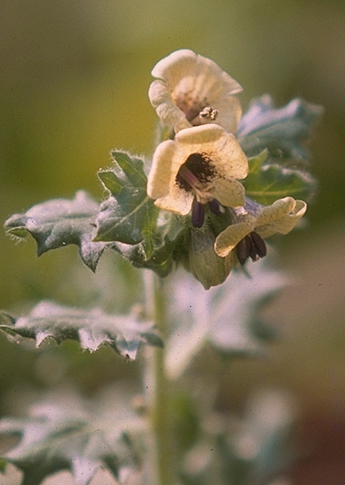
Family: Solanaceae Common Names: Henbane, Black Henbane. Occurrence: Found all over Europe. Information: Black Henbane (Hyoscyamus niger) belongs to the Solanacea and is one of the oldest psychoactive plants known: its ritual and shamanistic use probably dates back to Paeolithicum. In ancient greece black henbane was used for clairvoyance and as a poison and during the Middle Ages it was one of the main ingredients of the hallucinogenic brewes. Until the introduction of the �Deutschen Reinheits gebot� in 1516 henbane was a common beer additive (henbane-brewed beer has sexual stimulating properties). Effects: Parasympathetic: euphoria, relaxation, restlessness, visual hallucinations and confusion. Episodes of restlessness are often alternated by periods of relaxation. Autonomic changes: pupilairy dilation (mydriasis), dry mouth, psychomotoric disturbances. The primary effects last 3-5 hours. The hallucinogenic (side) effects may last up to 2 days. The seeds and foliage contain the active ingredients; both may be used for the psychotomimetic effects. The plant material can be smoked (alone or in mixtures), prepared as a tea or just eaten. A henbane dose consists of 0.5-1.5 grams of plant material (maximum 3 grams a day). South-American Indians combine tropane-alkaloids containing plants (Datura- and Brugmansia species) with San Pedro cacti for synergic effects (see modifiers). Henbane combines well with cannabis and opium poppies. Always use with great caution!!! Chemistry & Pharmacology: The foliage and seeds of black henbane contain 0.03-0.28% tropane-alkaloids. The major active constituents are S(-)-hyoscyamine (which is converted to atropine upon drying) and S(-)-scopolamine (these are present in a ratio of 1.5:1). Aposcopolamine, norscopolamine, tropine, littorine, tigloidine, tigloyloxy tropane, cumarine derivates and flavonoids have also been isolated. Atropine and scopolamine are physiologically active at doses of respectively 1 milligram and 0.5-1 milligram. Because of the non-polar character of the active constituents absorption via the skin is possible. Atropine and its derivates are muscarine receptor-antagonists. These are compounds that do not exert intrinsic activity, but merely block muscarinic receptors; they are competitive inhibitors with acetylcholine and muscarine receptor-agonists at postganglionic junctions. Henbane is also physiologically active in cattle, fish and birds, but is inactive in pigs. Modifiers: � Tropane alkaloids reduce effectivity of muscarine receptor- agonists. � The effects of cannabis and opium poppies are potentiated. � The effects of harmala-alkaloids (Peganum harmala, Banisteriopsis species) are seriously altered and intensified. � Positive synergic with mescaline (Peyote- and San Pedro cacti). |